It appears some of you missed Cameron’s post.
I can’t remember when I post got so many comments is such a short time!
“Dear Alastair
For some time I have read your letters with interest and much pleasure. Thank you.
I decided that it was time that I made a contribution and you may wish to share the following with readers:
For some time I have struugled with track cleaning (as have many others!) as my layout has a fair amount of hidden track.
I have examined and tried various commercial cleaners but none has worked.
My conclusion was that the only way to clean track is to scrub it in some way – the Dapol track cleaner with its revolving brush was the only one that made sense to me but the cost is more than I could justify spending.
I have always had the attitude that if a manufacturer can make something then so can I – even if it’s not quite as neat and sophistcated.
Kim’s track cleaner gave me the boot up the rear end that I needed to get started on another one of my own.
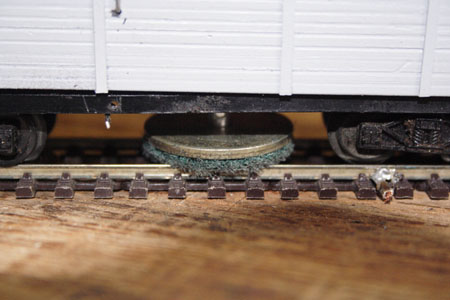
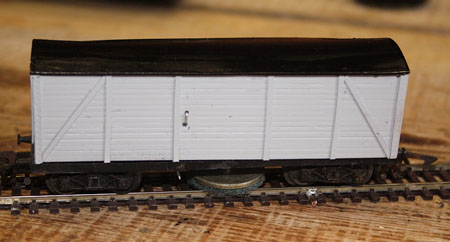
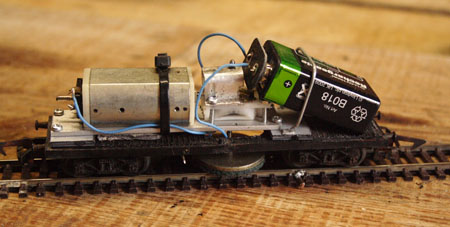
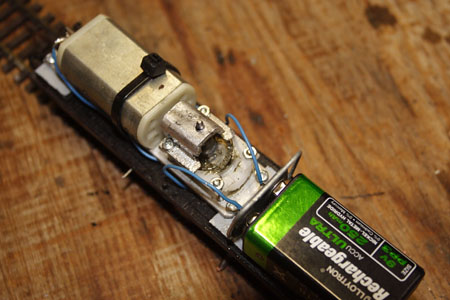
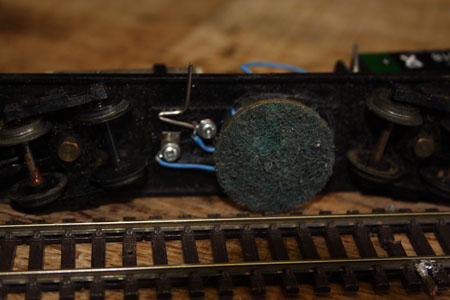
I raided my boxes of odds and ends and put them all together to produce something that cost me the price of a battery and a kitchen cleaning pad but nothing else.
I started with a chasis from an old wagon, found a motor from a discarded loco, a gearbox from an electric toothbrush, some bits of scrap metal and plasticard, a metal washer from my washer tin, a pop rivet, nuts, bolts and screws and finally plasticard to build the outer box car casing.
A small piece of wire from a paper clip made a convenient switch on the side.
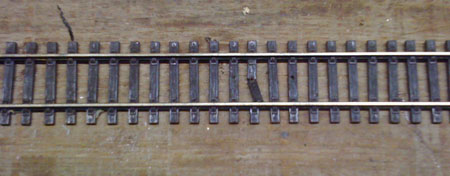
After some adjustment to the height of the brush. it works a dream and leaves gleaming track, The result can be seen in the photos.
Regards
John”
“Al,
There seems to be questions about how much slope to allow on our layouts so I thought I’d share my solution.
What I did before settling was to do my own testing. I laid out an oval of track on a piece of plywood about two feet by four feet, for n scale this was plenty big enough.
I set it on a table and put together a train as long as I expected to run on my final layout. (I used eight cars). I pick my favorite locomotive and started it around. Then I started lifting the end of my board in small steps looking for the maximum slope my train could go up at slow speed.
Once I had that I tested my other engines and adjusted the slope until it seemed everything worked well.
The final slope was then measured along the track using a level and ruler. That became the maximum slope for my railroad. It turned out to be three percent but I ended up not needing more then two and a half percent. (That’s is two and a half inches rise in one hundred inches of track.
Keep modeling,
Jim”
“Hi Al,
Most of Shell Hill is done, but there is a considerable amount of tune up and landscaping left to do.
Most of my running videos in the past were filmed in one location on my layout. I decided to show a tour around it and while I was filming, I began to make up a story.
The story is about a Mrs. McCrain who is on her way to meet her niece in Kent and she must make a change of train in Shell Hill. I had a lot of fun with it, I hope you and your readers can enjoy my silly fun too. It is quite different than anything else I have done.
At the end, I did a little shunting exercise to demonstrate the shunting capabilities of the new Shell Hill goods facility. It is my first attempt at shunting so it is a little jerky, but it gave me a chance to do a few close ups around Shell Hill.
I really enjoy seeing what others are doing with their railways and the tips and pointers have been very useful. Keep up the great work.
Rob
Latest ebay cheat sheet? It’s here!
A wonderful collection this time. Thanks to everyone. Please do keep ’em coming.
And if today is the day you get bored of sitting on the side lines, the Beginner’s Guide is here.
Best
Al
PS Latest ebay cheat sheet is here.