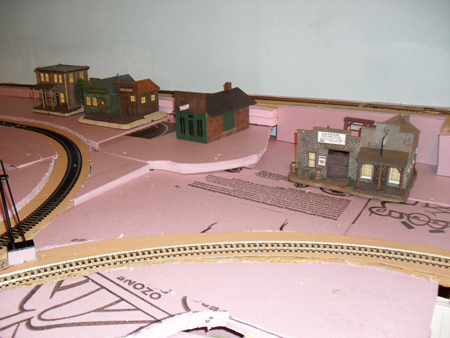
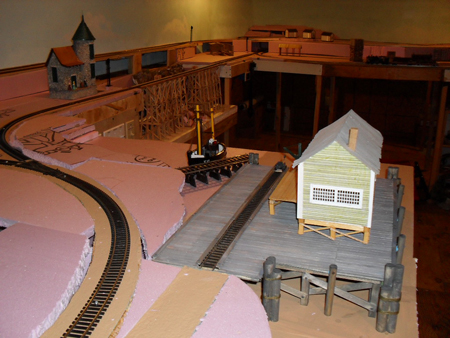
First things first, those of you who couldn’t watch Arnie’s stunning new video last time, it’s here.
Now on to Matthew, who has a done a brilliant job of explaining LED lighting for your model railroad.
“Hi Al,
I have been absorbing all your modelling tips and now it’s time for me to give something back…
I am an electrician and have great experience in wiring up LEDs in models (remember my Thunderbirds Tracey Island?).
The easiest way to wire up LEDs is according to their power source & LED voltage rating.
Say for a 3V LED, and a 9V battery power supply, you wire up 3 LEDs in series: 3+3+3=9V.
Then if you need more than 3 LEDs in the model, you can connect 3 more 3V LEDs in series (or a series circuit), then connect this series circuit in parallel with the first series circuit.
This way you don’t need to do any calculations for adding resistors, or look up the resistor table to find the right one – less mathematics, less soldering. It’s got to be good, eh?
Because LEDs consume very little power, or in other words draw very little current, you can connect many series circuits of 3 x 3V LEDs in this fashion.
In my Thunderbirds Tracey Island model I connected:
4 x 1.5V AA batteries in parallel for a total 6V power supply.
Then I connected 4 x 1.5V LEDs in a series circuit.
I connected 10 of these series circuits to the batteries. 40 LEDs in total.
Once you have the circuits and the power supplies sorted out, you can add switches to control each circuit of 4, or more LEDs separately.
Before I used these LEDs in my model, I tested them vigorously.
I ran my 10 parallel legs of 4 x series LEDs off 6V battery power for 8 days continuously.
My conservative calculations estimated 3 days of running time, so they well exceeded my estimations.
Because these LEDs use very little power, they are awesome.
NOTE: Battery voltage is DC voltage. So, all of the above relates to DC circuits only.
Now, because everyone in the train modelling world uses 12V DC output from the power adapters.
I live in 240V AC land, so my power adapters are 240V AC input via 3 pin flat plugs, 12V DC output.
UK and Nth America will be different inputs but I think we all talk the 12V DC output language.
So, for a 12V DC circuit using bright 3V LEDs:
4 x 3V in series = 12V
Or
8 x 1.5V LEDs in series = 12V
How to arrange your LEDs series circuits
So, arrange your series circuits around your models, run a twin wire (+ and -) back to the power source for each series circuit.
Connect all your positives together, connect all your negatives together – no resistors required!
Then, you can decide how you want to switch them. Easy.
I have also wired LED interior lights in my VW transporter 9 seater.
I have estimated you could wire a house in LED lights and have them running for 1.5 days continuously off a 12 V DC battery. How good is that?
I am willing to help any modeller with composing circuits of any voltage, using any LEDs, with any amount of switches, in any layout, because you guys have given me so many good modelling tips so far.
Have a good day, Al!
BTW, I now design optical fibre networks. So as soon as Intel develops the optical micro processor, we will all stop warming up the planet with excessive amounts of heat dissipation from electrical devices. It will be all electrical supply to optical converters. If we transmit at visible wavelengths, then we don’t need an extra electrical device to convert the light source into a wavelength we can see…
Wouldn’t that be nice?
Our power bills will be a lot less.”
“Hi Al,
Thank you for the time and effort that you put into running your “Tips and How To” Site.
I wonder how Meany modellers throw away a great power supply for running their accessories each time they up grade their computers. The computers Power Supply. I run several.
Each power supply has mutable out lets in 3.3v, 5v &12v that I use to power up several bus-bars. The outlet wirers are colour coded to give you the voltages and the amperages of each supply.
I hope that this will help a little with recycling old computers.
Cheers,
Geoff”
“Hi Alastair,
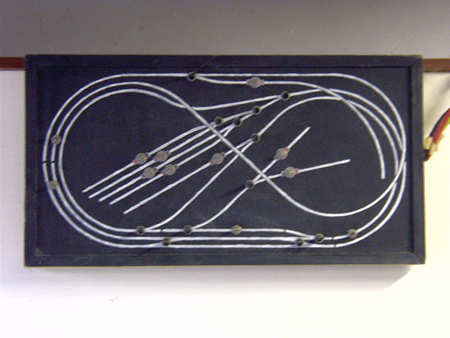
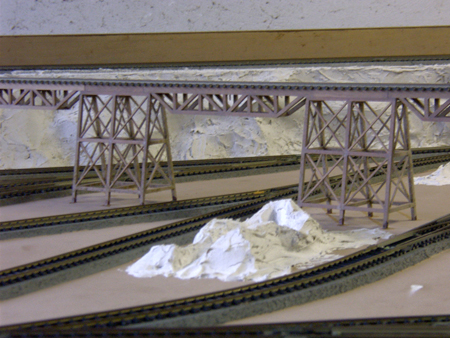
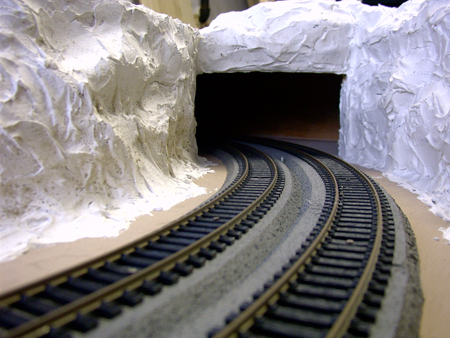
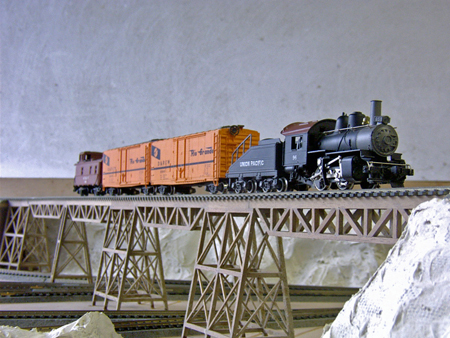
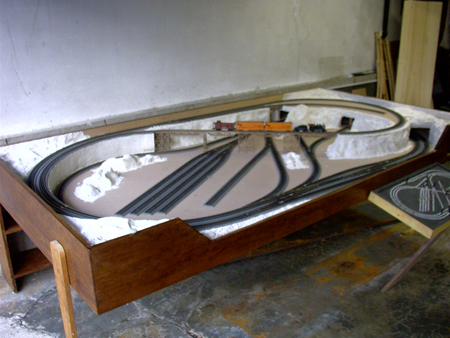
I started this layout with my kids and taught them how to build this railroad as their skills increased.
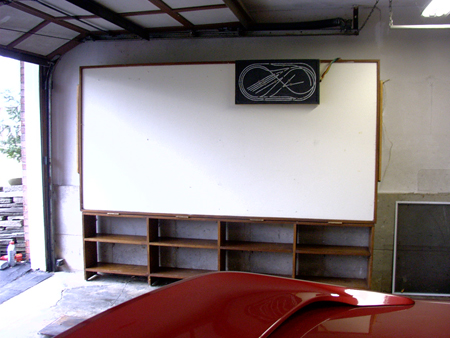
We didn’t have much room so I built it as a wall unit 10″ deep with shelves to store rolling stock when it was folded up against the wall.
They used the 4 x 8 flat side to post their school work.
All the wiring is in a 2 inch space between the railroad bed and the outside.
Two support legs swung out as it was lowered down to operating condition. All the scenery is crushed screen wire tacked in place and covered with plaster. We never finished it as they went off to school and their jobs took them else ware. So it sits in the garage gathering dust. Sad.
I enjoy looking at all the layouts that you post. Really nice work.
All the best
Harold”
That’s all for today folks.
Please do keep ’em coming.
And if today is the day you get started on your layout, the Beginner’s Guide is here.
Best
Al
PS Latest ebay cheat sheet is here.