Is there no end to Dave’s talents?
I recently asked him about a problem I was having with a decoder, and he came back with this.
And even if you’re not interested in the decoder – it’s a brilliant video of his layout.
Is there no end to Dave’s talents?
I recently asked him about a problem I was having with a decoder, and he came back with this.
And even if you’re not interested in the decoder – it’s a brilliant video of his layout.
“There’s no denying it, Al. This one is outrageously simple and horrendously frustrating. But hopefully some may think the results worth the effort.
It is not for those who have a tendency to beat the cat when things fall apart. It is for those who like to ‘fiddle’ (I might have phrased that better). While experimenting, I had a number of disasters but, fortunately, have the patience of the gods.
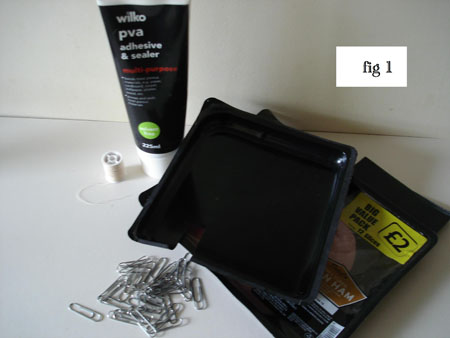
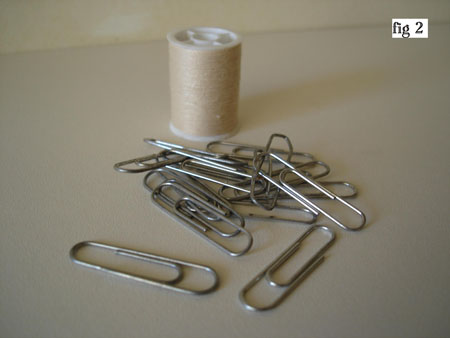
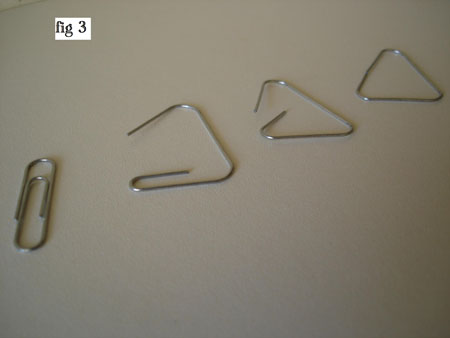
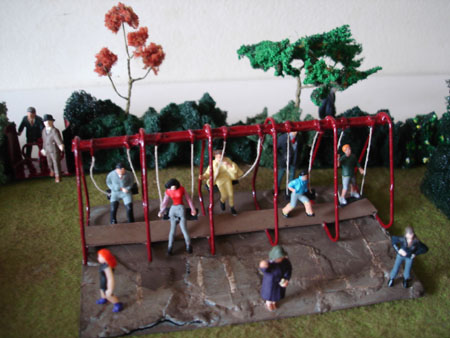
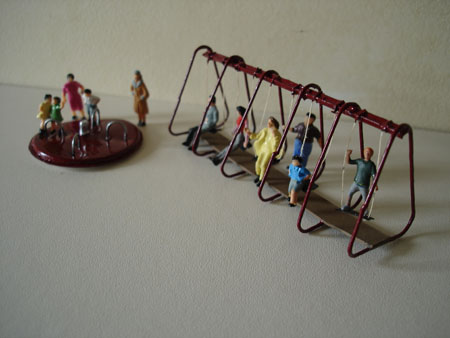
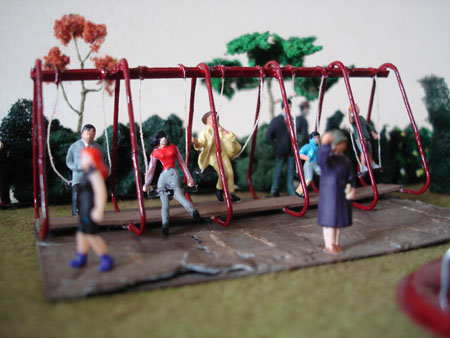
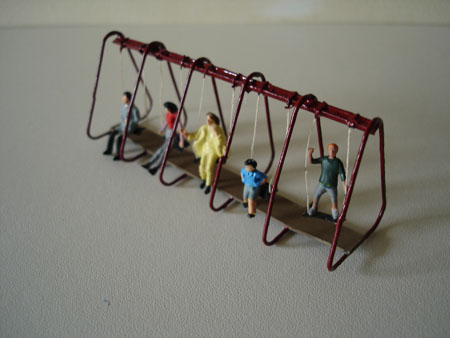
The photos are self-explanatory but here are some instructions, born out of experience, for those who would like them –
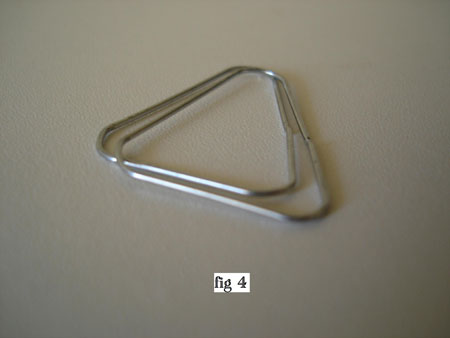
1. Unbend the paper clips to form triangles – so that the ends meet. Important that they match perfectly so lay them one on top of the other to make sure (Figs 3 and 4) Superglue the join.
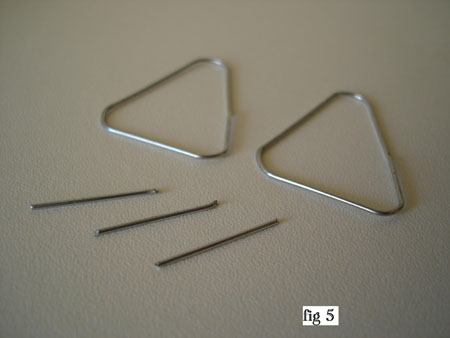
2. With wire cutters or pliers, cut your three cross members (from other paper clips) – 2 cm long – match them up too (Fig 5).
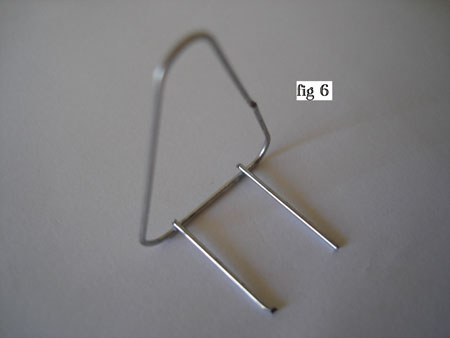
3. Glue two to the base of an upright (Fig 6). Helps to use tweezers to handle them. Leave for a good old while.
WARNING – Despite its claims and its addiction to people’s fingers, superglue doesn’t care much for metal – but will do the job in the end. Before gluing it helps to scratch your proposed joint with a craft knife or similar and make sure you apply tiny drops to both surfaces – hold the joint in place while it settles and LEAVE IT. I learned this the hard way. Even after hours, your joint will still be fragile so handle with care during the construction – learned this the hard way too. I never use the grotty, clogged up applicators supplied with superglue – pour a little into one of those blue plastic milk bottle tops (which I save in their thousands for this and paint jobs) – apply with a matchstick. And I buy cheap superglue in packs from Pound (99 cent) shops.
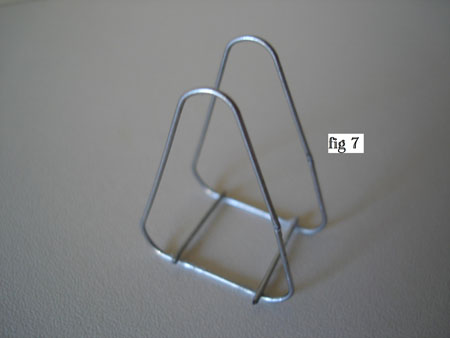
4. Glue the cross members to the base of the other upright (Fig 7) – make sure all is straight and vertical – helps to put a matchbox or suchlike next to the upright while it sets – to keep it straight. LEAVE IT!
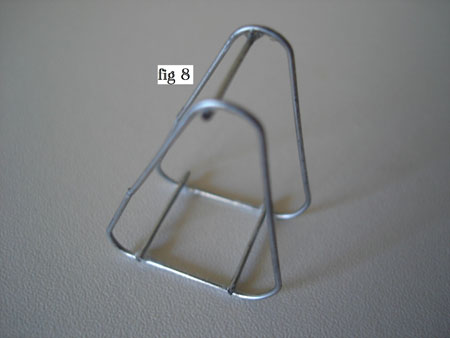
5. Turn your structure upside down and carefully glue in the top cross member (Fig 8). Hold down with a finger and LEAVE IT! Have a double whisky and leave the whole thing overnight.
6. When you awake, remember it is still very fragile. Apply superglue to all the joints, quite generously and … you guessed it … LEAVE IT!. When all has hardened you can gently scrape off excess with a craft knife – but it paints over okay. The structure will never be incredibly strong so handle carefully while working on it.
7. The two suspending chains to the seat of the swing were an unforeseen problem. Thread just flicked all over the place and wouldn’t hang. Fuse wire wouldn’t straighten. The solution was to run a length of thread through a blob of PVA adhesive – then through my fingers to saturate it. It dried nice and straight and firm. Cut the lengths of thread. You need generous lengths – trim off excess when all is done. Tie a knot at one end of each thread. The knot will slot in UNDER the seat.
For the single swing mark each length 3 cm from the knot – the length of the drop.
For the multiple swings mark off 2.5 cm (I’m assuming a standard size paper clip – mine were 3 cm – top to bottom).
DO NOT CUT OFF EXCESS UNTIL COMPLETELY FINISHED.
8. I always keep a couple of OO gauge people close by while I’m making stuff – maintains a sense of scale. Cut out your swing seat from a sheet of that free plastic substance known as chilled food container (pictured). Should be just wider than an OO gauge bum. You can use a piece of plastic sheeting as a base too if you wish. Cut two TINY nicks in the centre of each end of the seat. You can slot your thread into these – the knot under the seat. Glue the ends of the thread underneath the seat.
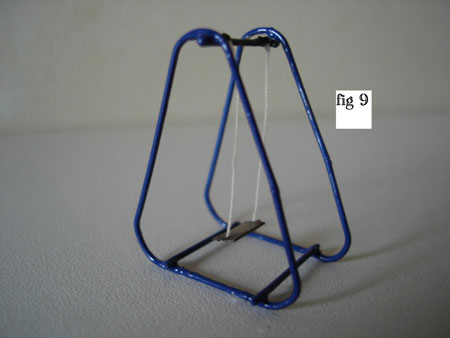
9. At the top rail, wind your thread round the bar at the mark – suspending the two threads from the upright. Glue parallel to hold them (Fig 9).
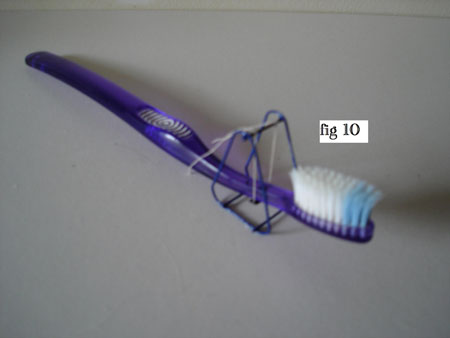
– The Toothbrush Test – Place a toothbrush (or similar) on the swing seat (Fig 10). You can check how parallel your seat is. Bit of wiggling at the top rail will sort out small inaccuracies. Apply a little more PVA to the thread – will help straighten and hold.
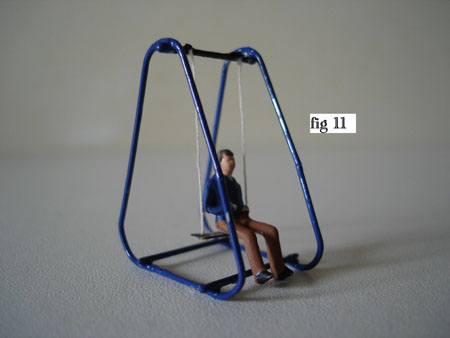
– OO gauge feet should just clear the ground. You may find that, when you put a person on the seat, he turns upside down with his feet in the air! Just glue his feet to the base (Fig 11).
– When you’re happy – cut off the excess.
10. Paint and admire. Have a double whisky.
FIN
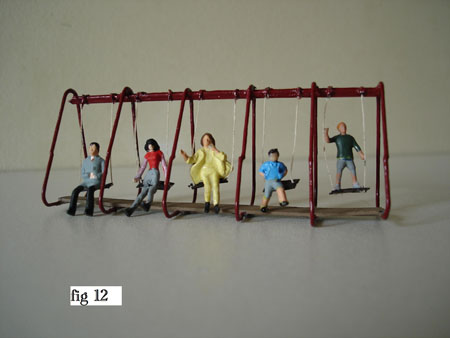
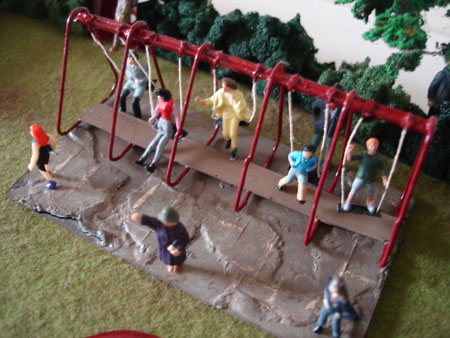
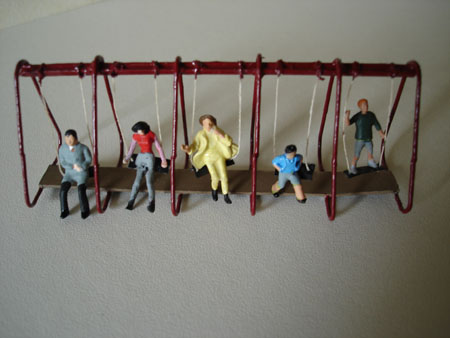
The row of swings (Fig 12) was actually easier to make than the single – same process. A length of plastic sheet (free – see above) joins it at the base – and a length of old Hornby rail at the top (you could use wood – anything). When you’ve completed it – well worth while mixing up a little two-tube epoxy glue, spread it right across the UNDERSIDE of the base – so that the bottom lengths of the uprights set in it like rock. Really strong then.
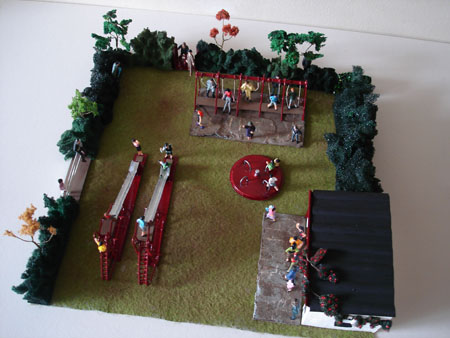
This is the first structure intended for what I’m calling PAPERCLIP PARK. More to follow if you can bear it. And yes – I know – the Park Keeper would have kicked those adults off the swings and fined them – but I didn’t have any OO gauge children for the prototype. Will get some when I make another.
Best wishes to all.
Roger.”
(NEXT TIME – THE ROUNDABOUT FOR ‘PAPERCLIP PARK’)
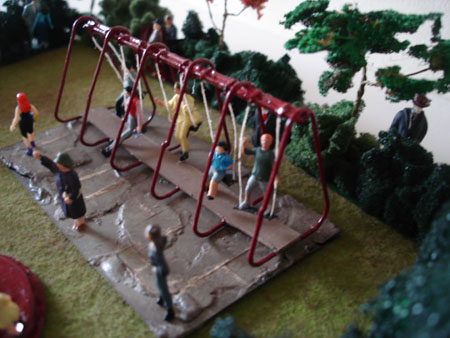
Wow! A big thank you to Roger for sending in this ‘how to’. Impressive stuff!
Latest ‘ebay cheat sheet’ is here. Thank you for all the comments.
Best
Al
Got some more tips for building a model train layout for you today:
“Hi Alistair,
This might not qualify as the best modelling tip but it is my personal opinion anyhow:
Model railways are meant to be fun! Do your own thing and do not react to so-called “purists”. The shape of your layout and what you run on it is YOUR choice – for you to enjoy.
I have a layout of approx 5m X 2m and it does not resemble any particular place or time. I have American, German, British and South African locomotives and rolling stock sharing teh layout. Who cares if my South African GMAM Garrat is standing aside a British water tower while the Flying Scotsman with LNER and LMS passenger stock thunders through the station.
My layout is also named BRAMGERSA, an acronym for BRitish, AMerican, GERman and South African.
Enjoy your e mails and regards,
Ray”
“On HO Scale layouts, I’ve used fallen branches from trees. After the storms of the past few mornings, when you clean up the bigger branches, look at the ends…. Instant Trees…. The branches into smaller scaled small trees, usually 3-4” tall. Add Woodland Scenics. and cover foam and stretch em out and spray with your diluted white glue and detergent mix. I usually cut and make these trees 10-20 at a time and let them dry for a few days before poking the holes in plaster and white gluing them in place. Save A LOT of money and looks very realistic when you need trees n mass, and no two trees are exactly the same.
Bill”
“In N gauge the stalks from bunches of grapes make good foundations for trees, just need brown paint for bark & green flock for foliage
Arthur”
Thomas has more tips for building a model train layout:
“Hello Al,
I’m not sure if you know this but you can use a common wooden dowel, I purchased mine from walmart. But i’m sure some hardware store’s and art’s and crafts stores would have them. They come in different thicknesses and i think the most expensive was about 2 dollars US.
Once you have the dowel thickness you want, you cut one end of it at an angle with your cutting tool of choice and you can either hot glue or crazy glue a flat piece of wood on the angle end you just cut for stability, or just hot glue a pad on the end.
The whole purpouse of this idea is to be able to clean those really hard, far away, to reach rails. This isn’t my idea so i can’t take full credit for it and you may revise it how ever you see fit but i have seen this homemade tool around and in use before so i know it works.
I can however say i do have an idea for a track cleaning car but i haven’t built it, tested it, tried it, or am i even sure if i could patend it since i’ve never seen anything like it on the market. I run N scale and most of those track cleaners run for over 100.00 US dollars. It’s crazy how modern society know’s, that if you need it, we can charge you an arm and a legg and we pay for it. ex diapers. but that’s a whole different conversation lol.
Another little tid bit you may or may not already know is weather you run DCC or DC layout’s just to save a couple buck’s instead of useing an atlas 2/3 way switch to power your isolated rails you can just use a simple toggle switch of your choice and they range anywhere from 20 cents to a few dollars a piece. being it’s a train layout i don’t think you would need something as complex as a lighted toggle switch but to each their own. even if you paid 2 dollars a piece and you needed 50 of them that’s only a 100 dollars compared to atlas or other 2 way switches on the market that run 4 to 8 dollars a piece, that’s in the range of 200 or 400 dollars.
You could always use real rock’s instead of hydracal and painting.
That’s about all i can think of off the top of my head, so i have a question for you i have an over whelming dust problem i’ve even considered buying a box of lint roller’s for my next option to try. my layout whenever i don’t use it for say 3 day’s, it needs dusting and a rial cleaning, i use a hand vac on it but just keep loosing product and that’s all it seem’s to suck up. The 4 or 5 tree’s i do have on my layout need to be torn out and completely redone due to the dust i would call them bunnies but at this point i think there more like full blown rabbit’s. i’ve even put the hand vac right on it and it didn’t even seem to phase it at all…
Thomas”
“Take some pva and mix in a little follage, pour it into a beaker and leave to dry, when you remove it and turn it uside down
it looks like a round pond with weeds in.
Andrew”
And lastly, I cry for help from Joe – and this is what this blog is all about.
What tips for building a model train layout would you give to Joe? Please leave a comment beloe if you can help:
“Dear Mr. Lee: I am a 66 year old single grandfather of 3 beautiful teenage girls…I am a subscriber to your website and I enjoy it quite alot…But I have decided to start a new layout…I have built layouts in the past but never one hopefully of this scope…It has been 30 years since I worked on the last one…where should I start? Thanking you in advance, I am J.R. Gray in Tennessee, USA”
Please post a comment below to help Joe – it’s always daunting when you jump back in after a 30 year gap.
And I know the collective wisdom of you all will be a great starting point.
That’s all for today folks.
Please do keep ’em coming.
And if today is the day you get started on your layout, the Beginner’s Guide is here.
Best
Al
PS Latest ebay cheat sheet is here.
PPS More HO scale train layouts here if that’s your thing.