Custom model trains

Andrew’s been back in touch with a wonderful kit bash ‘how to’ – it’s very much like making your own custom model trains.

Embarrassingly, this was sent in ages ago. I discovered it clearing down my emails this week.

“Mommy says I am a hoarder but prefer the term “Collection Connoisseur”, after all, you never know when that little oddity will come in useful.

Besides it lends itself to my objective of “modelling on a shoe string”.

In my opinion, one of the cutest (if one can use such a term when describing railwayania) is the Midland Railway Class 1F (0-6-0T).

I know that there are some fine models out there but where is the fun in that, besides I have been looking for a locomotive to model where I can experiment on a new, low cost method of producing a chassis. So, let’s get on with it.

Scratching through my “hoard”, I came across a Mainline J72 body that had lost its chimney and on comparing it to the drawing, I thought that with a small amount of cutting and filing and hacking,
I could transform that into a reasonable facsimile of a Class 1F.

Custom model trains

Fortunately for this article, the body was black and Plasticard is white so I think that without too much explanation, the pictures will tell the story.

Custom model trains

Using my trusty no 10 scalpel (with that box of Band-aids close at hand), I cut away the front wheel arches and sand boxes and made up new splashers and filler sections.

A portion of the footplate where the sand boxes were was glued in place to cover the resultant gaps. Tamiya putty would as always hide a multitude of sins.

Custom model trains

I had set my mind on the early open cab format so I sliced through the roof and reshaped the “windows”.

Custom model trains

Obviously, I lost the rear wall between the cab and the coal bunker in the process but was careful to keep as much of the coal as possible, installing a new “wall” to stop the coal from falling out.

Next I cut thin strips of 0.5mm thick Plasticard into lengths and glued them in place to form the ridges around the tanks. Strips of 1mm thick Plasticard was fitted around the coal bunker in similar fashion. The tricky part was the lining around the “windows”where in the same manner 0.3mm Plasticard strips were applied. Once dry, these were sanded with 800grit water paper to ensure that they were smooth and straight.

You probably noticed in the first picture that the body had no steps and these were done last as they tend to break off with too much handling. Once again, 0.5mm Plasticard was used for the legs and 3x3mm Plastruct angle was trimmed to size and glued in place for the steps.

The broken off chimney remains were filed away in order to obtain a smooth rounding. You may find here that the file will slip and the rivets around the smoke box are destroyed in the process. Never mind this is easy to fix with a handy little homemade tool and I digress briefly so that you can make one of your own.

Custom model trains

The Rivet Tool: Talk to your local watch-maker/jeweller and request a clock’s brass gear, as fine as possible and approximately 30mm in diameter (I’m sure you must have one lying around from one of your wind-up toys).

Now take a piece of 6mm round brass and drill a 2 or 3mm hole through the centre about 6mm back from the end. Cut a groove wide enough to insert the gear and approximately 30 in from the end. Give a slight bend to the bar (about 15°) approximately 100mm from the cut end.

Insert the gear into the slot and fix in place using a small bolt and nyloc nut. Push the other end into an old file handle and you are done. I would suggest that you round the gear teeth slightly so that there are not too many sharp edges.

So, how now? Well, cut a strip of 0.25mm Plasticard to the same width as the length of your smoke box. Place the Plasticard onto a firm (not hard) surface (a piece of softish timber will do the trick), place a steel straight edge onto the plasticard, approximately 0.5mm from the edge.

Now run the gear of your rivet tool down the length of the Plasticard applying enough pressure to make an indentation without going right through the Plasticard. Repeat on the other side. Next, turn the Plasticard strip over and laminate this to your now smooth smoke box. Hold in place with a clothes peg or other suitable item. You have now repaired the rivets on your smokebox and any mistakes can be hidden with some paint.

Now, back to the subject at hand.

Fill in all the handrail holes with Tamiya putty and once dry, sand smooth finishing with 1200 grit paper. So that is the bodywork pretty much done. Carefully wash with warm soapy water, rinse well with clean water and leave overnight under a cover (like a clean, empty ice cream container) in order to dry.

Avoid touching the body with bare hands as you may well leave an invisible oily residue which once painted, will make you look like a trainee copper taking fingerprints at a crime scene. I use cheap latex gloves for handling at this stage and find that when spraying, keeping them on makes sure the hands are clean.

I stripped off all the loose bits putting them one side for later use and held the body up against a 1:1 scale drawing which in this case was a photograph which I scaled using Adobe Photoshop®. It all looked good so far.

Overspray the entire body with a gloss black and put one side to dry. Once again, the trusty ice cream container comes in useful. I normally resist the urge to mess with it for 2 to 3 days to be sure that the paint dries well. It is important that the paint bonds properly and you may well opt to use a plastic primer before you apply colour. Extending the process byanother 2 to 3 days is well worth the wait.

Scratching about in my junk box, I found a suitable white metal chimney and although not 100%, it looked good enough. A hole was drilled and it was fixed in place with a dab of super glue after first filing away a small amount of the paint so that it bonded.

It is now time to tape up and apply that wonderful Midland Red that makes all their locomotives such an attractive sight to see. Having handled the painted body quite a bit, it received another wash with warm soapy water, rinsed and dried as previously.

With careful reference to as many photographs and pictures as I could find, I taped up all the areas that should remain black.

This entailed cutting thin strips of masking tape on a CLEAN glass surface and carefully applying as required.

I left the smokebox and chimney uncovered as they would require a satin black finish.

The exact choice of red is up to you but I used what I had and am quite happy with the endresult. Don’t be in too much of a hurry to peel off the masking tape, rather leave it to dry properly.

Now apply the decals as per Midland specifications and you are done for all intents and purposes.

The picture below displays my almost final product.

Taking it a step further, I wanted to hide the motor so I decided to fabricate the boiler detail inside the cab.

A bit of extra effort but worth it at the end of the day.

Using bits of scrap, cut and trimmed bits and pieces to produce a not very accurate but reasonable impression. I am not going to go into the detail of this as I think it is fairly obvious from the picture.

You can of course purchase a white metal or plastic option from your local hobby shop but we don’t have that kind of facility here. What I did notice from the few pictures I was able to find on the Internet was that this was predominantly brass with the inside of the cab being white.

Custom model trains

Now to find some hand rails and some valves of the right design and I am done!

Currently, I am experimenting with the manufacture of a chassis using etched PCB and 10mm brass and once this is completed and tested, I will follow up with Part 2 on how to make the chassis in this manner.

I hope this provides further inspiration for producing acceptable models on a shoe-string budget.

Andrew”

A huge thank you to Andrew – loved what he’s done. Very clever and very frugal.

I suspect kit bashing is alot cheaper and alot more fun that buying custom model trains.

Now on to Alan.

He’s a man of few words, well none, but he sent in this which I thought was rather good:

That’s all for today folks.

Thanks to Andrew and Alan.

Please do keep ’em coming, I really am running out of stuff!

And if today’s the day you start your layout, the Beginner’s Guide is here.

Best

Al
PS Latest ebay cheat sheet is here.

Model train coach lighting

John’s been in touch with a very helpful piece on model train coach lighting:

“Dear Al,

Thank you for all you do for the most amazing hobby and for all the tips and advice given.

Below is a short tip that some might find helpful.

Wheel Contacts for coach lighting

I have loads of carriages and wheel sets where both wheels are insulated from the axel. So as not to have to replace all the wheel sets, I have tried various options for picking up current for coach lighting I have tried contacts on the wheel rim – too much drag; I have tried electric paint between the axle and wheel rim but that does not last; I have looked on the internet but not found anything that is really helpful.

So, my solution may be of use to some out there:

The wheel sets have a small rubber bush fitted to each wheel that insulates it from the axle. Using a drill press, I drill a small hole in one bush on each axle. The drill size needs to be small (0.5-0.75mm) so as to drill against the axel through the rubber bush and through the wheel.

model train coach lighting

Insert a piece of copper wire extracted from an electrical cable – it needs to be a tight fit (wiggle it round and back and forth, until it goes through).

model train coach lighting

Trim it off leaving about 0.5mm protruding each side. Using a par of pliers on each end of the piece of wire and crimp the wire to ensure a really tight fit.

model train coach lighting

Check the gauge of the wheels as they sometimes do move on the axle during the work. The small piece of copper wire cannot be seen behind the axle box and you have good contact.

I have successfully installed lighting in fifteen carriages.

model train coach lighting

model train coach lighting

wheel contacts for coach lighting

wheel contacts for coach lighting

wheel contacts for coach lighting

Best Wishes

John”

A big thanks to John for sharing his model train coach lighting tips.

Now on to Bob:

“Hi Al,

I was moving the tructrain out of my way the other day and it looked so good when I was running it that I decided to take some pics of it.

So here it is running on track 2 over the lift bridge passing through part of the town toward two crossings; and past the ice cream stand I had previously posted.

The PRR style signal bridge does not give accurate indications. I configured it to show stop when the bridges raise.

I activated the raised bridge circuit to make the signal look better in the pics.

The left hand signal on the bridge is actually showing a turnout position for track 1 on the other end of the bridge.

The green light signal is showing another turnout on track 2. My son who is an engineer had some angst about that one!

I used a different configuration on the other end of the bridge for the bridge up signal.

There is a lift bridge in the Newark, NJ area that I passed at times during my commute. I always wanted to get a picture; but a main truck route runs right next to the bridge. Just before the bridge is a smash board that drops when the bridge is raising.

I always wanted to model that, and thought about using an HO crossing gate; but then decided to use a Lionel Banjo signal, as seen in a still shot.

All the single mast signals also are turnout indicators. Many of the turnouts are crossovers so the signals help me stay out of trouble.

I wired the turnouts to throw together so the dual signal changes as well. The red roofed station platform is at least 70 years old. I added a close up still shot. It’s made out of wood with a metal mesh on it. I don’t know if my Dad made it or picked it up somewhere. It looks like it’s closer to Standard gauge, but it’s a keeper.

The Girard station is tin and was made by Marx. It is also up there in years as it was on my original layout as a boy. As you can see the layout isn’t quite finished to say the least; although I got quite a bit done these last few months.

Keep all the great information coming!

Regards,

Bob in Colts Neck Crossing, NJ”

And now on to Hall of Fame member, Rob.

Embarrasssingly, he sent me this ages ago, and it got buried in my inbox.

It’s a wonderful vid on how he takes his fab videos. Have a look:


Whenever Rob gets in touch, I always think of his scratch built crane.

That’s all for today folks.

But please do keep ’em coming: it’s getting very thin on the ground here, and I don’t want to have to feed you on a diet of reposts.

And don’t forget the Beginner’s Guide is here if you want to stop dreaming and start doing.

Best

Al

PS Latest ebay cheat sheet is here.

HO scale turnout switches

John’s been in touch with his HO scale turnout switches, and how he tested them:

“Al, I want to share with you a test project I just completed to insure it would work as planned.

I have two turnouts on my yet to be finished HO layout. I decided to use manual Caboose throw switches. Boy they look so much bigger on the Internet. The two turnouts must coincide with each other. I was concerned at a distance how would I know if the two turnouts were in sink with each other.

I watch westerns on TV where the train man comes out to the track and moves the switch handle for the on coming train and then he goes back to where ever he was. I always wondering how did they know if the track was set correctly for the next train, without going out and looking at the switch. I devised a system using LED lights, a push-on push-off switch and a 12 volt automotive Relay.

I made a cabinet to house the push button switch that I hope looks like it belongs next to a train track. This cabinet in two parts, the bottom has the push button switch and the top slides over the bottom with an aspirin like button in the under side of the top which makes contract with the push button switch.

A 12 volt adapter provides juice to a particular terminal (#30)of the Relay and comes out of another terminal (#87a) which in my case goes to a “green” LED light beside the turnout indicating that the turnout is in the straight position.12 volts is also going to the push button switch and when the switch is activated it sends juice to terminal (#86).

When terminal #86 receives juice , terminal #30 is no longer connected to #87a (tuning off the “green” LED light) but instead it’s now connected to terminal #87 which in my case turns on the “red” LED light..The concept is that if I see a “green” light at one turnout and a “red” at the other I need to change one of them.

I hope the pictures below of my HO scale turnout switches will make this a little more clearer.

The first picture is the test project using a 9 volt battery. On the left top corner is the second switch cabinet. The top is upside down to show the aspirin like button that touches the push button switch, You have to assume I have thrown the Caboose throw to move the turnout to the straight position and pushed down the cabinet to turn the “green” LED light on.

The second picture shows me changing the position of the Caboose throw to change the turnout to the curved position.

The third picture I am pushing down the cabinet to change the light to “red”. I plan to have these LED .

John”

HO scale turnout switches

HO scale turnout switches

HO scale turnout switches

A big thanks to John – his last post is at the bottom of this one.

It also reminded me of this post Kato turnout switch issue.

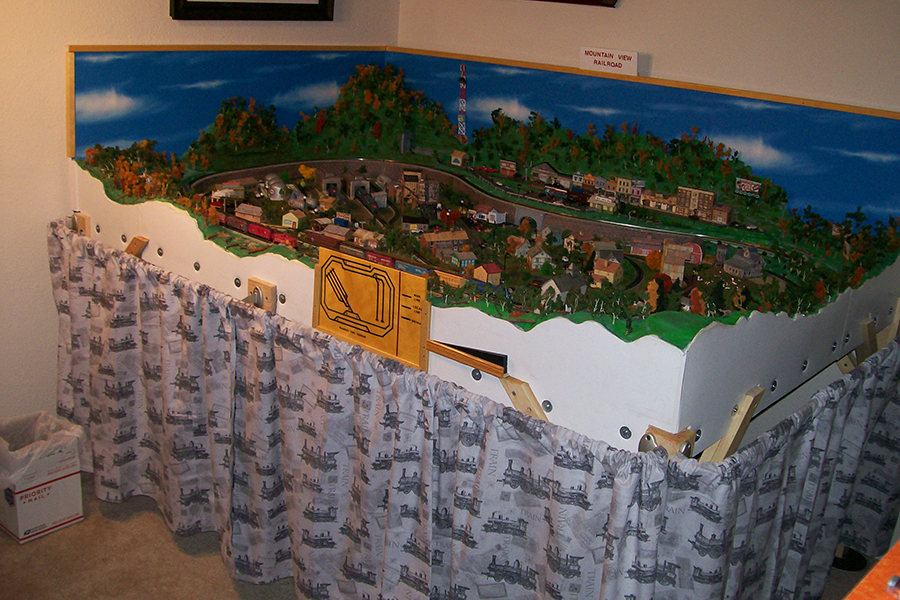
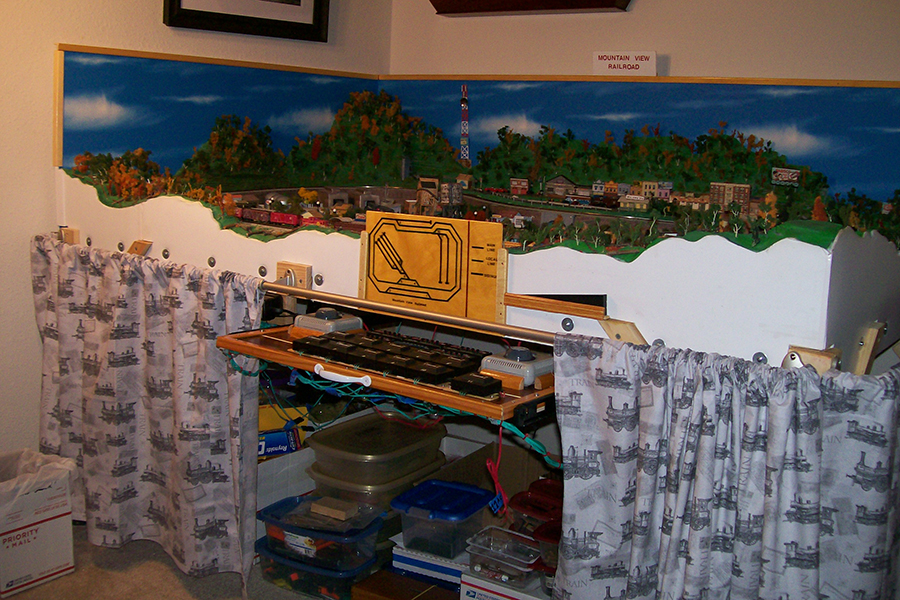
“Hi Al, this is a 9’2”x11’ stand alone room we were using for storage now turned into a train room.

I inherited four large boxes of HO scale trains consisting of twenty engines and numerous chars of all kinds. This has been a winter project that I will pick up again this coming winter.

We get lots of snow then so nothing else to do. I’m seventy years old now so it’s down to doing this.

The lift out section is 48 inches by 16 inches and locks in place with dowels on each side as shown. I’m almost done with preliminary track layout. Will send picks of that later. Thank you for a wonderful web site for all of us to view and get ideas.

Gerald in Northern California.”


benchwork

benchwork

benchwork

benchwork

benchwork

A big thanks to Gerald and John.

It’s still wonderful after all these years to see what you’re all getting up to.

Please do keep ’em coming.

And don’t forget the Beginner’s Guide is here if today is the day you get started on your layout.

Best

Al

PS Latest ebay cheat sheet is here.