HO scale church

Domonic’s been in touch with his HO scale church – have a look at stain glass windows he made, and that dome too, all from a single vintage pic.

“The old photos are of the original church of Saints Peter & Paul in Mundare, Alberta. This was my parish for a couple years back in 1955.6.&7

I made the model from these photos as the old church building is long gone.

The dome is covered in gold leaf flakes. And if You’ll notice I owe the model the three smaller domes. They are more difficult to make! They, too will be gilded.

HO scale church

HO scale church

HO scale church

Many, many more refinements to be done as time, money and interest demands!

Eventually there will be lighting in all the buildings by zoned LED areas.

This church, being the largest feature on the layout, has coloured glass windows throughout. (Not picture windows depicting saints, etc.)

I make the windows by using high gloss acrylic varnish and a broad brush to draw the liquid across the mullions or window frames. It is a long and tedious operation. It’s almost like blowing bubbles! Sometimes it forms a sheet, sometimes it will break. Then I must repeat the process. To get colours I use a thin water-colour wash and let it spread on the “glass” I can repeat this as often as needed to get the right tone.

This whole process has been quite successful, and I have made dozens of windows in this manner.

HO scale church

HO scale church

This is the main section of the layout and town of Dorothy. The town gets it’s name from the ghost town of Dorothy, Alberta, whose old grain elevator is still standing, and I made a copy of it from photos. It stands with my larger elevators.

The Ukrainian Church is at the top centre of the photo.

HO scale church

This shows my “Dorothy” grain elevator #903. I chose that number as it is the radar outfit I was in while in the USAF. The other elevators are numbered 905, 907, and 909.

HO scale grain elevator

The shows shows my “elevator row”. 903 is dwarfed by the others, but that is how small the prototype is.

HO scale grain elevator

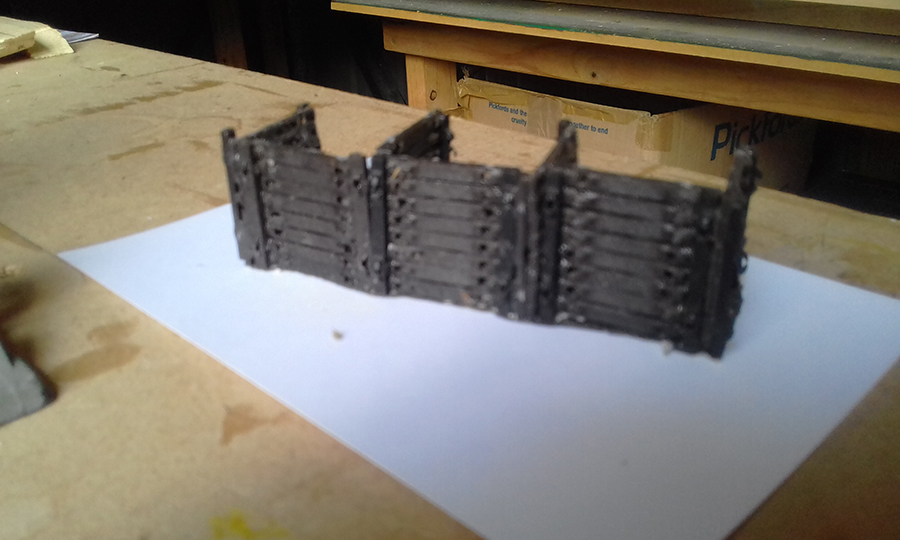
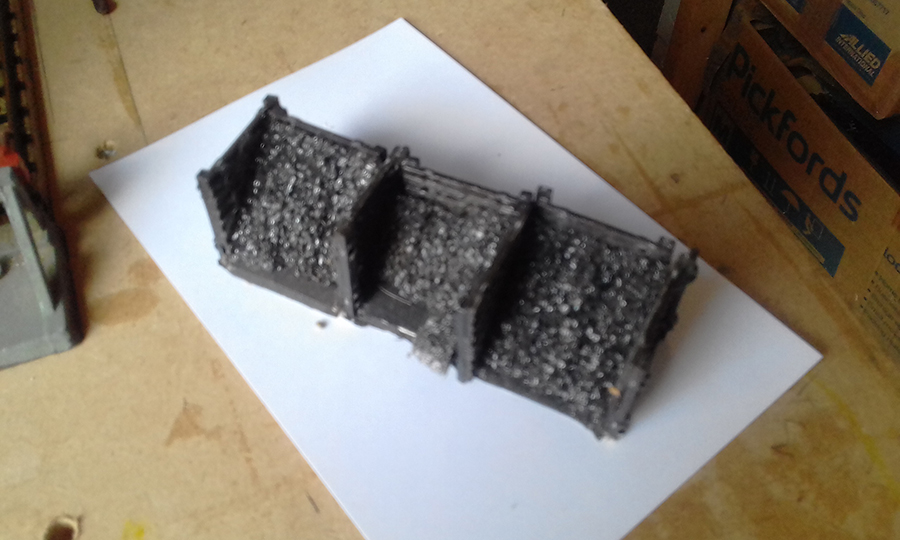
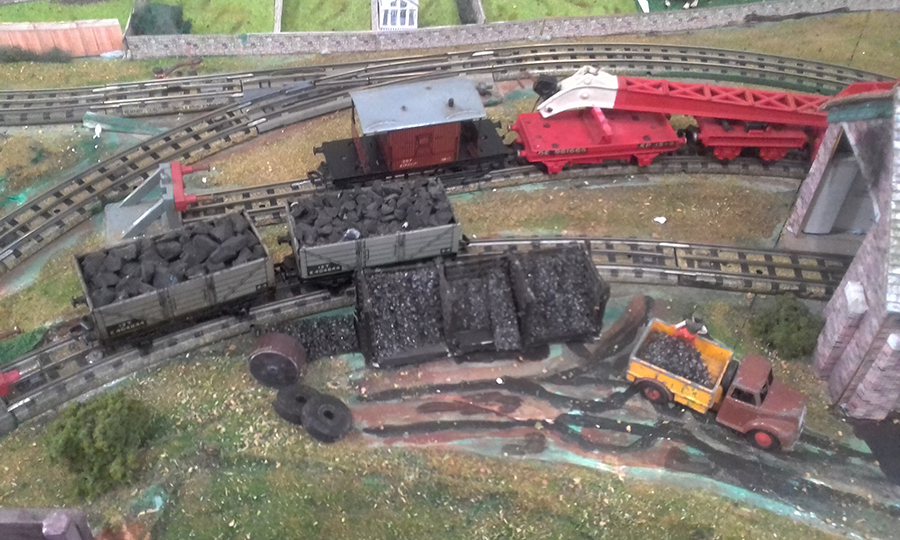
This is my first annex which is accessible by a removable one track trestle. The annex is my “Cudahy” area containing Red Star Yeast and Milwaukee Vinegar Company, The Campbell Bell Foundry, and my favourite, the Romanowski Coal Company.

This picture is the other end of the “L” shaped main layout. It has a six house residential area, Saint Ambrose Park and fountain, and the Russian Church and bell tower.

HO scale

HO scale

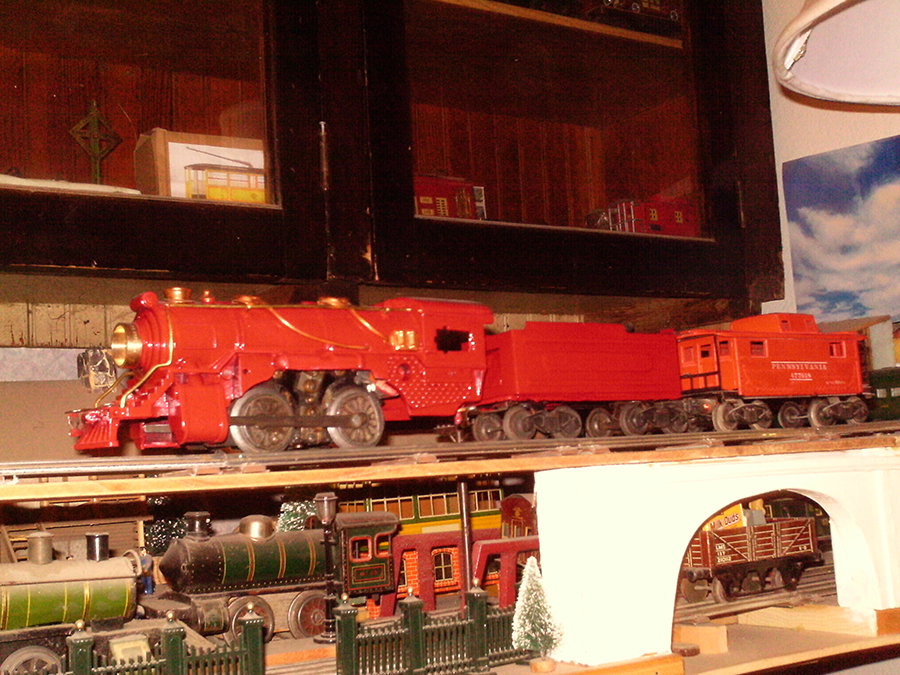
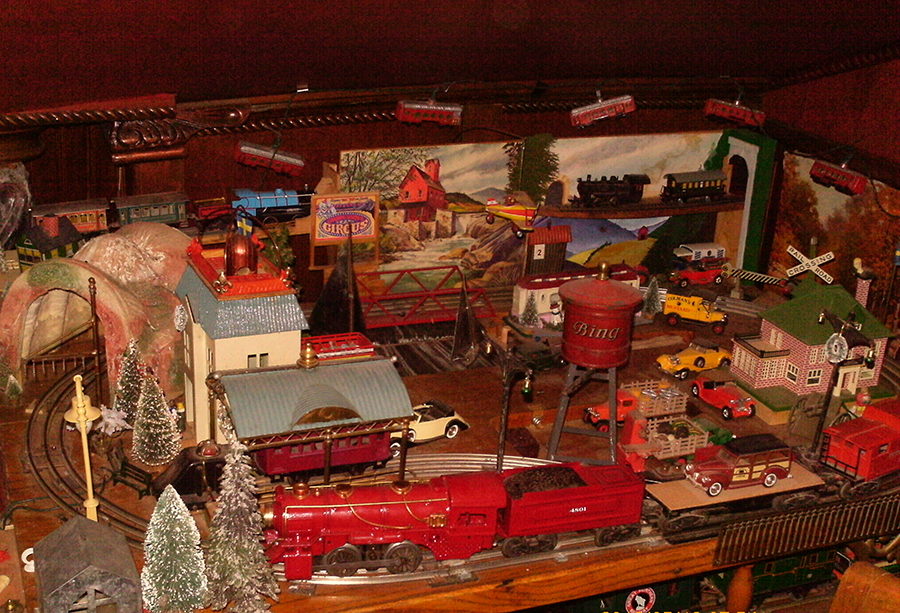
There are several shelves above two sides of the layout. One set has all HO gauge equipment and the other has my American Flyer, Lionel and Marx collections.

A little over lapping here. This is the central area of the main. Visible is the J.B.Meyer Organ Pipe factory, which is a hundred year old operation here in Milwaukee. The streetcar and passenger station is an old Tru-Scale mission-style kit.

This is a closer look at the Romanowski Coal Company. They were down the street from where I lived back during the Second World War.

I can provide more details if You want and more close-up pix of things of particular interest.


Ho scale coal bunker

Close up of scale model of full length wooden 32 foot Bombarde pipe.

organ

Dominic, Milwaukee.”

A huge thank you to Dominic for sharing his HO scale church.

(It reminded me of Tony’s: Church kit build.

What I love about Dominic’s layout is his theme – your layout can be whatever you want it to be. And I’ll bet he’s had a great time putting it together too, which really is what it’s all about.

That’s all this time folks.

Please do keep ’em coming.

And don’t forget the Beginner’s Guide is here if you’re looking for inspiration to make that first step.

Best

Al

PS Latest ebay cheat sheet is here.

PPS More HO scale train layouts here if that’s your thing.


Model bullet train

John’s been in touch – he’s made an all American model bullet train:

“Hi Al

I have been receiving your model railroad information subscription for some time.

As you might know the U.S. has no high speed rail, that is until I made it. After repainting a Kato bullet train into Amtrak colors the rail road dream is on…

I am 63, retired and struggle with all this new technology but would love to show some modelers my layout ( as bad as it is) via pictures and a short video

I have lots of obstacles to over come. My rail road hangs from the ceiling because of the space available in my tiny little apartment. I have no sense of spaceial design so layout is difficult for me as well, but I have the basic track design down and track tested and working.

You really do offer a great service to those of us who don’t have local clubs and friends to talk to about our hobby.

model bullet train

Before…

model bullet train

After…

Thank you for pulling us together.

John”

John’s model bullet train really did put a smile on my face, I loved it.

Now on to Dave:

And now on to Dave:

“Hi Al… well I know posted too many lately, but well it was raining this afternoon, so what can one do?

No gardening, and so back up in to the loft and run a few trains, used the Mobius a bit, and spotted a lot of work that needs doing on the layout, which you do not see with the normal camera… they do have three uses..

Regards

Dave


“Hi Al

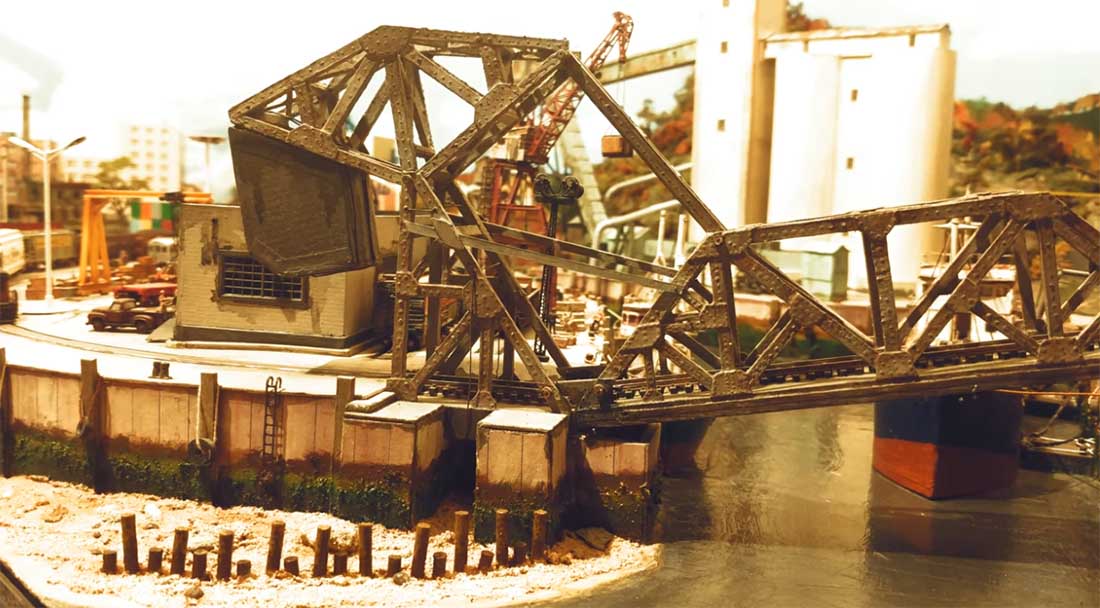
Someone asked if the water on my harbor was superimposed.

Definitely not (I would not know how to do it anyway)

Here are a few photos of the water in the harbor.

Many thanks

Brian – the HOn3 guy – Knysna RSA”

model railroad harbor

model railway harbor

model train harbor

Latest ebay cheat sheet is here.


“Hi Al,

Spent many frustrating hours trying to carefully strip the ends of the very thin wires on LEDs and Grain of Wheat Bulbs. I even resorted to not stripping them but just soldering them hoping the heat would burn off the plastic. Not ideal but it mostly worked. Today I have found a solution !!!!

I got an old pair of nail clippers, the cheap nasty sort from Christmas crackers, and squeezed them on 3 different gauges of spring steel wire. This created notches in the clippers which are just perfect for stripping theses fine wires. Hope this might help any one else struggling with the same problem.

Best regards,

John”

“Hi Al

I just want to share this with you, as some of our other readers might have had similar problems with signalling.

On my layout there is a passenger station with two platforms, that needs to be signalled for operating sessions as the engineers needs to obey the signals.

I encountered a bit of a brain teaser when it came to the simple arrangement of 3 signals at each leg of a turnout or switch.

On the opposite side of my layout, the arrangement is quite easy, as there is a single platform, so a simple double pole switch does the trick. Throw it to the left and it turn the east side home
signal green and the west side home signal red, and vice versa when thrown to the right.

At the next station which is more complex, I wanted to use a similar switch arrangement, which also helps with interlocking, that we do not get to opposing green signals.

I then realized when the Home signal controlling entry into the station, on either platform 1 or 2 is green, I need both the starter signals on platforms 1 and 2 to be red at the same time. To keep cost down, I opted to use only one single pole switch double throw switch to select between platform 1 and 2 to turn the starter signal green.

Another single pole double throw switch controls the home signal. If I simply wire the signals from the switches, I end up getting a green and red signal at whatever platform I select the starter to be green at, as there is a feedback from the home signal switch to both red starter signals.

Then it dawned on me, why not use the diode matrix system I am using for my turnout control for the signals too? I quickly drew a table with the 6 signal lights, and the switch positions, and saw that I would need 4 diodes to control the signals. I then wired the diodes into the signal wiring, and hey presto, all is working well.

(I still have to install the signals on the layout, but now the wiring is sorted.

I include a PDF with the wiring diagram. Hope this can be of help to someone.

Regards

Henry in Pietermaritzburg, Kwa-Zulu Natal, South Africa”

model train signal wiring

What a clever lot you all are. Some great tips today – a big thanks to John for sharing his model bullet train, and to Dave, Brian and Henry.

That’s all for today folks.

Please do keep ’em coming.

And if today is the day you get started on your layout, the Beginner’s Guide is here.

Best

Al

PS Latest ebay cheat sheet is here.
PPS More HO scale train layouts here if that’s your thing.


Passenger train dioramas

Tony’s been in touch – he’s added to the passenger train dioramas on the blog:

“I have been enjoying my daily email from Alastair for some time now and figured it was time to share a project of my own.

It is great to read about everyone’s experiences because there seem to be some very common threads- not enough time, not enough space and not enough money.

The first 2, in particular, have been my bane for many years. Having moved a lot over the years, I have built layouts in N, HO, OO and G but I have never really finished any of them before I moved again. And I’ve always had in mind that one big, final, perfect layout.

We moved 2 years ago to our retirement house but, not being retired yet, I ran into that other common theme- getting motivated to get started!

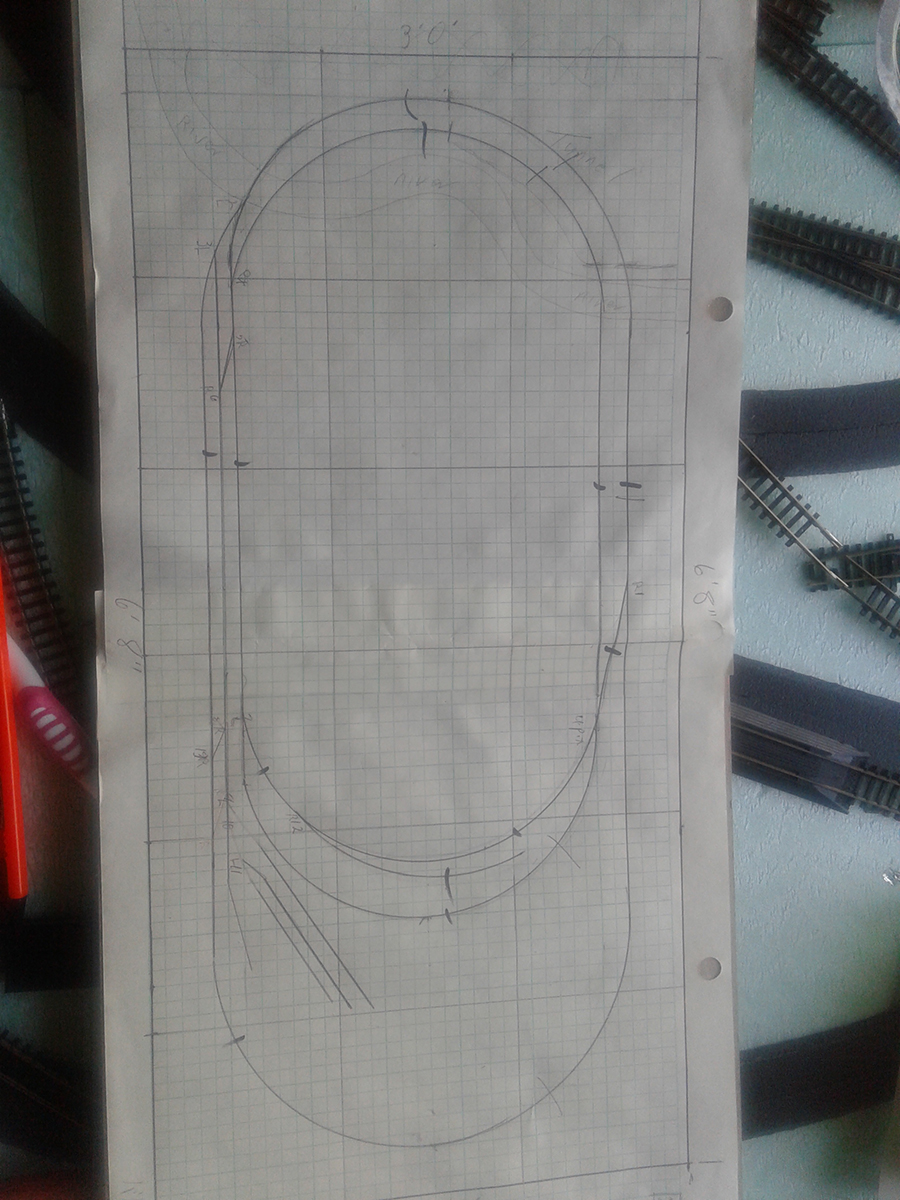
I have been reading Alistair’s wonderful newsletter for some time now (it’s the one email I get that I make sure to read every day) and there is always something motivational in it, so I am planning that final layout- an 18’X10’ OO layout of the Golden Valley area, around Chalford, Glos. (BR Western Region) in the mid-50s. I’m currently still in the planning stage, but well on the way.

At first, I was very disappointed that this new house had such a small area where I could put my trains (and all my books, memorabilia, work bench, etc) because I have always envisioned at least a 20’ X 30’ layout.

I almost gave up before I started, but reading so many positive comments from this group about working with what you have convinced me to press on. In the meantime, I wanted to share my progress a project I have been working on for some time.

My main interest in the hobby is scenery and, over the years, I have contented myself with building small passenger train dioramas. These are usually planned to fit somewhere in my final layout but they often wind up getting damaged in a move (or by the cat!) and none have survived. In any event, I always enjoy the process.

A few years ago, I was looking at my favorite railroad print, the wonderful “Riverside Local”, by Don Breckon. It occurred to me that it was a scene that might fit on my final layout so I decided to try to model it as a diorama.

steam train painting

I started by building a 24” X 30” baseboard and laying it all out. It didn’t take long to realize that the perspective was going to be very difficult; translating the 2D to 3D wasn’t easy. The main problem was the river- I just couldn’t get it to look right.

I eventually abandoned the idea, but I had built the Inn and that looked OK, so I kept it and tossed the rest. When I unpacked the building recently, I decided to re- visit the idea. I figured that if the perspective of the river was the problem, why not just try to build the half that doesn’t have the river? That is the project I am currently working on.

My passenger train diorama about 1/3 complete and looking like it might work, so I thought it was a good time to share my progress.

This time I built an 18” X 20” base. I usually just use simple plaster over chicken wire terrain, using 2” newspaper strips soaked in plaster. This is easy and cheap and I have found that it holds up well over time. In this case, however, I needed to match specific terrain contours and I would need to be more accurate than that method allows. I had some Woodland Scenics Shaper sheet rolls and Plaster rolls that I had bought at auction years ago and put away for future use. I had never used these products but I figured they would be good for this application.

passenger train dioramas frame

passenger train dioramas frame

I started by cutting out some foam core strips as risers to approximate the contours that I needed. I wound up cutting 3 or 4 versions as I was back to the problem of trying to translate the 2D shapes in the painting into 3D. I finally got shapes I thought would work and then cut wood pieces to match the foam core risers.

passenger train dioramas frame

Using the shaper sheets was not as easy as I had hoped, I probably would have done just as well using chicken wire and plaster- but I was in now. I played with the contour sheets a bit and then pushed ahead with covering them with the plaster roll. This product was easy to use, but, again, plain old plaster would have worked fine, and been much cheaper.

Once I had the total board covered with the first layer of plaster, I realized that it was going to be difficult to get the contours going down to the river to look right so I got out some modelling clay and modelled the edge – which proved to be quite satisfactory.

At this point I was still struggling with the perspective and my wife jumped in with 2 very helpful suggestions. First, I covered up the half of the print that I wasn’t modelling and this helped a lot.

The other tip was that I turned the whole thing at an angle- basically looking at the model with the same view as the painting. Both ideas helped a lot. In general, I think this is a great tip.

Whether you are laying out a track plan, wiring, building scenery or whatever, have other people (including non-modelers) take a look at your progress- they will usually see something, or have an idea, that you have missed.

diorama scratch build plaster

diorama scratch build plaster

Once the first layer of plaster was on, I just started adding layers (plain old plaster after the first layer), working in small sections to get the contour I needed. This is pretty much where I am now- getting ready to lay down grass and other landscape materials.

diorama scratch build

I am going to model the edge of the river, but this will just be representative as I will have a full river if I eventually make this a part of my layout.

diorama scratch build

The Inn, by the way, is just a simple card stock and balsa construction. The window frames came from the parts bin and I used microscope slide covers for the glass- I like the reflective quality you get that way.

I usually model interiors of buildings and light them, but this is a daytime scene, so I didn’t bother with that. The walls are just patching plaster. This product comes in various colors and I just looked for one that would approximate the picture, without having to color it. The roof was made from card covered by a roll of roofing tiles and the chimneys were scratch built from balsa, covered with brick paper from the parts bin.

passenger train dioramas

passenger train dioramas

passenger train dioramas

I need to finish this project before I can move on to building my main layout, so hopefully, I will be able to share more progress soon. That’s assuming I can get it all to look right!

Tony”

A huge thanks to Tony for adding to the passenger train dioramas on the site. I hope you enjoyed it as much as I did. It just goes to show lack of space is really just an excuse – anyone can have fun with this hobby.

I’m very much looking forward to hearing from Tony again. Wonderful stuff.

And if you have any advice for Tony, please do scroll down and leave a comment.

That’s all for today folks.

Please do keep ’em coming.

And if today is the day you get started on your layout, the Beginner’s Guide is here.

Best

Al

PS Latest ebay cheat sheet is here.