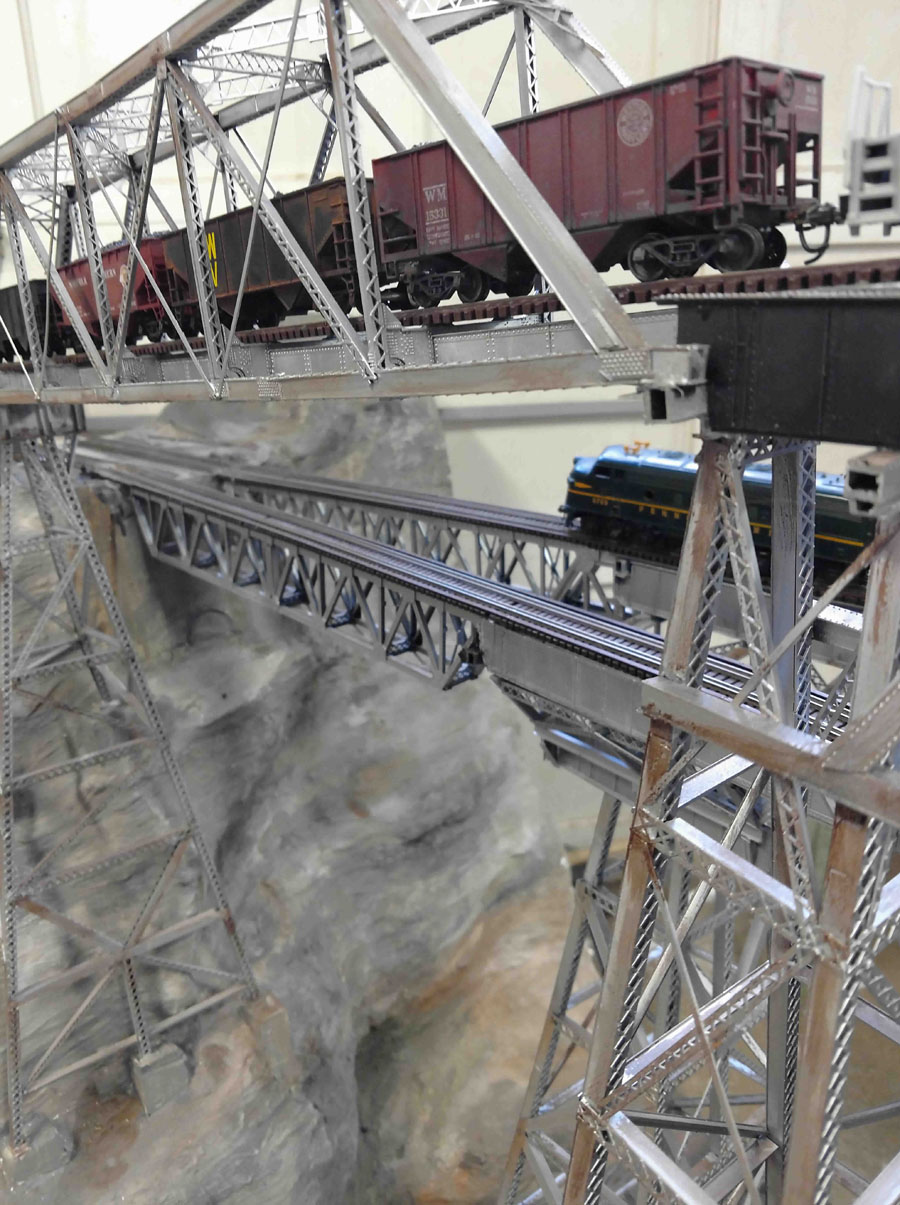
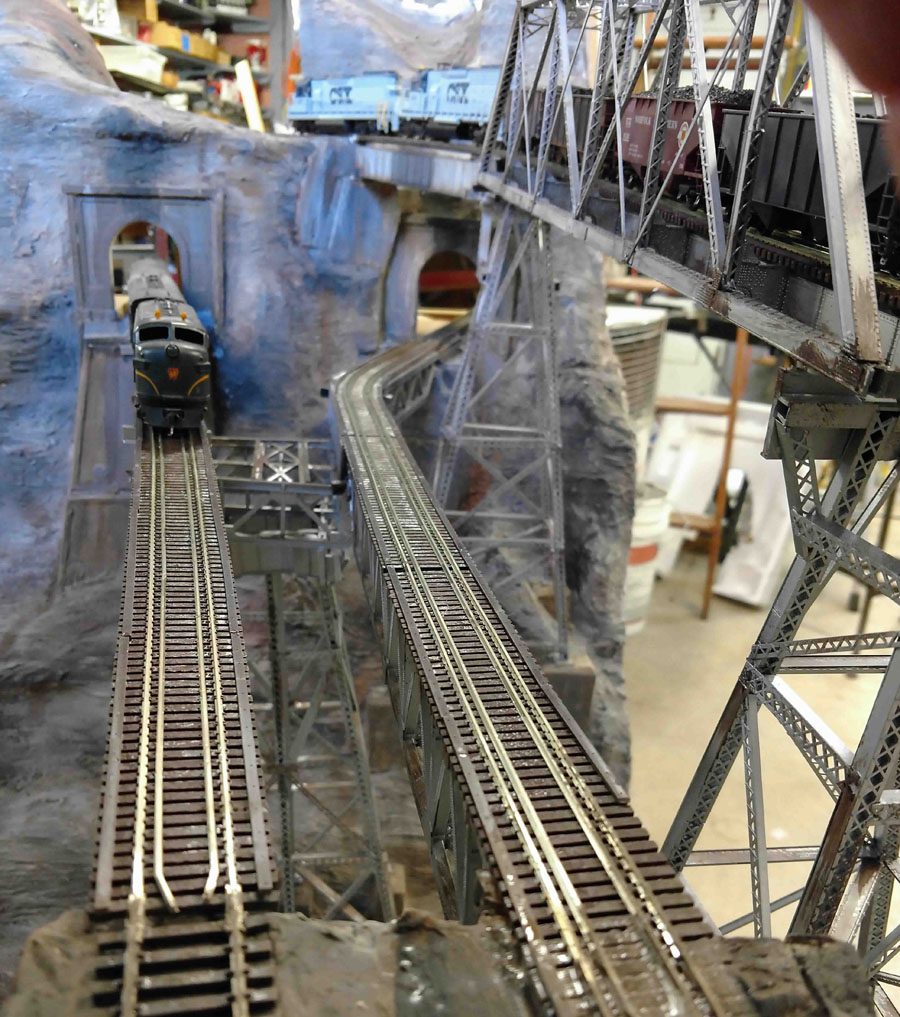
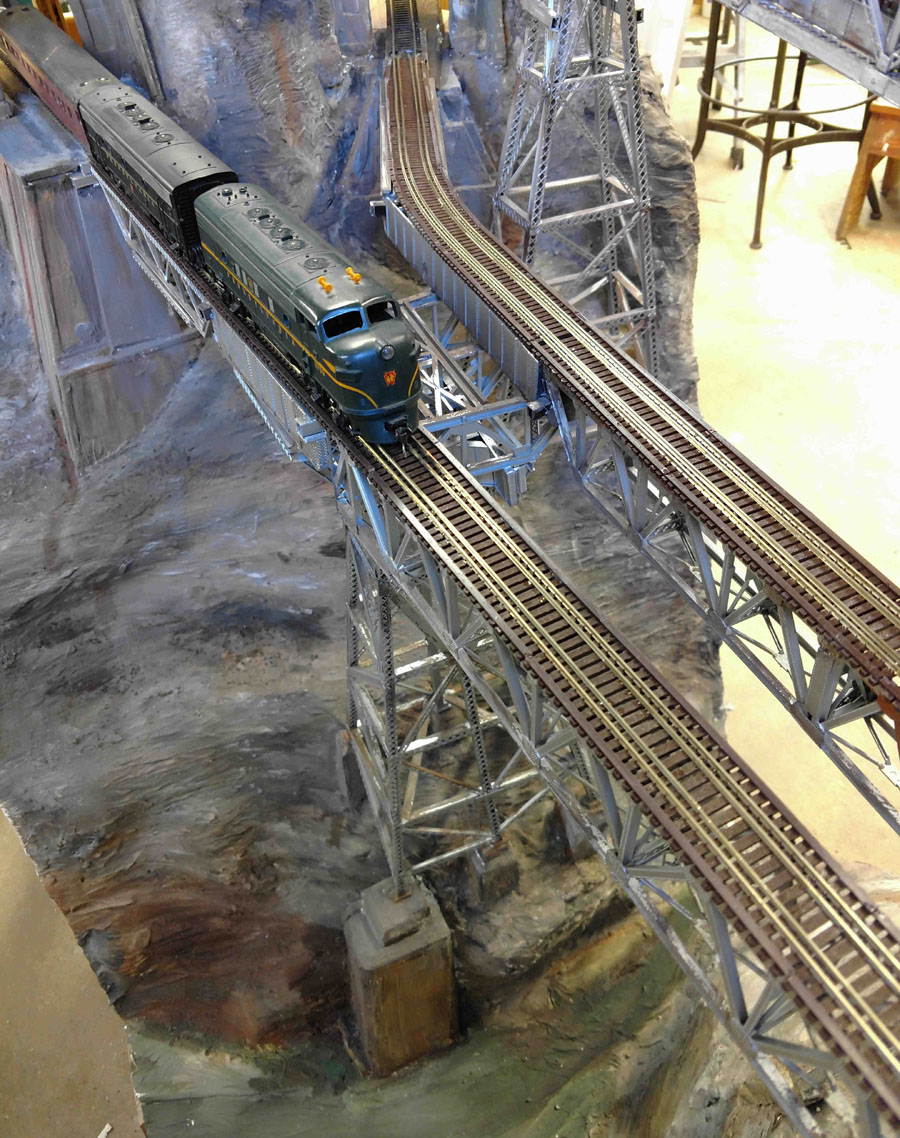
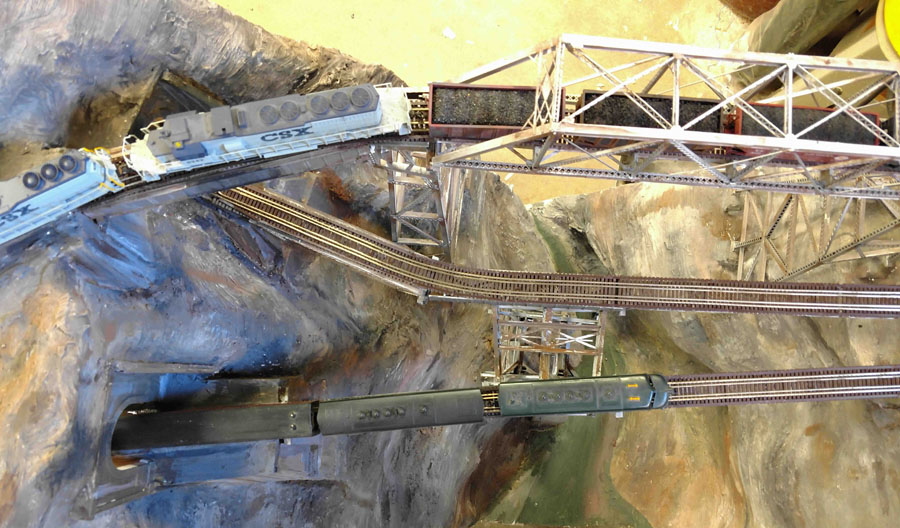
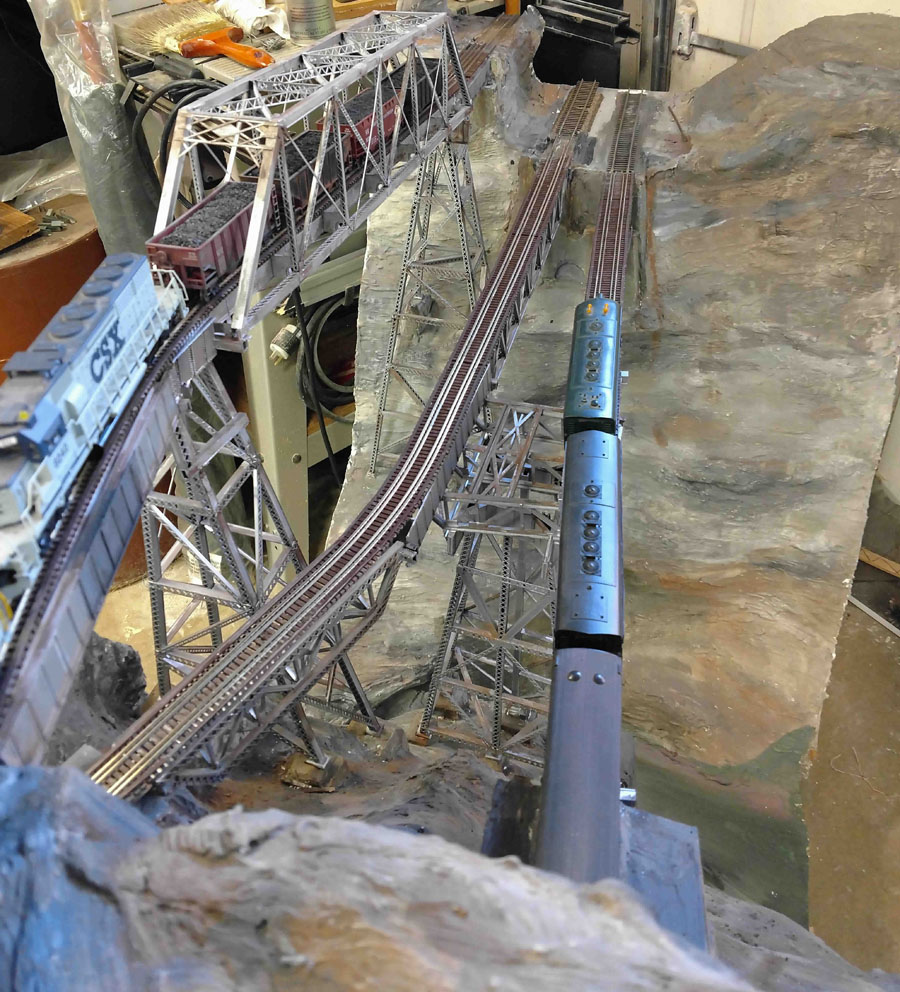
The bridge module is ready for scenery, trees, dirt and water.
Bridges came out pretty good so far, I’ll be going back for “super-detailing” like power lines, safety platforms, tunnel liners, and signals for the tunnels.
Probably not going to be able to get back to this for a while, as I’m traveling again starting tomorrow, and am teaching some Transit people how to troubleshoot a new train-control system.
John”
John’s contributed a lot to the site over the years, if you scroll back through his posts it’s a joy to see his layout come to life over the months.
And he’s really nailed it with the bridges – they look fantastic. His post today reminded me of John’s pics: John’s trestle bridge pics.
His layout is constantly evolving – it just goes to show, a layout is never really finished:
“Hi Al , just uploaded this video… I did say I was going to make a few changes, well here we are, doing a bit more than intended, but now giving me more platform area, a loop track around the Station area, and a smoother run with the curved areas, few tips here on using track spacers, filling in track joints, and maybe a few more on Laying track…
Peter’s been in touch with his Hornby track layout:
“Hi Al,
I dropped you an email earlier this year, with my thoughts on initial planning for a model railway. So here goes a synopsis of my progress to date.
I had an early Hornby 3 rail model raiilway nearly 60 years ago and had hours of fun with it. However I left home to find my way in this world, my Dad sold or gave away my model railway.
I flirted with layouts a couple of times, but I was in the army and moved round a lot and also found I had little spare time for modelling.
I had been following your blogs etc for about 15 months really enjoying everyones contribution. Anyhow my wife clocked me visiting all the model railway sites and bought me a Hornby Flying Scotsman set for Christmas. (Surprise!).
I had nowhere to build and run an extensive Hornby track layout and “she who must be obeyed” wouldn’t countenance a shelf in the spare bedroom for a linear out and return layout.
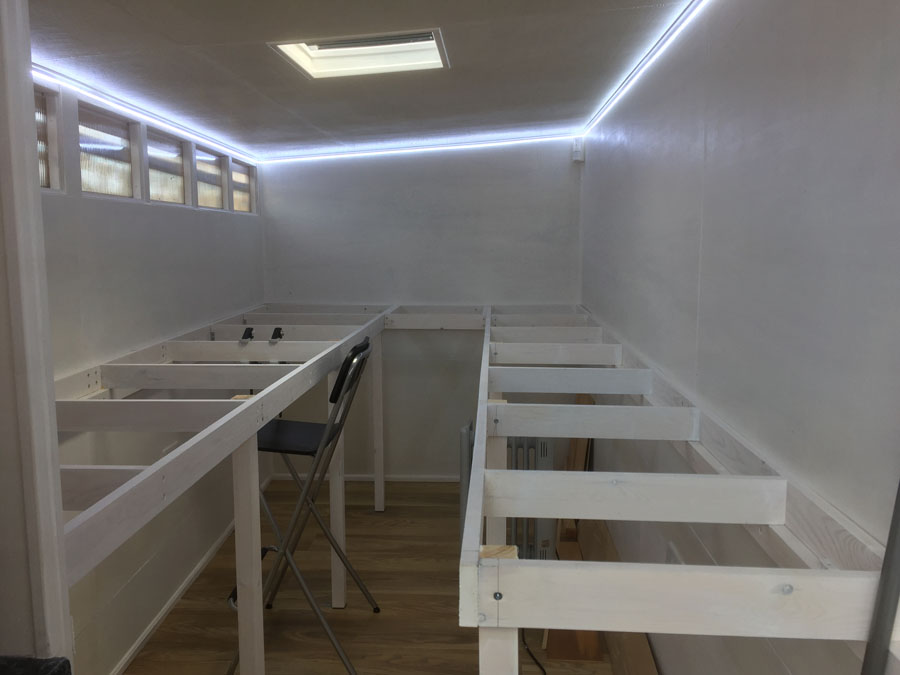
I had one shed but that was used for a gym and tool storage, so I decided to put a 14 ft long shed at the back of the house, however the width available was only 6 ft tapering down to 5 ft. Once the shed was built I lined it with 2 inch foam insulation and a top covering of 6mm ply.
I installed ring main power and lighting circuits. Adjacent to the door I installed a 2 foot work area with an old kitchen cupboard and worktop. This left me about 11ft length for my layout. The attached photo shows the shed with the baseboard staging set out.
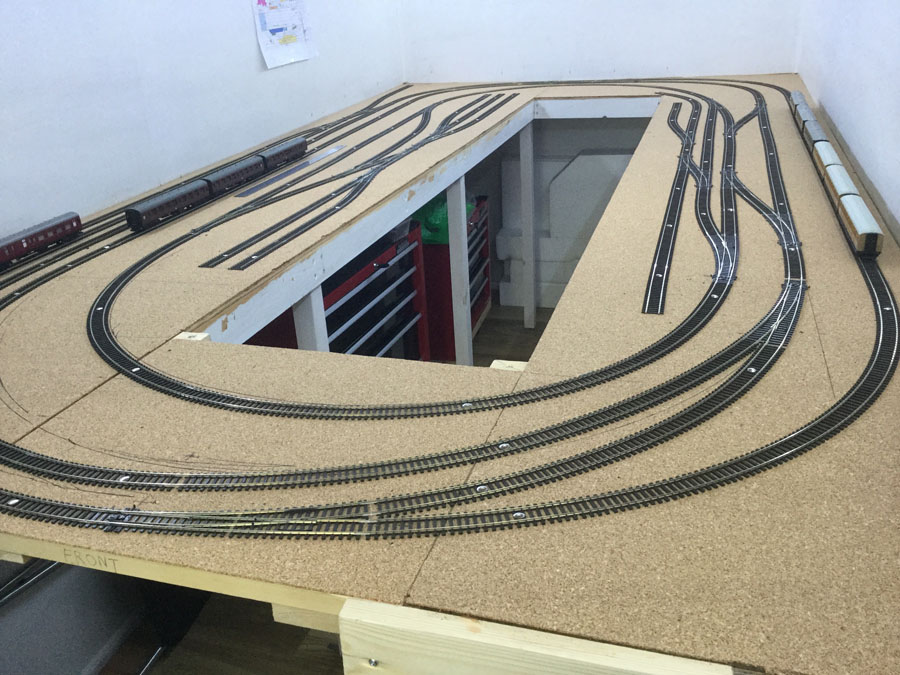
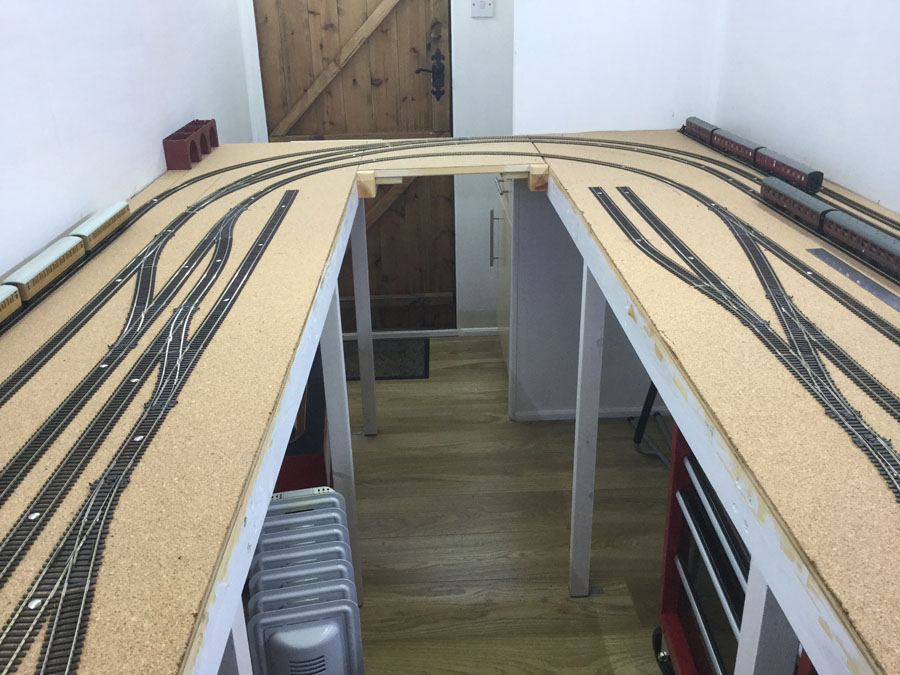
I covered this with 9mm ply and a 2mm cork topping. Near the work area I have a a 2 x 2 ft lift out to allow trains to have a circular track.
I considered an N gauge layout but read that I might find this a bit difficult on my eyesight at my age, so have gone for OO gauge.
I have gone for a late 50’s early 60’s era of UK railways, but I am not being to pedantic about that. I have spent many hours working on track plans from the very simple to most exotic, and have come up with a solution which seems to meet my operating requirements. (Dangerous Dave’s layout gave me plenty of inspiration!).
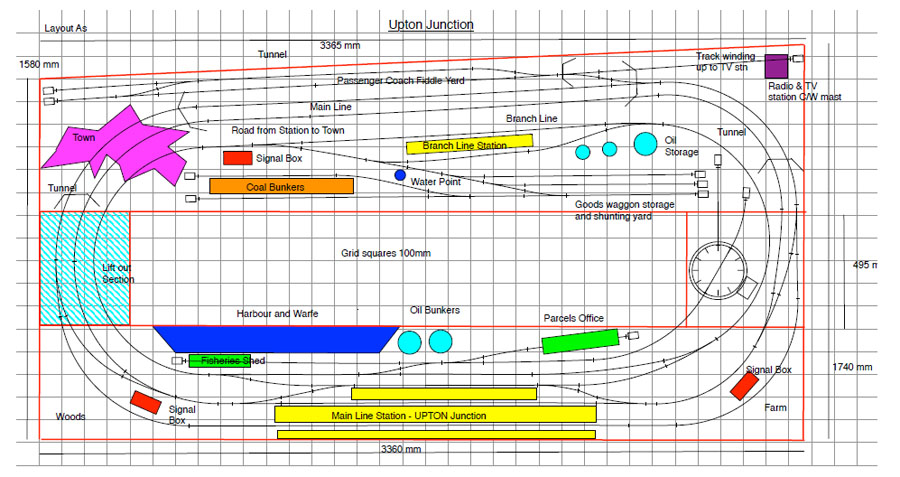
I have not put in any inclines as it seems to eat up to much room, plus the fact that I have never built a complex layout before, I’m not sure of my modelling skills so I thought I would err on the side of caution. I have included a copy of the track plan with this email. I would welcome any comments that you have, but please bare in mind that I have now built this layout! I used Empire Express on my Mac as the planning tool and found it to be pretty good on the whole and not to expensive.
I found that building the track to be the most satisfying experience I have had to date, really good fun. I am using Peco Streamline code 75 track and points, finding it easy to manipulate.
Using the metre long lengths to form curves was an interesting experience, I found that if I staggered the rail joints by about 3 inches I got a really smooth curve (I picked this tip up from You Tube). A bit fiddly to do at first, but I soon got the hang of it!
I planned to use some Peco curved points in several locations, but did not like them when it came to laying the track, they could do with a tighter radius to be of benefit to me. All my curves are no smaller than 500mm radius, but still seem tight especially on the inner track.
There are a couple of photos of the Hornby track layout, It is currently held in place with drawing pins, this allowed me to go back and adjust points and curves for a better fit; rolling stock seems to trundle round OK, but the proof of the pudding will be when I start running locos round the track.
I am using electro frog points and plan to use Seep point motors which will switch the point and the live frog. (A lot of pros and cons!). However I may have made myself a lot of work as I have not fitted the point motors yet, as I wanted to make sure that I had the track exactly as I wanted it.
I am seriously considering splashing out on a Z21 DCC controller, enabling me and others to use iPhone or iPad as the cab. I know this has the ability for point switching which I am pondering about, although the driver of the train does not set the points! Thats a job for the signalman and their control panel (Signal box). I would appreciate anyones thoughts about that.
Something I did not seriously consider was if I was to use a switch panel for points and signals, where would I locate it, as there is not much room in the middle! (Doh! as Homer would say). If I do use a switching panel it will have to go up on the wall.
I feel that I have achieved a lot to date (I spend most of the summer at my static van so little was done then) but I have a lot yet to plan and implement. To paraphrase Winston Churchill, this is just the start of the beginning! I will keep you posted with updates and hopefully soon some trains will be running.
Best regards,
Peter…”
(Click on the track plan to enlarge)
Whenever someone sends me a Hornby track layout, I’m always reminded me of Dangerous Dave:
A big thanks to Peter for sharing his Hornby track layout.
Love the approach Peter has taken – secured a space of his own, and then taken his time to do a ‘proper job’. Can’t wait to see the updates on this one. A big thanks to Peter.
Ernie’s been in touch with his model train layout floating shelf layout:
“Hi Alastair
As a retired Electrician I prefer to hard wire switches and lights.
But recently bought a system called light genie, excellent stuff, and I cannot wait to incorporate it onto my lay out.
However a couple of pics of my shelf layout.
I used IKEA floating shelf and covered with Aldis green mat cut up as well as some stuff from Model Tech Studios as background and loads etc. as a useful tip, the cobbled road from Lemax is great stuff but needs a lot of patience to get it to lay flat.
Thanks again
Ernie”
Next, on to Gene:
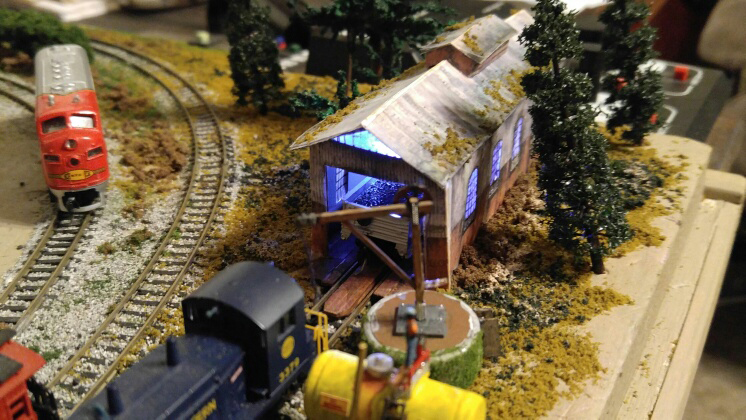
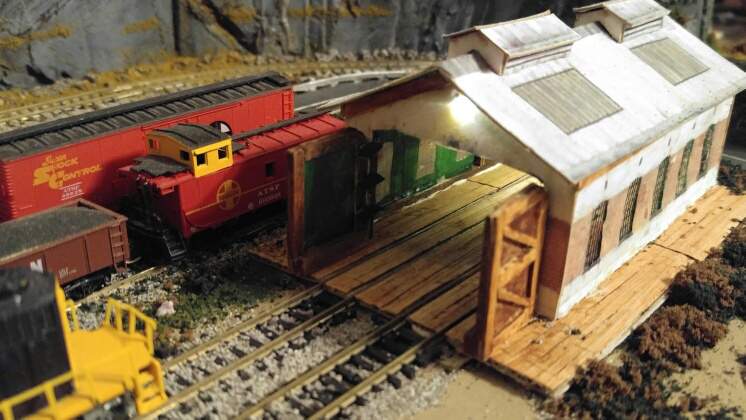
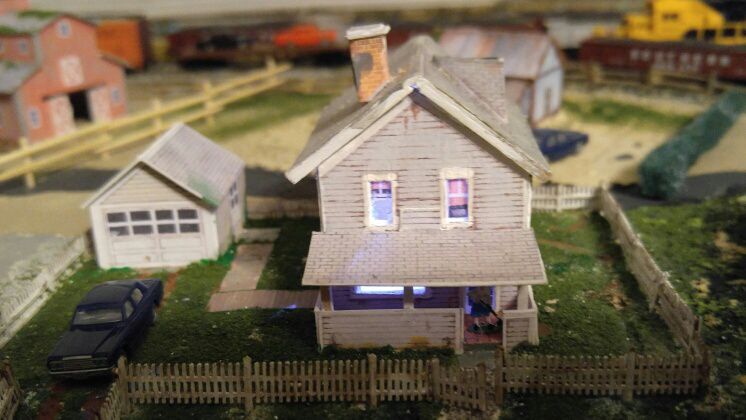
“I liked Larry’s shed so I thought I would show what I did with this paper cutout, along with a few other paper cutout projects I did.