Houses:
Lock ups / store houses:
Smokey Joe’s lock up |
Carl’s brick store |
Fat Bob’s store house |
Big Tom’s timber store |
Bundle deals:
Big Kahuna bundle deal |
Silly discount bundle |
Walls:
|
|
Houses:
Lock ups / store houses:
Smokey Joe’s lock up |
Carl’s brick store |
Fat Bob’s store house |
Big Tom’s timber store |
Bundle deals:
Big Kahuna bundle deal |
Silly discount bundle |
Walls:
|
|
Rod’s been in touch with some very impressive plasticard modelling:
“Hiya Al,
I have been leafing through an old album of photos I took of the real Diano Marina station and thought it might be fun to see which I could recreate on the model with my phone camera.
The old station is now closed, the lovely route along the coast of Liguria having been replaced with a more direct double track line mostly in tunnels, further back from the sea, The route runs from the French/Italian border at Ventimiglia through San Remo, Imperia, Alassio and Savona to Genova.
It’s electrified at 3Kv DC overhead. The bit of the old line through Diano closed in 2016 so it’s nearly ten years since we visited. Our regular hotel proprietor’s son found it hard to understand that we wouldn’t return, the new line would get us there faster, he said! Well, yes, but that isn’t everything.
Here are the first two, I regret I was too lazy to take down all the pictures from the walls of the railway room.
The photos show an E656 articulated electric loco on the left and a ‘semipilota’ or driving trailer on the right, passing in the station, which had a very narrow main platform and no footbridge or subway, so when trains crossed here, the first arrived on the main (left) platform and passengers would board or alight, then the other train would be signalled in at caution to the loop (right) nearer the station buildings. Most Italian passenger stock can be used as push-pull sets with a variety of loco types.
The layout is 11′ by 9′ with baseboards mostly 2′ wide, and is HO scale using Peco track and Sommerfeldt catenary.
These pictures show the toilet block to one side of the station building. My phrasebook was never up to asking ‘which came first, the toilets or the palm tree?’ It doesn’t appear to have done any structural damage, growing there.
The model is just Plasticard, approximated from a pace count round it and the photo and some doors I had handy. That’s the joy of modelling a real place, it makes you make things you’d probably never have dreamt up. The station had, as well as toilets, a booking office, signalbox, patio with water fountain and a cafe.
Once again I must apologise for the pictures on the ‘sky’. This is the 3,000v DC substation that supplies power to the overhead live wires. I had to shrink the prototype a bit to fit on the corner of the layout, the switchyard is half the size it should be.
The tall tower has a crane for changing transformers on or off well wagons, the siding being more usually used to house over head line maintenance trolleys. The trolley in the model pic is a brass kit from Linea.
The substation was made with a transparent plastic which I was told would cut and stick just like polystyrene but it was polythene based and very reluctant to be glued, but it ended up OK-ish.
Plasticard modelling:
This pair shows the level crossing by the Bar Eden, which occupies the ground floor corner of the huge round-ended block of flats and shops. The bar staff got used to me leaving my seat whenever the crossing bells began to sound. It would often be quite a while before the signalled train arrived and the little street would quickly fill with traffic, luckily it was one-way.
The model crossing is a Viessmann product and although Italian crossing barriers don’t have hanging skirts, the ones on the model were too nicely delicate to want to cut them off – they could certainly do with them as the locals get rather impatient and even push mopeds under them at an angle! I am sad to say I still remember hearing somebody killed here, while I was swimming peacefully round the hotel pool; the shriek of the engine’s whistle and brakes and the ensuing thump are hard to forget.
The L-shaped building was made with a thin plywood frame and ply top and bottom with plastic drainpipe section forming the three external rounded corners and a plasticard facing for the straight walls in between, the various bits being blended together with Humbrol filler. I am lucky with modern Italian architecture as they have plain reveals and recessed electric shutters, easily modelled. Lazy is my middle name.
Plasticard modelling:
Here is our regular hotel, the Torino, in Diano Marina. I was determined to have it on the layout so had to ‘edit’ it a block north, so it’s just over the road from the station. This also meant moving the swimming pool a tad to the left. The pool is just a coutout in the 1/2″ chipboard baseboard with a bottom and sides of blue plasticard tiles and a layer of clear perspex for the water.
The owners seem to be keen gardeners and went through a spell of enthusiasm for exotic succulents, hence the border of cactii. The grey canopy covers the patio extension to the restaurant. My favourite spot is under the palm on the little protrusion on a lounger with a good book, and well, well, there’s a bloke with a beard just there!
You might notice the model has one extra floor, I did this so it would come up far enough to cover the joint where the backscenes met at 90 degrees – the hotel is low relief and L-shaped so lifts off when the layout has to be moved. But that year, Sue rang the hotel to book a Spring trip and was told “ah, our great regrets Signora, we will still be closed then, we are having an extra floor fitted!” A spooky moment, like sticking a pin into a wax doll… it now matches the model.
Plasticard modelling:
In hindsight, I wish I’d fitted the hotel for LED lights on the balconies, and done a couple of little room scenes in the wider bit above the front door. Too late now, not worth tinkering with. The structure is mostly thin plywood with balcony railings from plastic fencing.
Rod”
A big thanks to Rod for showing us his plasticard modelling – you all know how much I love a layout with a theme, and it really looks like Rod had fun too, which is the whole point.
You can see more of Rod’s layout here: European model railroad.
That’s all for this time folks.
Please do keep ’em coming.
And if today is the day you press the fun button and get started, the Beginner’s Guide is here.
Best
Al
PS More HO scale train layouts here if that’s your thing.
Need buildings for your layout? Have a look at the Silly Discount bundle.
Brian, the Brit in New York, has been in touch with his latest project: Ashover light railway.
“Hi Al,
As a population of railway enthusiasts, we have been remiss in not celebrating the birth of passenger trains 200 years ago, the first being on September 27th 1825. It was pulled by George Stephenson’s Locomotion 1 travelling at 15mph between Darlington and Stockton in the North-east of England. What a change we have seen since then!
I want to let you know what I have been doing recently in the model railway area. I took down the mountain railway I posted to you earlier this year and decided I would make something a bit more traditional but using the 009 light railway concept.
First, a bit of background. I have always signed off as “Brian, the Brit living near New York” but now I need to give you more of my background.
I was born and brought up in Chesterfield, Derbyshire, a town with strong railway connections. When I was a kid it had 3 separate railway lines and 3 stations; now thanks to Beeching there is only one. Chesterfield’s railway claim to fame is twofold:
Horns Bridge was one of only 2 three level railway bridges in the world. It carried the Grand Central railway on the lower level, the Midland Railway on the middle level and the Lancashire, Derbyshire and East Coast Railway on the upper level. It also crossed 2 rivers and the junction of 2 main roads.
The Father of railways, George Stephenson who built the Rocket and Locomotion 1, lived for a time at Tapton House and is buried in Trinity Church, both in Chesterfield.
When I was at senior school, I was asked to write a report on some local subject and with my mother’s help we wrote a report on the Ashover Light Railway.
Ashover is a small village a few miles south of Chesterfield where my mother grew up on a farm. When George Stephenson was surveying the route for the North Midland Railway between Sheffield and London, he realized the potential for the development of a colliery near Clay Cross.
Following his death, the George Stevenson and Company developed further mineral deposits in the area and in 1920 the company, then called Clay Cross Company built a 2ft gauge narrow railway from Ashover to Clay Cross where it met the main line to carry the minerals to other parts of the country.
Most of the engines and rolling stock were army surplus from the War WW1. Construction was completed by 1922 for goods traffic, and it started a passenger service in 1925. The quarry at the Ashover end closed in 1950 and the last train to run was on 31st March 1950.
Sadly it can never be resurrected as in 1966, part of the valley was flooded to create the Ogston Reservoir where coincidentally I learned to sail when I was a schoolboy.
Below is a map of the railway also showing both the Ashover Light Railway and the main Sheffield to London LMS line which it linked up to, which took the coal and minerals to other parts of England, including London. Ogston Reservoir is at the bottom of the map flooding Hurst Lane and the Ford Loop.
My layout will be loosely based on this map. I will have a main line (OO gauge) running parallel for part of the route to the ALR (009 gauge).
Off the bottom of the map is a stately home, Ogston Hall which I will also model. I also hope to show Clay Cross as a typical mining town and Ashover at the other end of the line.
I have a corner in my train room which has available wall space 8 feet and 6 feet long. I have built the infrastructure using a storage shelf system which seems very stable.
The layout will be L shaped with trains going end to end. Because I need to access the space below the stairs, the shelf is 52 inches above the floor. I have my work bench under it, and yes, I have to be careful not to bang my head when working!
Base showing the shelving system
Entirety of the railway, Ashover will be on the left and Clay Cross is on the right
View showing Ogston Hall in the corner
View of Clay Cross. In addition to the houses there will be a coal yard for transferring the coal from the narrow-gauge railway to the main line.
I will post more when it is complete.
Al, you do a great job managing this blog for all of us railway modelers. Thank you and thanks to all the contributors, I look forward to the emails every morning.
Brian, the Brit living near New York”
A big thanks to Brian for sharing his version of Ashover light railway. I’m really looking forward to seeing his updates.
(You can see one of Brian’s earlier posts here: Narrow gauge railway.)
Next up is Wayne:
“Al,
I have been reading your blog for about six years, but never sent anything in before. I picked up an idea from one of your post several years ago and decided to give it a go.
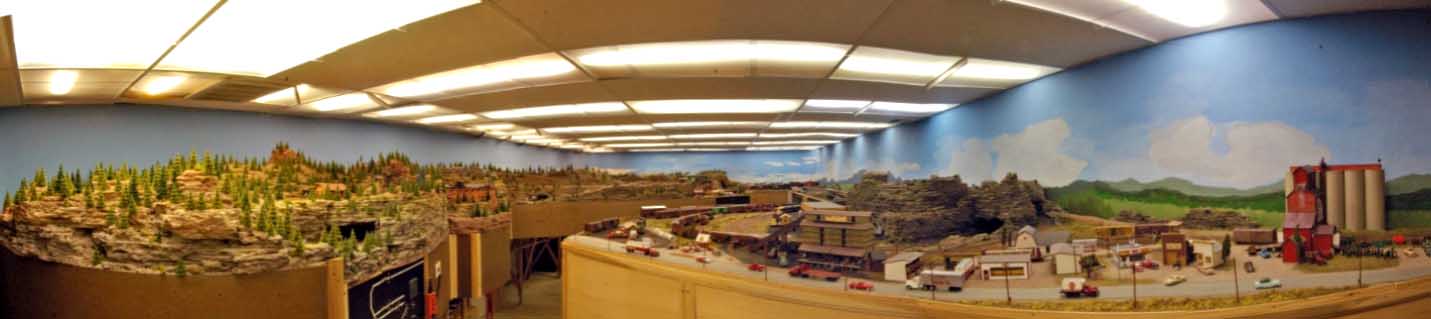
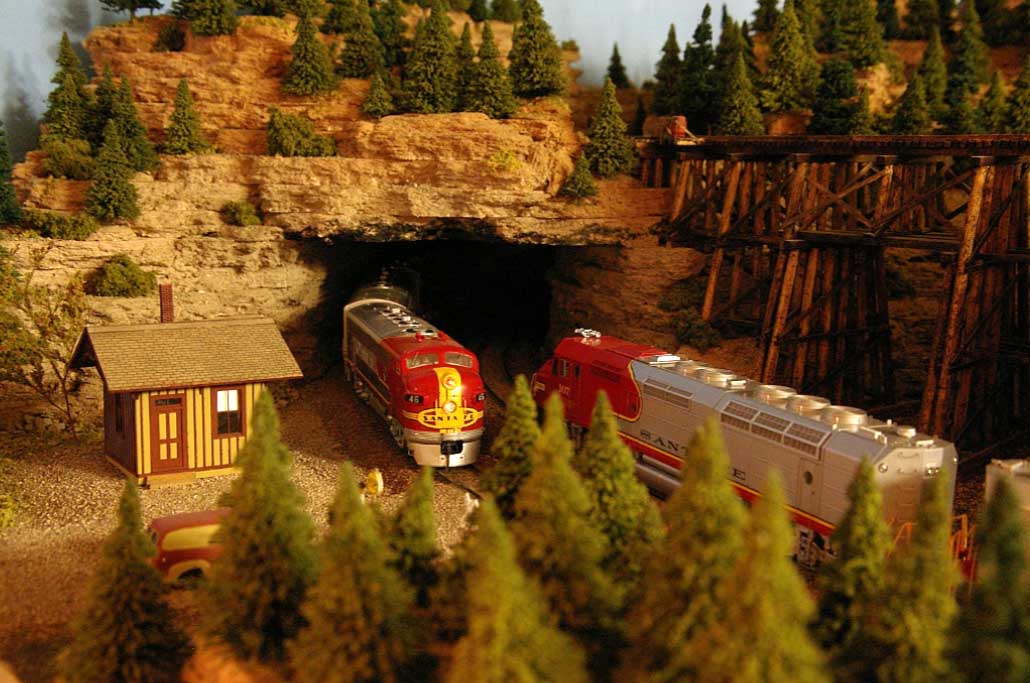
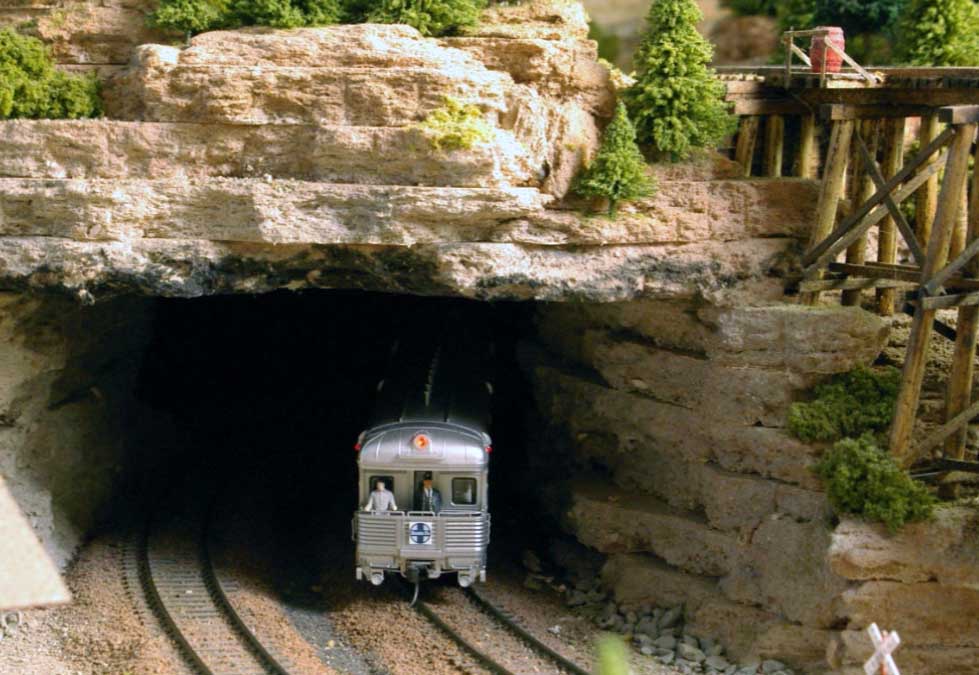
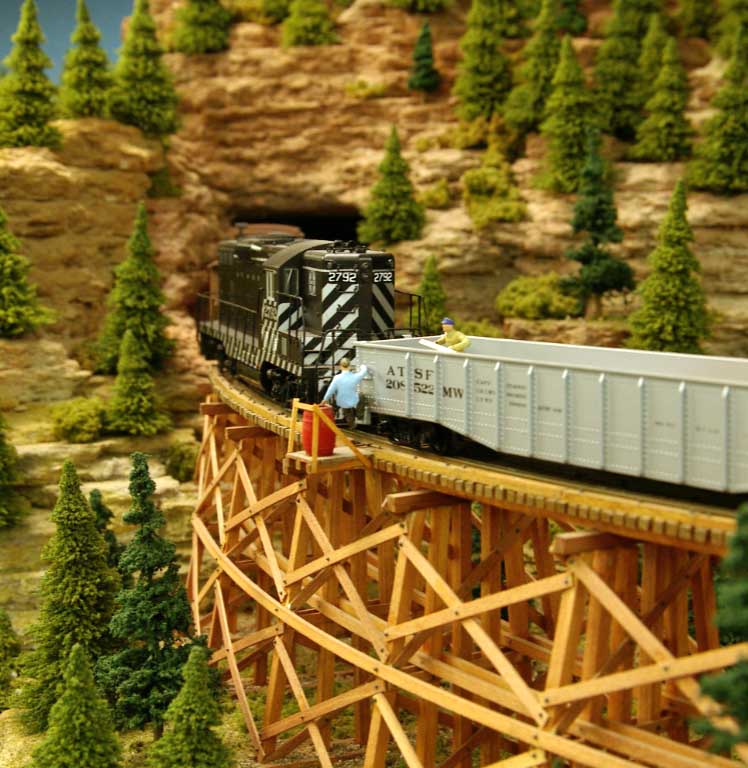
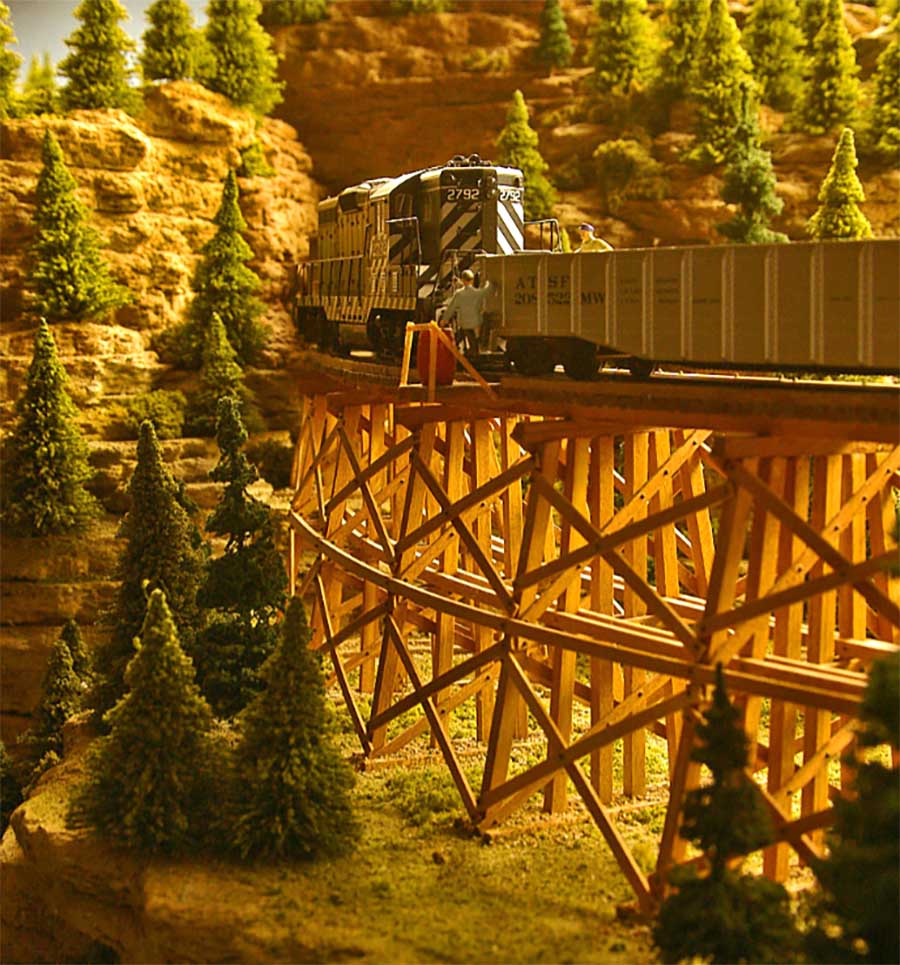
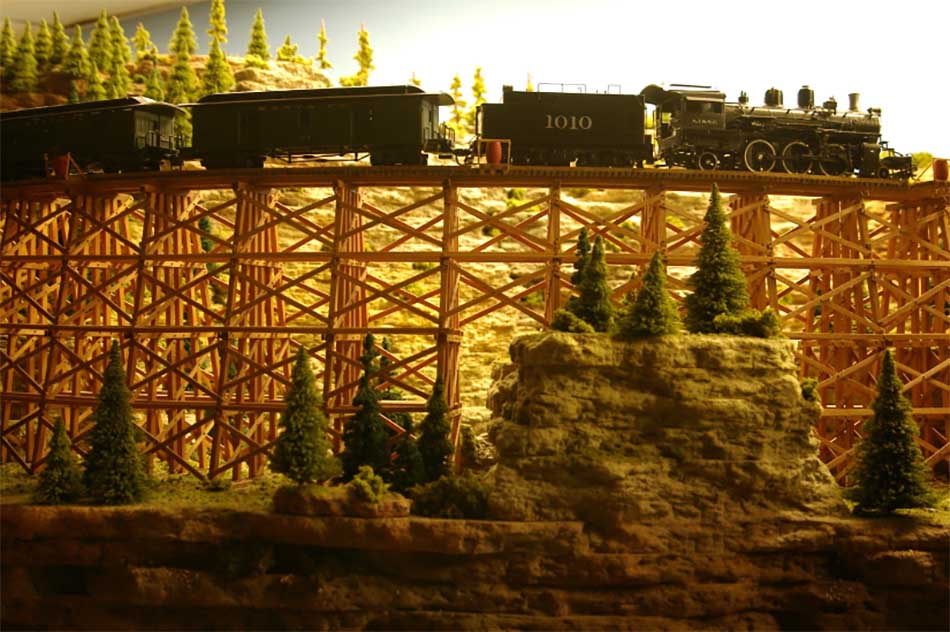
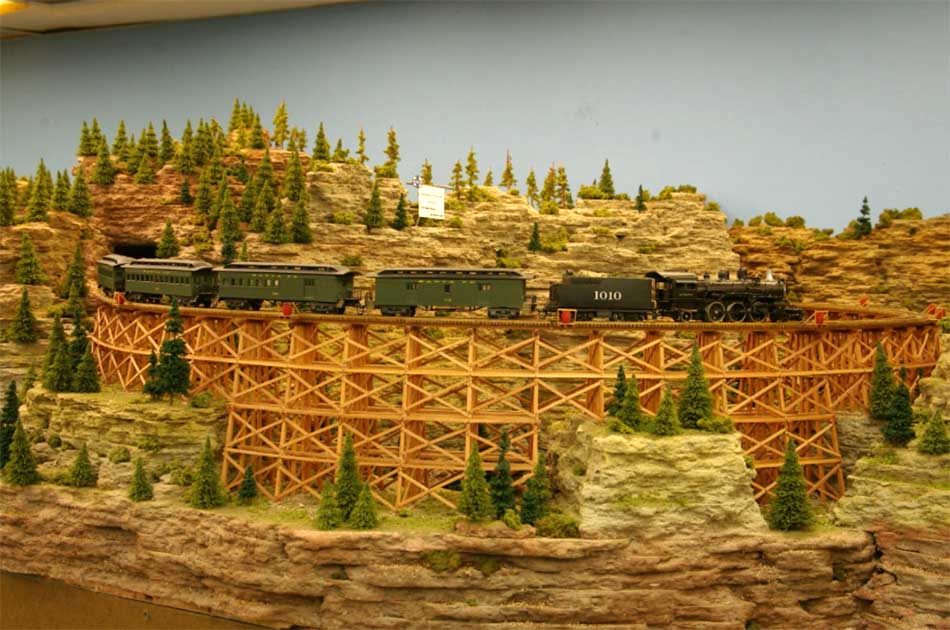
Using N gage to serve a a backdrop for my HO railroad. I tried to keep every thing as close to scale as I could. I even downloaded a dimensional drawing of a trestle from the internet which I used to scratch build my trestle.
For a title, just say “we had better call dispatch to let them know that we are going to be late. There are bear cubs on the trestle.” We hope mama papa bear can get them off because they are not afraid of all the noise we are making.
Wayne”
That’s all for this time folks.
Please do keep ’em coming.
And if creating your own model railroad is an itch you just have to scratch, the the Beginner’s Guide is here.
Best
Al
PS More HO scale train layouts here if that’s your thing.
Need buildings for your layout? Have a look at the Silly Discount bundle.