Snowplow train

The mystery of the snowplow train is solved.

Thanks for all the comments on the weird and wonderful trains video. I’m glad I posted it.

If you missed it, the below won’t make much sense, so here it is again.

A few of you kindly sent in this pic, of the train that was gnawing away at my curiosity:
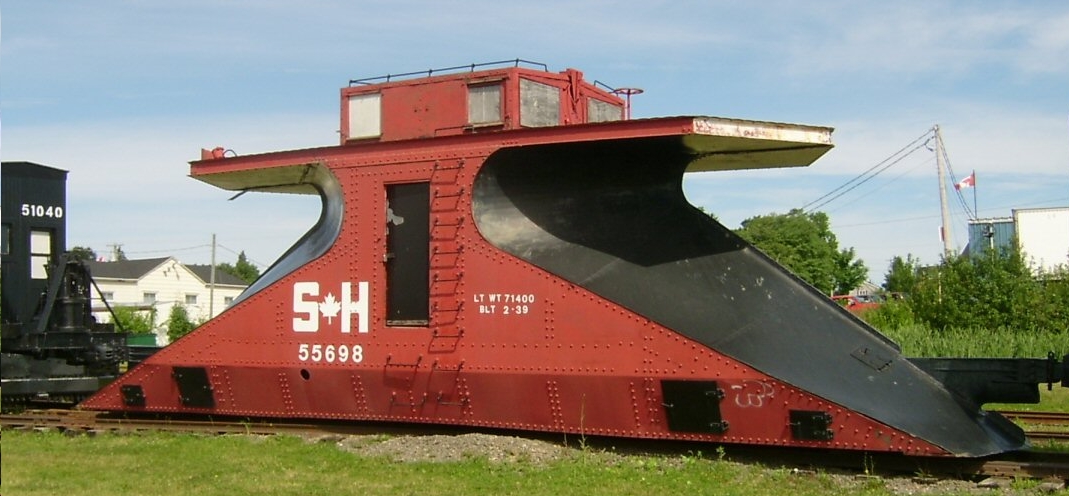
snowplow train

How I couldn’t work out it’s a snowplow train is beyond me. But there you go.

Some really good stuff came in about the other to:

“The unit at 2:19 is a double-ended snow plow.

Most snow plows of that type had a “box” end on the rear which required the unit be turned to clear snow in the other direction (see attached photo.)

This one eliminated the problem by having a plow at both ends.

The NYC “Jet” passenger car was actually an RDC (Rail Diesel Car, self-propelled) that was modified.

Supposedly it reached a claimed speed of about 150 miles per hour. The one that followed that was the Russian version which reached roughly the same claimed speed.

Interestingly enough, the train that set the North American speed record at nearly 170 miles per hour used jet turbine engines — the United Aircraft Turbo Train, which was a double-ended train that didn’t have to be turned at the end of the line. Each locomotive had seven turbine engines.

Matt
San Bernardino, California
United States”


“Dear Al,

Very, very, good! Thanks I have saved it.

Actually some of the locomotives were very successful.

The Pennsylvania Duplex 4-4-4-4 and 6-4-4-6 were developed because the pistons and connecting rods from one cylinder per side were getting so big they played havoc with the tracks.

The idea was to have 4 cylindrers instead of 2 and divide the power to the eight drivers.

The Union Pacific needed the power of the Big Boys and the Huge Gas Turbine locomotives over the mountain grades. The UP is now using multiple diesels, some times as many as six in one train instead.

Likewise the C&O allegheny 2-6-6-6 mallets were very successful.

The Algerian (PLM)4-6-2+2-6-4 streamlined Beyer Garrett was built for fast Passenger trains in Algeria and still holds the world speed record for articulated locomotives.

The Mig15 jet engine is probably not a locomotive but an attempt at snow removal. The New York Central built an experimental snow removal vehicle by mounting a jet engine on a flat car.

It worked wonderfully blowing away the snow and the heat melted ice from the switches.

Unfortunately it also blew away the ballast from the tracks, braking lineside windows and injuring passengers waiting for trains in stations as it passed!

I’m going to send this post to all my buddies at the Peninsula Model Railroad Club in Newort News VA USA.

Thanks again.

Frank.”


I was very hesitant of posting the Weird and Wonderful video, but I’m glad I did now – especially now I know about the snowplow train.

It also reminded me of another post on the site – the ‘maintenance of way equipment’.

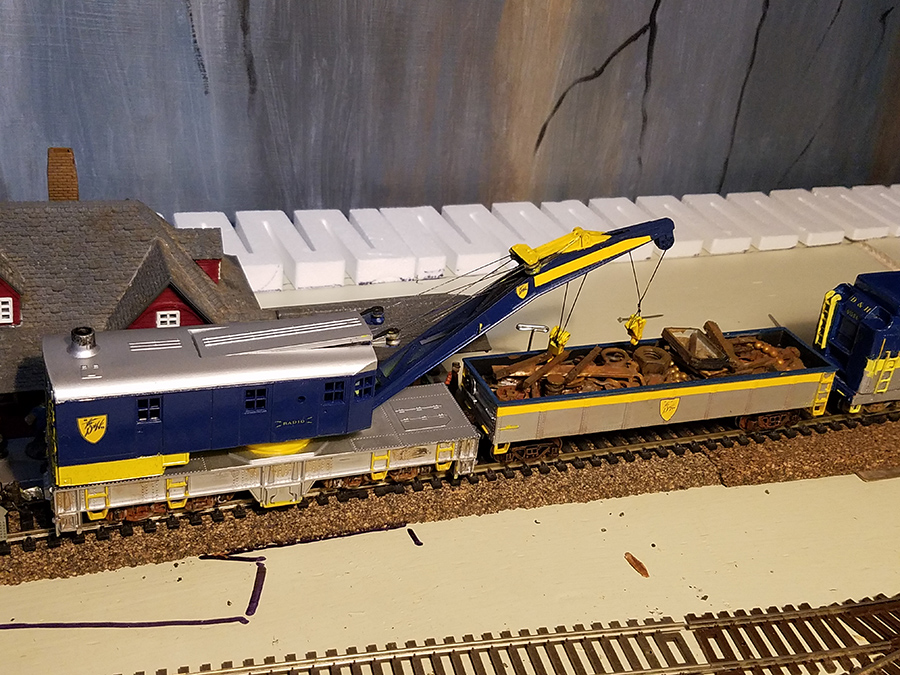
Here’s a pic of it – it’s a series bit of kit:
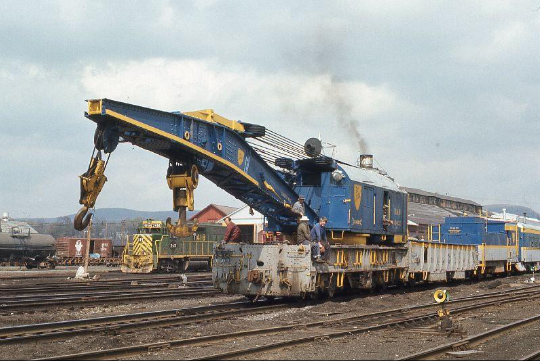
maintenance of way engine

And here’s what Dan did:

You can see the full post here.

Anyhow, please keep ’em coming. Business as usual next time.

And if today is the day you stop dreaming and make things happen, the Beginner’s Guide is here.

Best

Al

PS Latest ebay cheat sheet is here.


Weird and wonderful trains

I get sent tons and tons of videos and all kinds of stuff. Some of it weird and wonderful.

I do my best to keep the posts model train related – but as you will have found out, some time I can’t resist posting something ‘off piste’ (especially when there’s a rant brewing).

Anyhow, I came across this. I thought it too long to post, but then seeing as it grabbed me all the way through, thought I’d share.

Now, can anyone tell me what the engine is 2 mins 19 secs in?

And if anyone has any info on the jet powered trains, please share (I’d seen the propeller ones before, but jets? Wow).

Hope you enjoy it as much as I did.


Now on to Brian:

“Hi Al,

I built a simple 00 gauge model railway for my two sons in the early 1980’s.

At the time I was photographing and writing about the colourful and interesting freight movements in the north east of England which culminated in a book published in 1989 ‘Railfreight Today’.

At the same time as building a railway for the children, I was buying odd freight wagons that interested me, with a view to one day having a layout of my own.

With other interests, that never happened, they languished in boxes, surviving a number of house moves for 30 years – until like others ‘Lockdown’ arrived.

I had decided that due to space restrictions, my layout would go in the garage partly along one wall. But with all the usual garage paraphernalia, it was not going to work. Then I hit upon an idea.

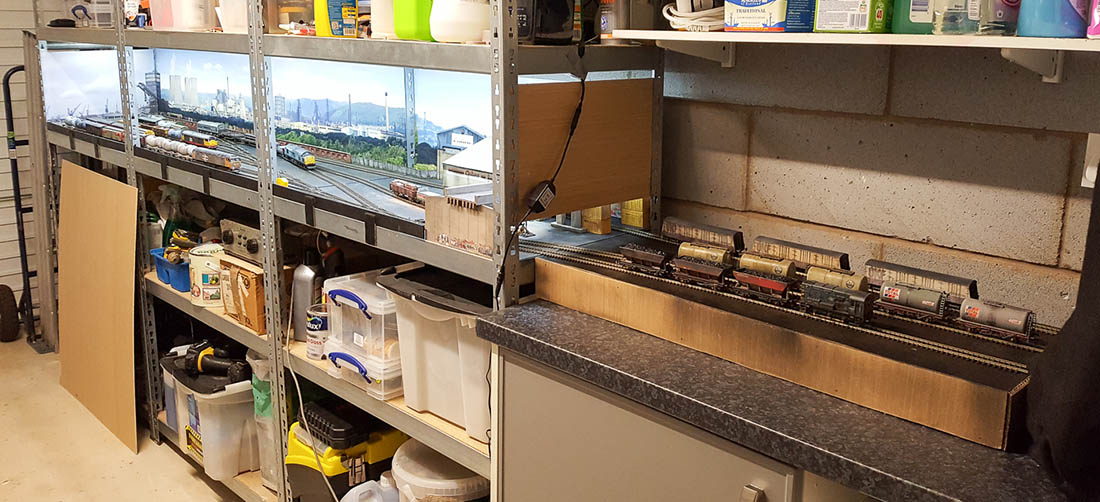
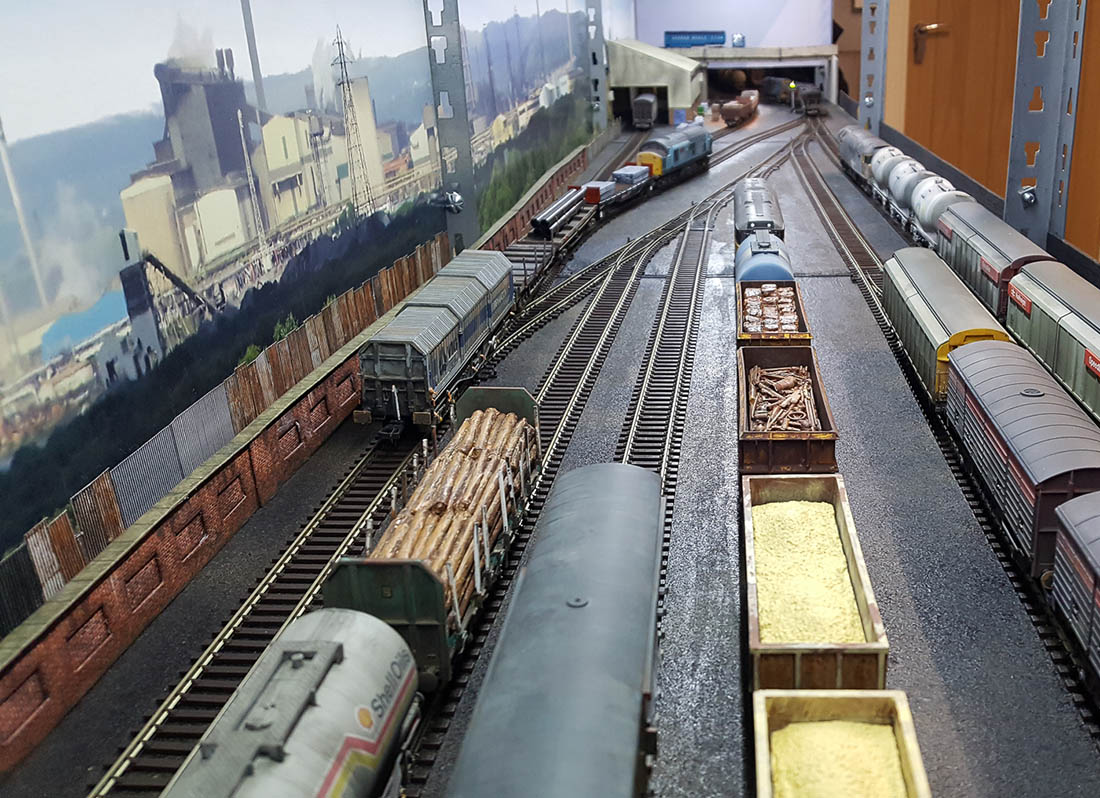
The layout would be built within my sturdy metal shelving system.

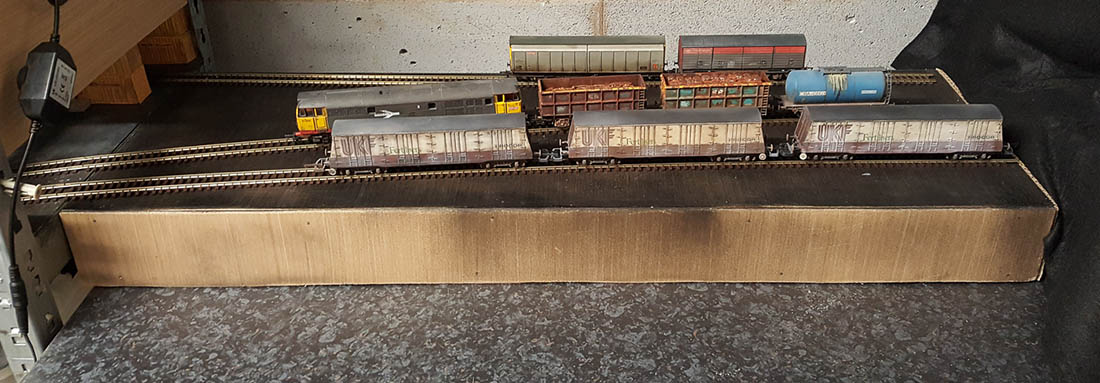
This meant a layout 3 metres long and 0.5 metres wide, with an additional temporary, one metre length of hidden sidings on the adjacent worktop!

Naturally, for me, I wanted a layout to be freight only, no passenger trains in sight! I wanted to run longish freight trains (limited space), but more important, I wanted shunting to be done.

I didn’t want the hassle (and cost) of moving to DCC. My wagons and locos were from the 1980’s ‘Speedlink’, Railfreight era. I looked at plans of end to end layouts, played about with SCARM and eventually came up with a basic layout, which inevitably was altered multiple times.

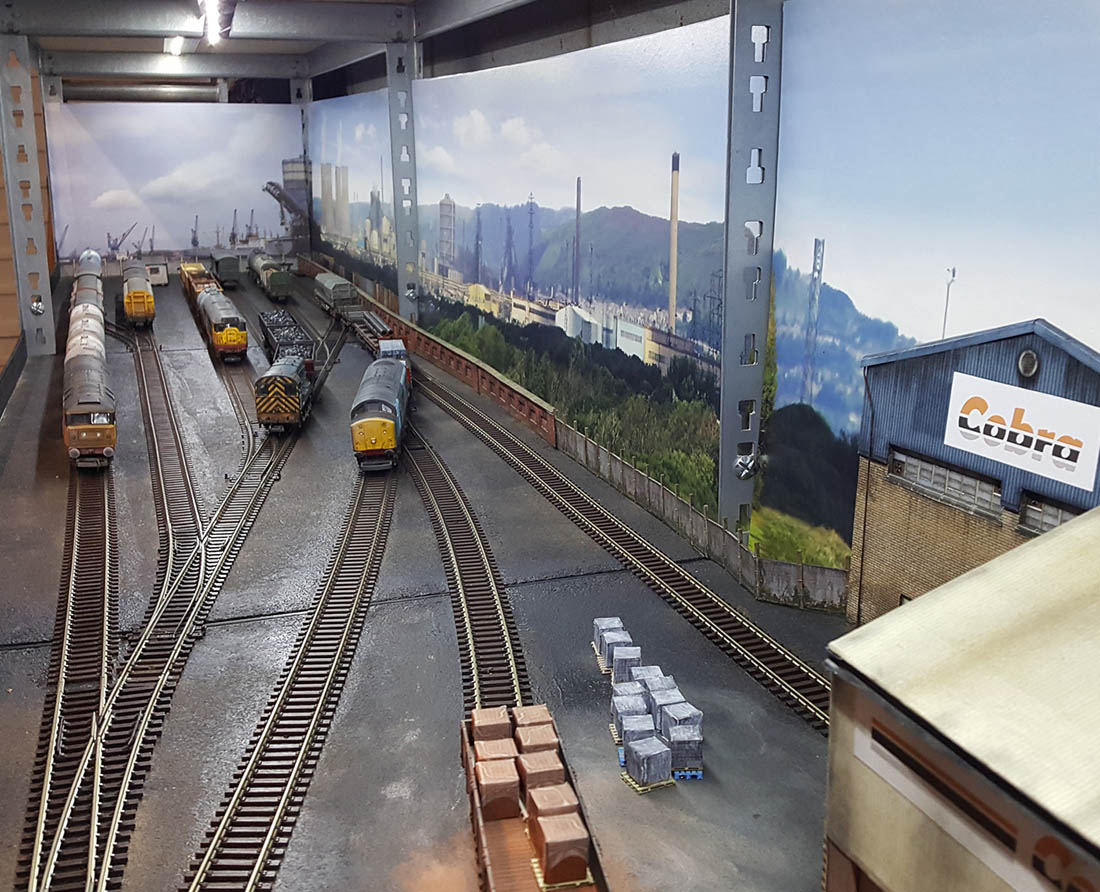
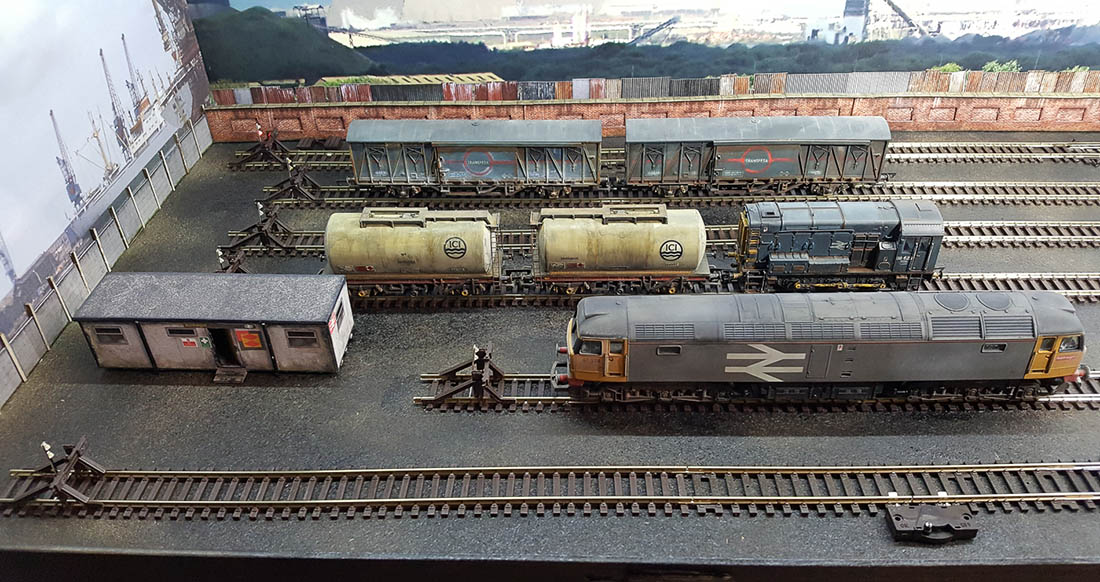
Then the penny dropped. I would create a very, very scaled down version of Tees Marshalling Yard at Middlesbrough!

The Speedlink trains would enter and leave as longish trains. These would be split and marshalled in the yard and small ‘trip’ trains would take and collect wagons from the various private sidings etc. (hidden from view), where I could load and unload commodities. This offered me plenty of different shunting puzzles – ideal.

Problem with ‘Lockdown’, the model railway shops were closed. But, I found that some online shops were open for business. I wanted the layout to work electrically and with as few joints as possible so settled on all Peco flexi streamline code 100 and kept the postman busy.

Having walked around many industrial railway settings, the track was never pristine ballast. I decided I would spray paint the baseboards (shelves) black and would not lay down any ballast. The black paint would give it the grimy conditions I wanted.

The track was glued down with dilute PVA glue and additionally pinned near the pointwork. There are just two electrical feeds and I can control two locos from my ageing late 1960’s H&M ‘Duette controller. I have included two loops, which allow for engines/wagons running around.

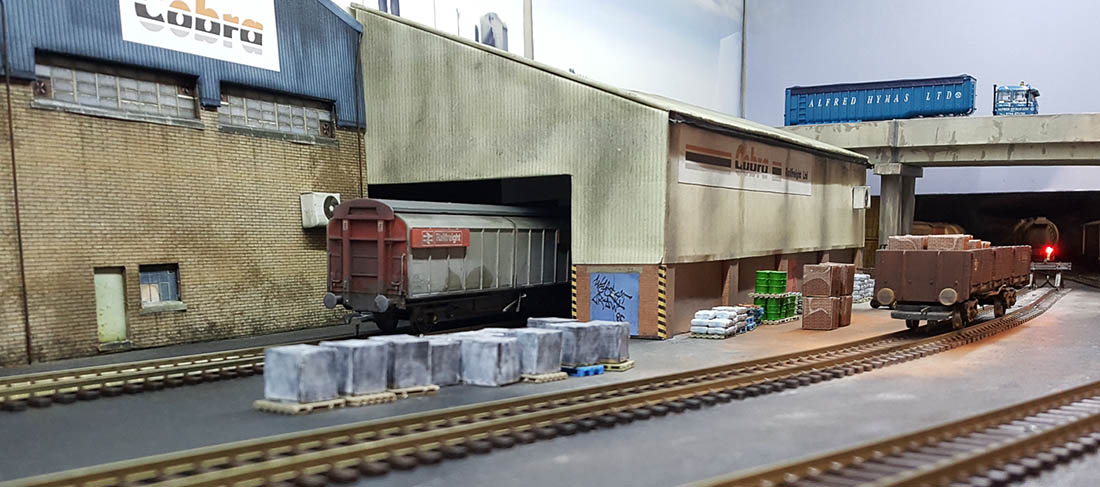
I was fortunate in seeing a Gaugemaster industrial backdrop that had the appearance of Teesside. One of my ‘better buys’ which work a treat are ‘Train Tech’ buffer stop lights. I have one fitted behind every buffer stop on the layout. They draw very little current. Although not authentic for my era, they let me know which track is live and where I am shunting to, particularly at night! – brilliant.

Being on a shelving system, where ‘garage items’ are stored, above and below, was going to make the layout dark. I found on the internet a string of low voltage LED strip lights with a rheostat, which I mounted under the shelf above. I can have the short trip workings operating to and from the yard in daylight and by turning the lights down, the long ‘Speedlink Services’ depart and arrive overnight, very authentic!

The hidden sidings (three) are built onto a box construction that sits on top of the adjacent work unit, I can quickly connect ‘when playing’!

These sidings are ‘hidden’ from the main layout by a modern road overbridge and a freelance through goods shed, giving access to more docks/sidings beyond. The only other building on the layout is a ‘Portakabin’ (mess room) at the opposite end of ‘the yard’.

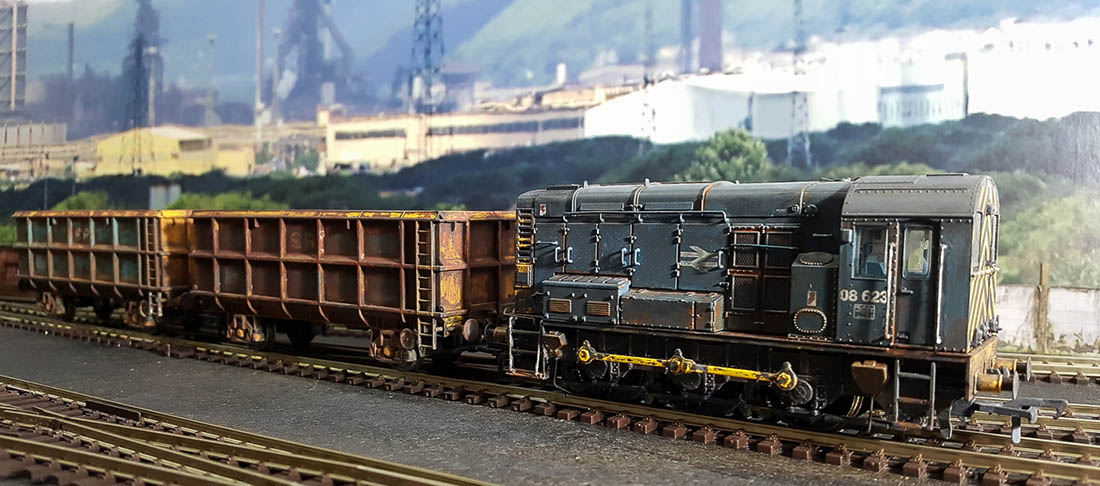
My mint condition wagons and locos (I bought a few extra) needed an upgrade to what a working railway should look like. I set about ’destroying’ the out of the box immaculate look, by weathering them all, to something resembling Teesside in the 1980’s! Something I really enjoyed doing.

I even varied the weathering on each side of the wagons/locos to double the size of the fleet, as viewing is from one side only! Of course, it could be any fictitious place and I can run almost any freight wagons and locos I want – joy?

So now, thanks to ‘lockdown’ and after thirty years, I can now enjoy amusing myself looking back in miniature, to an era of wagon load freight.

Brian”


Absolutley loved Brian’s weathering.

That’s all this time peeps

Please do keep ’em coming. Just hit reply to any of my mails if you’d like to share anything.

And if today is the day you make that start on your layout, the Beginner’s Guide is here.

Best

Al

PS Latest ebay cheat sheet is here.


Dave’s new layout

“Hi Al ….I have been working on the layout again, here’s how I got in to Model Railways and when I started…here goes:

I retired back at 63 years of age, and after moving to the East Coast to a bungalow.

I decided to floor the loft out. After doing this and having a couple of accidents whilst doing it, I fell through the ceiling – legs just hanging down in to the hallway below, broke 3 ribs ..

So again a 5 month rest for the ribs to heal, then on putting the last floorboard down I drilled through a water pipe, thinking I had fixed it the water was turned back on, and as all looked fine, I left it and went out for maybe 1 hour, came back the pipe had disconnected and we had a flood, of course the whole ceiling had to be renewed.

So from there I got a reputation, known as Dangerous Dave…

Anyhow when all was done , I thought what can I do with this space now, and after visiting a model railway show at Wakefield ..I thought I would like to have a go at that. This would be about the beginning of 2007

So my first railway was built in the loft… (I have made a video which shows this )

Of course I sort of got carried away and soon had a layout that stretched for near 30 ft long and 8ft wide, and as you will have seen it has been changed a few times.

And of course, as you can see in the video ..its all change again ..complete new layout ..

Regards

Dave”

Latest ebay cheat sheet? It’s here!

Can’t wait to see Dave’s progress. I have no idea why, but it’s all the ‘behind the scenes’ stuff I like best.

Please do keep ’em coming.

Best

Al