More model railway scenery tips

” Al,

For scenery, I use Plaster Of Paris and water based paint, available at any art shop or hardware.

If combining two or more colours, mix small amounts of each until colour is good, keeping notes on quantities.

Make it a little darker than required. Take a small amount of Paris and start adding water to about the consistancy of milk.

Again, take notes on quantities.

Add the colour slowly so that the mix is darker than required, to the consistancy of toothpaste.

You can always add more black etc to darken it. Apply the mix to a test strip and practice makes perfect.

Don’t mix too much at any one time, the Paris will lighten the colour and the paint will stiffen the mixture, causing it to dry more quickly than normal. It can also be painted over when dry.

Steve”


“Hi Al,

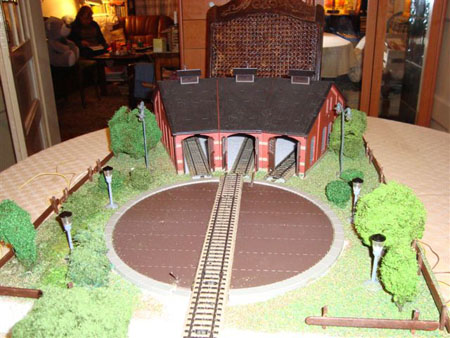
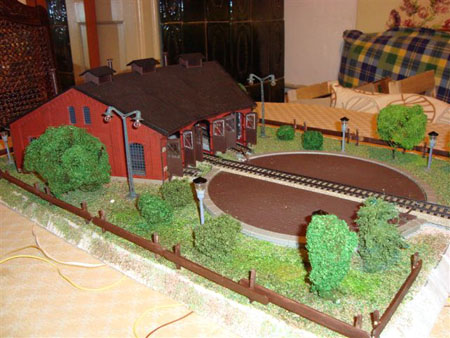
Here are 3 photos for you.

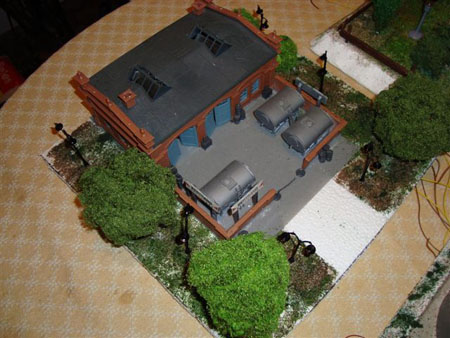
1 Flying Scotsman at my mpd.

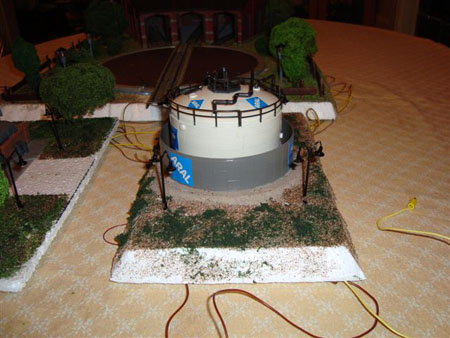
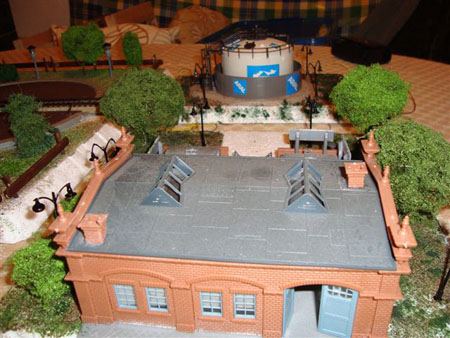
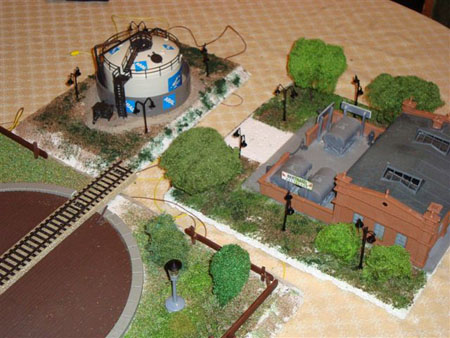
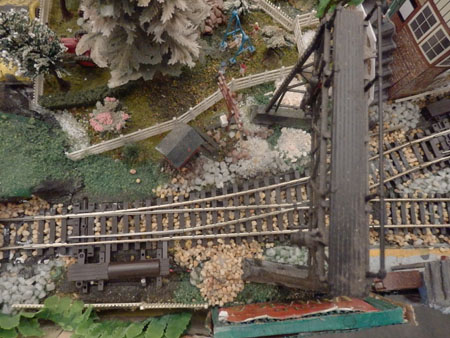
2 Atlas water tower with weeds growing around it.

3 TR 67 on display at my model Park.

Tr 67 was built by Hudswell Clarke for the New Zealand Public works Department. later taken in to NZR stock.

Written off 1960.

Paul Otway”


“Alistair – making waves.

Dennis wrote:

“The only problem is that the liquid last for some time and it takes time to gather enough to make some more.”

That’s why we have relatives, and neighbors.

Another alternative (for loners like myself), is to buy as many as needed, and transfer contents into larger containers… like 2 litre soda, or orange juice bottles or gallon milk jugs. No need to wait till it’s used up…

Here is another tip for making “waves” at the seashore…

Clear silicone sealer. Comes in a caulking gun style tube.

Lay down a heavy bead, then with the edge of an old/expired credit card, start to press it into the surface going away from the direction of wave travel. This smoothes the “back” of the wave.

Do the same to the front of the wave. When that is done for the entire length of the wave.

Start at the base of the front of the wave Dig the card in, and pull it up and in the direction of wave, let cure, then paint.

Here’s a diagram…


And here’s the latest from the talented Dave:


“The Tornado from Bachmann Al , i am well impressed with the markings , but not the bet of runners

Regards

Dave”

Latest ebay cheat sheet is here!


That’s all for today folks.

Please do keep ’em coming.

And don’t forget the Beginner’s Guide, if today is the day you start your railroad adventure.

Best

Al

PS Latest ebay cheat sheet is here.


Model railway trackside scenery

Stuart’s been back in touch – have a look at his model railway trackside scenery – impressive stuff:

“Hi Alistair,

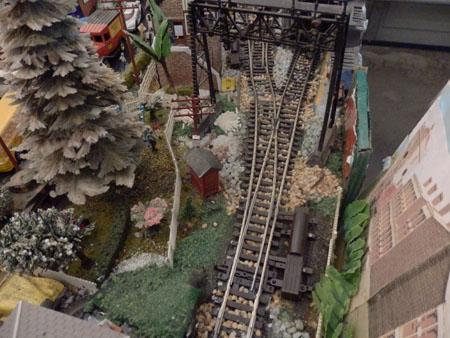
New photos of my layout to date, still a very long way to go but thought I’d share them with you.

The gauge is 00 and the front of the mountain at the back actually comes away to get into the tunnel should I need to.

Cheers
Stuart”

OO scale trestle bridge

model train village

Model railway trackside scenery

Model railway trackside scenery

Model railway trackside scenery

Model railway trackside scenery

Model railway trackside scenery


model train steam freight

model train town

oo scale tunnel

Model railway trackside scenery

model train layout

Stunning pics, Stuart – a big thank you for sharing your model railway trackside scenery.

You can see Stuart’s first installment here.

Also, when it comes to trackside scenery, I always think of Kaustav’s post: weathered train tracks.

Now on to Len:

“Alistair,

I have had so much pleasure from your e.mails that I think it is time for me to contribute a couple of cash and time saving ideas I have come up with.

1. Coloured hexagonal drawing pins from office stores make wonderful cafe, etc., tables.

2. Foil cups from my Xmas mince pies make lovely corrugated roofing when carefully cut. (Right slope too)

3. 4mm rivets cut off approximately quarter inch below rivet and stuck down are perfect for bollards or, with thin black wire soldered between, make lovely seaside, river, or road railings

4. 3″ flat sided cable trunking makes an excellent test bed for gradients, allowing you to figure out exactly where and how high the track supports need to be and, in fact, if suitably camouflaged make quick and easy culverts, bridge supports, or for any other part of your permanent way. (Straight sections only).

5. Paper cocktail umbrellas make great roofs for circular shaped buildings or gasometers etc.( I made a Chinese Restaurant), and can be treated and made to look like corrugated roofing if needed.

6. Why not make your own benches and chairs out of matchsticks (5000 for a fiver at my model shop), and I find cheap lollipop sticks from a craft shop are perfect for making your own buildings etc.. ( Windows courtesy of modern day celluloid packaging ).

7. I had an empty container from a pack of 100 DVDs and decided to cut it in half lengthwise then remove the bottom arc of plastic. Result ? A perfect tunnel shape (double track), which fitted exactly onto a pair of bought tunnel entrances. The beauty is that they could be used on their own as moulds around which plaster bandage could be formed, allowed to dry, and the mould removed to be used again and again.

8. Although extruded polystyrene is definitely the best for sculpting scenery I have found the perfect use for the normal `pellet` type polystyrene. If you make the lengths and shape you require then break off the `face` and paint it a suitable grey followed by a weak black wash, then rub off the excess, hey presto!, it looks for all the world like cobbled walls.

I hope these will be of use to other modellers.

Best wishes to all.

Len.”

A big thanks to Len and Stuart.

That’s all this time folks.

Please do keep ’em coming.

And don’t forget the Beginner’s Guide if you want to get off the side lines and join in the fun.

Best

Al

PS More HO scale train layouts here if that’s your thing.


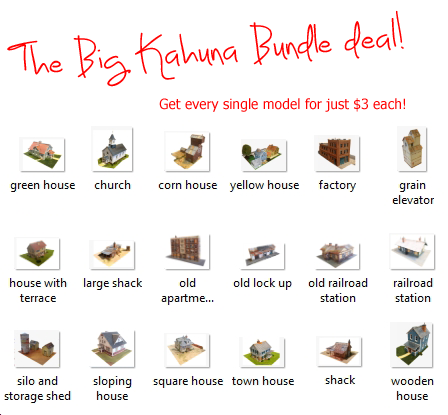
Need buildings for your layout? Have a look at the Silly Discount bundle.

Even more model railroad scenery tips…

“Something I have done that did not turn out so cheap ( because of the size of that layout) was using insulation spray foam to mold and shape mountains etc.

I then covered it with plaster cloth (using a spray water bottle).

Poking with sticks and fingers to take to the shape of the spray foam was an amazing realistic look and time saver, however next time I will semi preform the mountains with chicken wire to save costs.

Dave”


“I like using black drywall sandpaper for roofing. It looks good and easier to cut than plastic roof slate.

Michael”


“I would like to add to Dave’s comments:

1) Start small & simple. Plan your work and work your plan. Just because you have 100 sq feet does not mean you have to fill it ALL immediately. It is easy to get overwhelmed by too large a project.

2) Break your schedule down into smaller “achievable” projects. The sense of accomplishment on each project will encourage you to move on. You can always expand your layout as time & resources permit.

3) Get at least 1 locomotive & some rolling stock operational. It serves as to break to just to watch something moving (see #5).

4) If in doubt: a) seek help; b) experiment –> be patient, not everything works every time, even on a real railroad!!

5) Most important: RELAX!! HAVE FUN!! ENJOY IT!! Model railroading is a hobby – not your life’s work.

Cheers

Peter”


“Don’t know how much help this is… but

1) Don’t be afraid to make mistakes

2) Don’t be afraid to change scales!

I went from ”N” gauge to a 1:20.3 garden Rail Road. THAT has been a lot of pleasure! I can finally see what I’m working on.

I still have the small loop of track outside, but it’s not much fun freezing my “Jingle Bells” off in the winter but great fun for my grandson and I when the weather is nice.

Having been bitten by the “Narrow Gauge” Bug AND the “Geared Locomotive” I am now working in On30… and plan on following my own suggestions.

Been thinking about a Shelf Layout, but don’t know if that will satisfy me… now that the kids are out of the house I just might take-over their bedrooms. LOL

Don’t know if this helps…. But it has been my experience as time went by. When I started in “N” Gauge there was no way I could have afforded a Bachmann 2-Truck Shay for an outdoor layout.

Sometimes… our wants and capabilities change over time… as long as we STAY in the best hobby in the world… no worries.

Thank you!
Jeff ”


“I have used plastic straws for lamp posts, and I used them to put the wires through the track base for street or any other lights for the houses, etc. We use rynolite instead of plaster mould for scenery, i.e. mountains.

Kind regards,

Noel ”


“Alastair after getting your email some time ago on tips sent in by Roger on Model train flat bed loads I decided to give it a go.

I have included a couple of photos on my finished product on which I think have turned out rather well.

The only problem is that the liquid last for some time and it takes time to gather enough to make some more.

Hope you like the photos and look forward to receiving more of your email tips.

Kind regards

Dennis”


The flat bed ‘how to’ was sent in by Roger, and it’s here. It’s also reminded me, I have another of Roger’s which I haven’t published yet.

Latest ebay cheat sheet is here. Have a peek!

Best

Al