Model skills aren’t just for railroads!

“Hi Alastair,

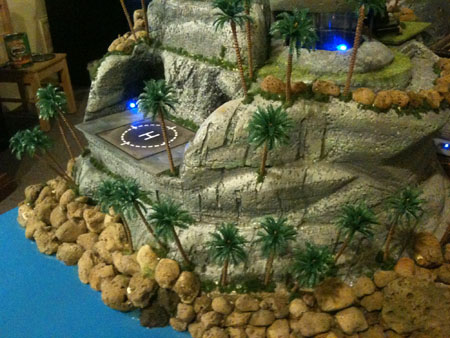
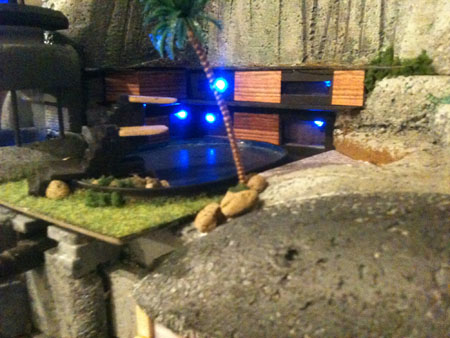
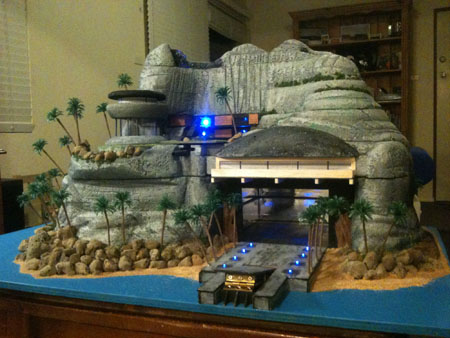
I made this model for my sons last year. It is my interpretation of Tracey Island from the Thunderbirds which I made from about $90 of materials, and 3 months of my time.

I included LEDs and a rechargeable battery pack, which lasts 9 days of charge, and cost less than $15.

Planning is the key, do concept drawings, details and elevations to plan it out.

Then do a mockup of all the foam bits to make sure they will all fit together before gluing.

I use polystyrene foam as the main building material. It’s light, cheap, strong compressive strength and you can use PVA glue and acrylic paints without dissolving it.

I also used balsa craft wood, yoghurt containers, perfume cardboard boxes, plastic bottles, steel cans, pumice stones, seaweed, timber hardwood and acetate film for the “glass” on buildings.

I hope this helps.

I’m doing an 8’ x 6’ train model for them next with 3 loops, tunnels, bridges, elevated trestles, a boat harbour and a mountain peak.

Matthew”

“Something for people without a dedicated Railway Room. And as a change from recent articles on here, this is about Layout rather than scenery. My priorities are:

Get as much track as possible into the available space.

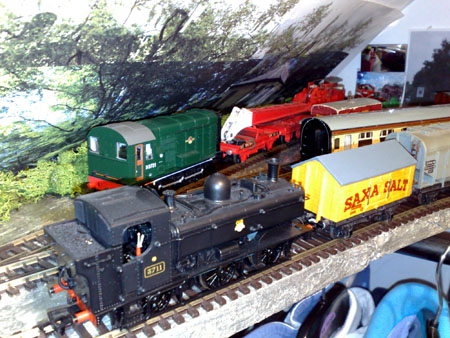
Re-use as much as possible; this means 50yr-old rolling stock from my Hornby 3-rail days, and old timber “that’ll come in useful sometime” except this actually did.

I’ve identified redundant space near eye-level in my 6ft x 2ft walk-in wardrobe: with sloping walls, which my head hits before my shoulders do, the space is unused.

I also realised the following:

From my train-spotting days at GWR’s Acton Goods Yard, I actually like shunting.
Small engines improve operability in a confined space.
With DCC, I could run multiple engines independently on the short lengths of track.
No circuit is required (or possible at 00-guage in 2ft wide!).

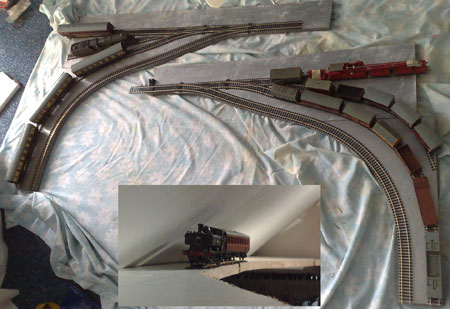
Hence the decision to build a 6-siding track, as below (this based on standard Hornby curves, flexi-track was used in practice):

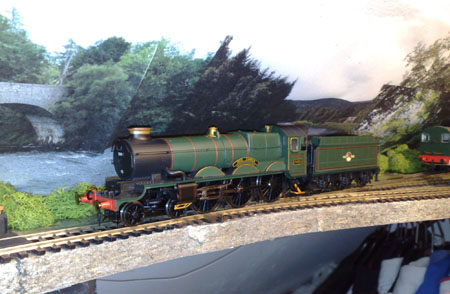
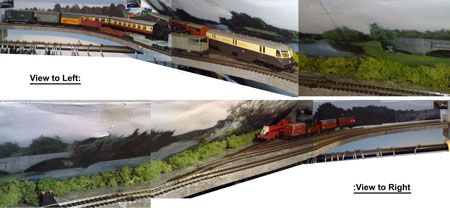
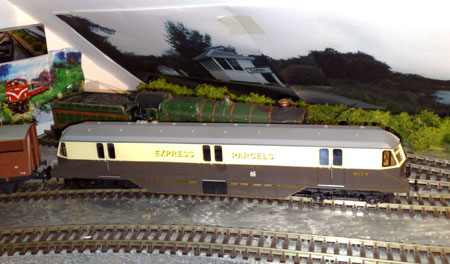
Further maximising my track in the limited available space, I added some “dummy” sidings (adjacent but unconnected, just by cutting flexi-track on an angle) on which I placed my old Bristol Castle and steel-wheeled trucks as “scenery”. The track had to be built in two halves to get it into the wardrobe; the pieces are as shown below. [Inset shows how the track has to run clear of the sloping wall.] Note that, for added immediacy, the track runs along the edge of the base-board where possible.
Having no space between tracks for signals, huts etc, my only scenic options were as backdrop. Inspired by the Acton Goods Yard of my childhood, I photo-shopped views from Google Street-View such that my sidings to the left represent the main-line from Paddington, and those to the right the Acton Goods Yard itself (now greatly reduced from its heyday).
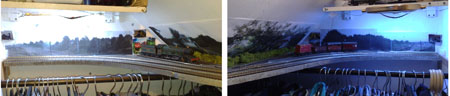
The finishing touch was to construct a backdrop panorama between the two siding sets: I decided to photo-shop from my holiday pictures, including the Tamdhu Station building on the old Speyside line, the Cambus o’ May Halt building on the North Deeside Railway, and shots of the Spey at Granton; these rendered surprisingly realistic by some rubber hedging material in the foreground.
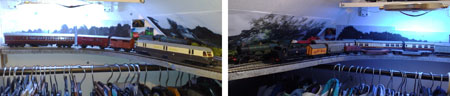
I couldn’t resist getting Ince Castle in as well, so now have four DCC locos installed. And yes: it is possible to run all the trains individually, although it takes careful planning; which all adds to the fun and realism. But being routinely confronted by one’s trains at eye-level at both ends of the day is something I can’t recommend highly enough!
Robert”


I know – and odd collection today. But what fun!

That’s all for today folks.

Please do keep ’em coming.

And if today is the day you get started on your layout, the Beginner’s Guide is here.

Best

Al

PS Latest ebay cheat sheet is here.

PPS More HO scale train layouts here if that’s your thing.


Road barriers and fences for your railroad layout

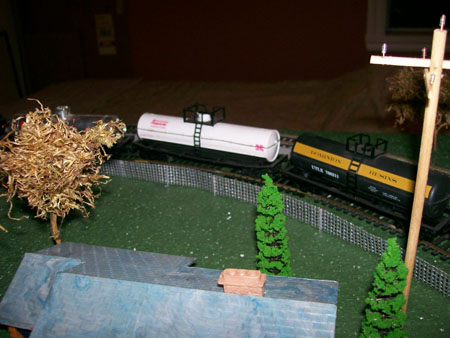
“Hi Al. Update on making metal looking fence’s.

1 nylon road crew flag. Cut up to make fence’s or can leave it to look like the construction orange fence ya see.

And already weathered. Paint with crafter’s acrylic water base paint. You can wash it off. Make sure you rub with small paint brush all the bubble’s out.

Take metal wire to make post’s and instant glue them on.

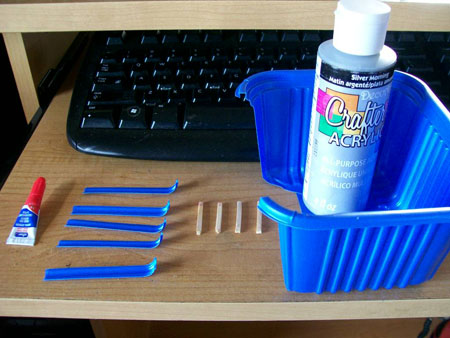
The road barrier is made from plastic food container’s.and glued with instant glue and painted crafter’s paint.and for the post’s i used wooden match sticks.

Kim”


“Hi Al,

I purchased a magnetic tray, which I can use for servicing my locos.

I can put the screws and other metal parts in it.

Result I don’t lose the screws and other metal fiddly parts.

Paul”


“Hi Al,

For realistic point operation, I insert insulated joiners about 18 inches leading into points on the switching tracks. If a train approaches the points, and the points are NOT set for thru, he train will stop at a realistic location before the points.

Its amazing how most of us use ‘junk’ and ‘REAL’ materials. Simple economics I guess !

Keep up the good work.

Steve”


“Hi there, I run 00 H0 and I’ve found that the empty 2 litre plastic milk bottles when cut down on the ‘bulk’ part and sprayed matt black on the inside and glued into place make ideal single tunnel entrances, and the 5 litre plastic liquid containers when cut down and sprayed do the same for double tracks. You can of course join several together if you wish for a longer run

Regards

Derek”


“I’ve found that old cotton sheeting or muslin dipped into a solution of polyfilla or similar is cheaper than mod roc, easy to mold and dries a lot quicker than papier mache. You will need to play about a bit with the polyfilla solution. Also, beware……..it can get a trifle messy.

Kind Regards

Larry”

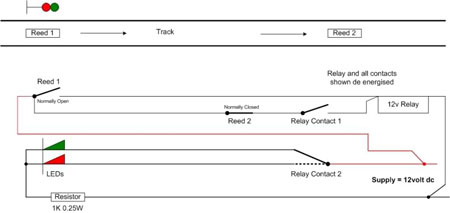
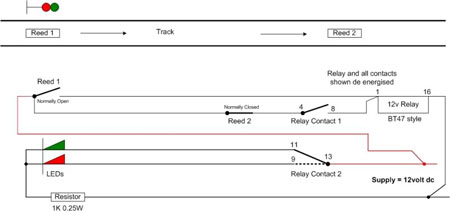
“Let’s try this again.This is a diagram for relay and reed switch’s for signal’s:

(Kim’s first post here)


“Alastair,

Attached, I hope, are two photographs I think you might enjoy.

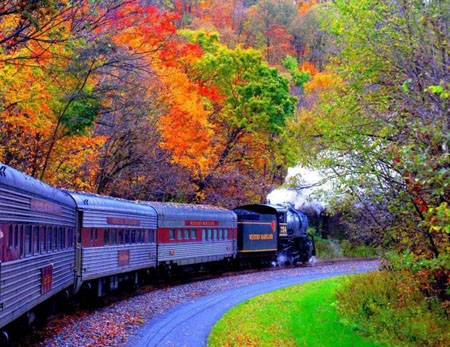
One is of a working railroad here in Western Maryland. My wife and I have taken this tour and we loved it. The foliage in autumn is beautiful.

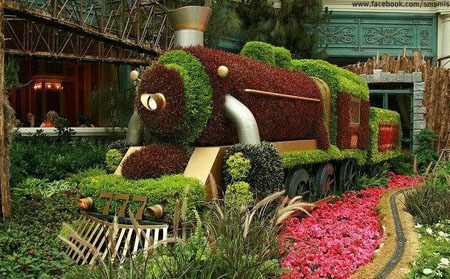
The other is a steam engine, #777 that you may have to keep watered all summer long.

Enjoy
Richard”

That’s all for today folks.

Please do keep ’em coming.

And if today is the day you get started on your layout, the Beginner’s Guide is here.

Best

Al

PS More HO scale train layouts here if that’s your thing.


More model railway tips and tricks

“Hi Alastair,

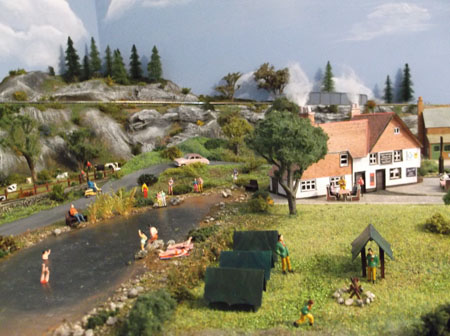
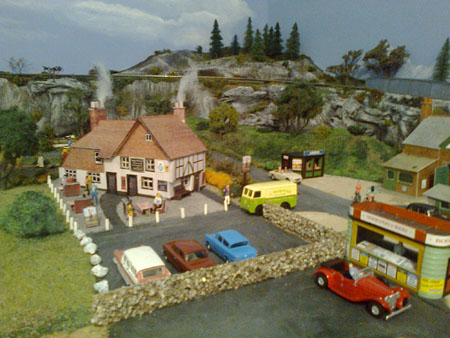
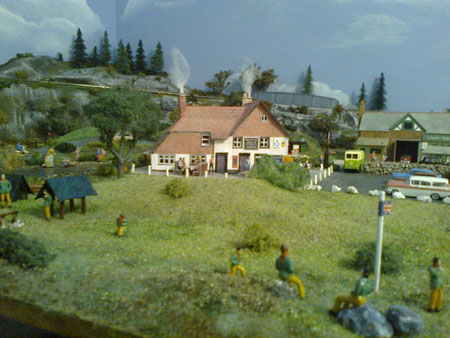
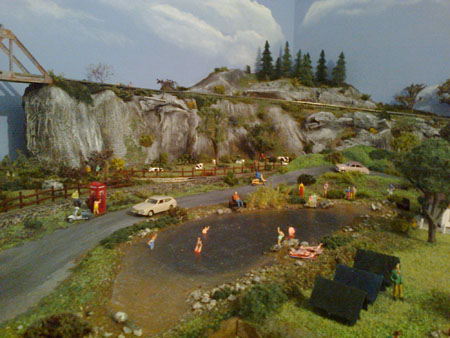
Latest part of my 00 guage model town with the water park and the town pub.

I am really enjoying doing this, I made the pond from model water.

The pub has turned out better than I had hoped. more to come at a later date.

The stone wall I made from a length of cardboard and covered in PVA glue I then sprinkled fine pebbledash which I sived through a cheese grater; came out great.

Keep up the good work sending all these tips and great ideas from everyone.

Cheers

Stuart P”

(See more of Stuart’s layout from an earlier post here).


“Instead of using ballast and track underlay I went ton a vinal shop and bought an offcut of brown spotted or flecky underlay that is used for laying vynal and cut it into strips for track underlay.It looks the real part. Track underlay out here in NZ is so dear.

Thanks Murray”


“Another tip for people doing benchworking is to have your plywood cut at the lumberyard before you bring it home. Most plywood comes in 4’by8′ sheets. This can be bulky to haul up to the attic or down to the basement. With a little forethought, you can have the lumberyard cut it into 2’by4′ pieces; or 4’by4′ pieces; or whatever specific measurements you need.

B”


“Hi Al.

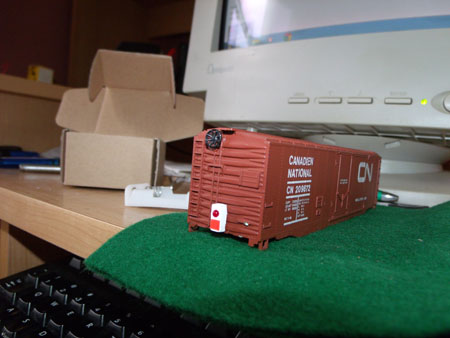
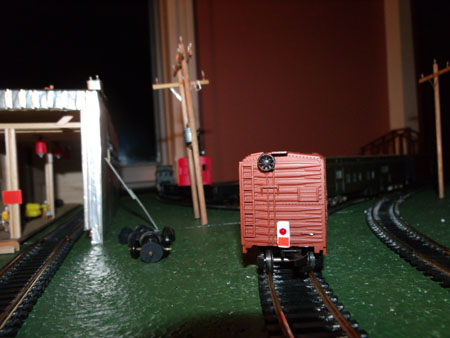
Not sure i sent you this yet.It’s my end train flashing warning light.Think they call it a fred.If ya dont want it on.Grasp it and unplug.or plug back in.

The two holes i made in the car are the same size as the leads going in.almost invisible from the outside.There is an old computer connector inside the the car that the unit plug’s into.Then that run’s to a temporary battery pack.

I plan on running power from the track later to run it.No wires should show.Really easy to make.Im going to shrink it smaller alittle and better material.Only a test.tell me what ya think”

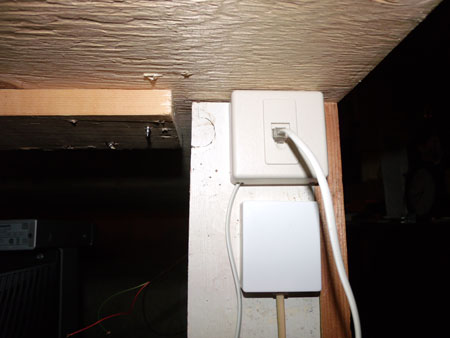
Been playing with these idea’s.Im useing phone boxes to distribute 12 volt and 6 volt power.You jack into the box like a phone.My street light’s are plugged into the phone box and if need replacement or repair just unplug from phone box.My signal’s are also plugged into the phone box.Any thing can be plugged into the boxes as long as you leave the connector on.Said this before when i sent you the how to wire signal’s.

Other is a test.My warning tail light at the end of the train.It flashes every second.And if you dont need it on there.You can pop it off.I made two so tiny holes in the back of it same size as the Led posts.And those post have a plug on the other side with a a battery pack inside the box car.It’s a test so far work’s great.I will steal power from the track later to run the 2mm flashing Led


There’s a lot of talent out there, isn’t there? Thanks for sharing everyone. Please keep them rolling in.

That’s all for today folks.

Please do keep ’em coming.

And if today is the day you get started on your layout, the Beginner’s Guide is here.

Best

Al