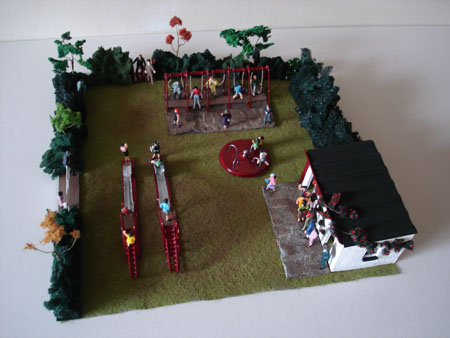
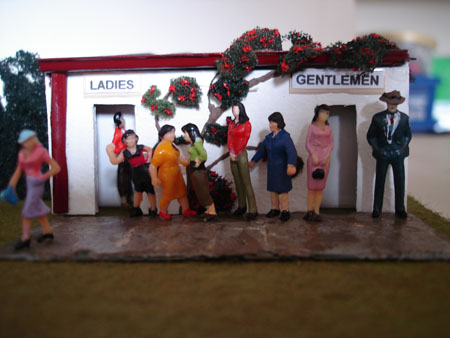
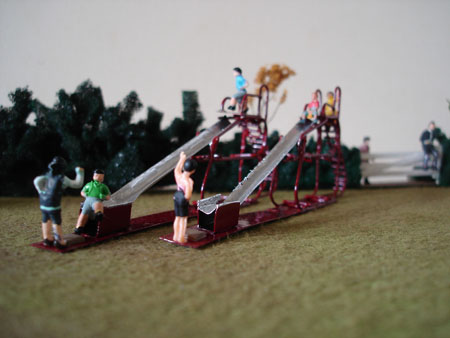
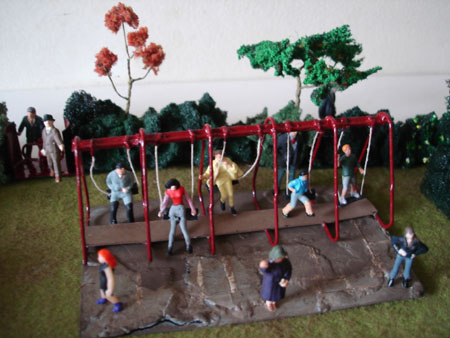
“I’ve been following your blog for a while now, and I am inspired by all of the tips and techniques. I am the science chair at a middle school, and I recently was awarded an educational grant from a coal company for my idea to build an HO scale model train layout. We built the entire 8’x4′ layout in my storage room. It took many class periods to complete. The majority was done by 13 year olds. I only offered my help with laying the track, electrical components, final details, and trouble shooting.
The CSX specific train dumps coal using the old Virginian TYCO hoppers that we will paint later and affix CSX decals. We cut square holes into the layout base for coal to pass through grates into a peanut butter jar, and we are currently in the process of using a coin machine motor to build a gravity loader for the next fair. With this lesson, I taught not only concepts of coal, but I focused on scale, electrical circuits, and topography. I wanted to introduce students to the hobby of model railroading that I recently became interested in myself. Anyway, we finished most of it up in time for the CEDAR coal fair, and took home 2nd place which gave me, the coordinator of the project, a $600 check! I was wondering if you’d be interested in seeing the pictures or video of the project to post? Granted, I nor my students are hobbyists. Our techniques are probably crude and rudimentary compared with others on the site. Thanks.
Garron”
“Alastair,
I have an idea on how to make realistic looking roof material and not cost an arm and a leg. A lot of model buildings have a tarpaper look to them but I prefer to use Kleenex for the true look. I know how hard it is to try to cut Kleenex’s with scissors but thanks to my wife she had the perfect solution. She does a lot of sewing and she gave me a round cut blade that has a round wheel (fabric cutter wheel) that is as sharp as any e-acto knife and when using a metal ruler for a straight cut you can slice Kleenex to any width you need. The next step would be to place it permanently to where you need it. I simply lay the individual strips where I need it and then use any brush with flat black paint needed to stick it to the roof or and other application
Lee”
Here’s Patrick’s take on Roger’s flat bed load ‘how to’.
Well, we’re all short on space, right? Well done to Paco – a great solution.
“Hi Alastair,
here is my promised layout suspended from the ceiling. Observe that everything is paper and cardboard structure, after all, I sleep under my train. One of my friends commented:
Paco, be sure is supported right, I don’t want to read in the papers ” Engineer squashed by his own train”
As describer before, the winch is in the closet. has a still cable of something like 250 lbs. strength, the nylon combination is also about 250 and the winch is 1000. The other factor is the anchored winch to a plywood structure bolted to the floor of the closet. By the way, this is my sixth design on this platform.
Next, I hope, is the highway with moving cars. If successful, I wish to find someone to associate with for production and sale.
After giving up the sailing in our little lake, am having a great time railroading. If you like, distribute this to anyone or any group you wish. I will love to receive comments.
Here’s the third of my FREELOADS – another one in the eye for those who would like to sell us wagon loads.
I guess you could make a log load by gathering a few twigs, strapping them together and dropping them on a wagon. But this, I think, is better. I’ve got an old wicker clothes basket which is falling to bits, shedding lengths of wicker and was ready for the bonfire. Then I thought a bit: –
– The width of the wicker looked to be correct OO scale for tree trunks.
– It was not perfectly straight, notched in places – just right.
– A cross section of it was the perfect colour for sawn timber and would not change over time.
– It was guaranteed not to rot for donkey’s years.
Usual pictures follow. I used a little handsaw to get a nice rough cut and glued the pieces together in a chunk after arranging them on the truck. Used a bit of sponge dipped in paint to colour the bark – more streaky and realistic. Often use chunks of sponge for painting (ex-washing up sponges – free – of course!). Particularly good for getting ancient brickwork effects using different colour browns and sooty black. I always attach loads to wagons with tiny pieces of Bluetack. Doesn’t mark and devalue the trucks, holds the load perfectly securely and you can change the loads whenever you feel like it.
All the best to you – and everyone.
Roger.”
“Great tips, everyone. Here is another tip that goes along with Peter’s idea of extra wires for layout expansion. Go to a local electronic surplus shop and buy a length of multicolored flat ribbon cable that is about one and a half to twice the length of your layout from one end to the opposite end, with the most amount of wires wide. (I think the most is about forty wires wide). I know that this may sound like a lot of wires but you will see why.
With double faced tape, secure the ribbon cable to the underside center of the layout length with extra overhang at both ends. At each major connection point, you can take a section of about two or three inches, (5 to 7.5 cm), fold it over and secure in a loop with a tie-wrap, then separate the wires as needed for making your connections. After making your connections, be sure to either use heat shrink tubing or electrical take to cover the wire connections.
Since the wires are colored, you can make a wire list of what colored wires are connected to things on the layout. If you need thicker wires, you just use adjacent wires to handle the current load. With colored wires, it is easier to troubleshoot wiring problems. I generally use the black and brown wires (together), for common negative track wires, with red and orange wires (together), for common positive track wires. I use purple and blue wires as my accessory ground wires. The other colored wires are connected to the various lights, track turnout switches and other items on the layout. As for the wires that you don’t use right away or have extra, can be used for later additions or expansions.
Happy modelling.
Toni”
“Hi Alastair, One tip only – NEVER buy used track or points – it takes a long time to get them up to scratch and costs more in the long run – the best and cheapest points and tracks are Peco from Rails of Sheffield.
Michael”
“My best model train tip: I model very realistic looking running lights for steam era locomotives, tenders and passenger cars using ball-head type straight pins. These are the type of straight pins typically used in men’s new shirts (but they also can be purchased at craft stores). The ball heads vary in size from approx. 1-mm to 2-mm in diameter, and they come in several colors including silver, white and black.
I add nearly perfectly round spots of bright green, bright red and white paints as appropriate (for right, left and marker) using round toothpicks with the points cut off to just the right diameter.
The really nice thing about using straight pins is that the shafts are steel, very rigid and strong and can be cut to length with wire cutters and inserted into the chosen locations in very small pre-drilled holes made with a Dremel, and secured with cyanoacrylate.
This little detail, often overlooked by modelers, makes a very big difference in adding realism.
Cheers!
Robert in Oregon”
“Hi Alastair…
I really appreciate your hints, especially because I am changing from HO to N gauge and creating a new layout. I am taking your hints to heart before I begin.
I would like to share a hint of my own. I found a great item to use as ballast for N gauge scale–finch and canary gravel. It is basically off-white in color, but has darker pieces in it. Being larger than sand yet smaller than regular gravel, it is the perfect size for such a small scale.
Anne”
“Nail polish remover is good at removing acrylic paints or when weathering rolling stock. Dip a cotton bud in a little remover fluid and rub the area to be worked on – experiment first time – the cottonbud sticks are useful for building projects or as pipes / loads etc when the dirty cotton is teased off.
Duncan”
“Four tips from the kitchen:
1) Remember to ask your spouse not to throw away the empty plastic spice containers. You can save them for loading scenic material in them. Just apply a new large label, (with material name and description), over the original label and use for shaking scenic material over smaller areas.
2) If you use the store bought microwaveable TV dinners once in awhile. Save the trays. The three sectional trays are good for holding materials when you are scratch building projects.
3) Check out second hand and thrifts stores for low cost muffin pans. They are good for holding small nuts, bolts, screws and other small components and parts while building projects or electrical circuits.
4) If you have a quart size cardboard milk container, you can use it as a large area spreader or as an open funnel. Just cut off the top part, then cut the container down one corner then the opposite corner. What you end up with is basically a ‘v’ shaped half container that you can use for spreading scenic dirt or grass material cover over a large area with a measure of control. With a pint sized containers, just cut off the bottom and use it as a funnel when you fill other larger containers.
5) In need of thin stiff cardboard for some of your buildings or signs? You could use the cardboard from some of the food containers that you buy at the market. (Like mashed potato mix or pancake/cake mixes.) Just open the containers and lay flat. Spray a thin layer of adhesive on the unlabeled side of the cardboard and apply the printed building material flat on the adhesive. Lay a lager piece of paper on top and press down firmly on all areas of the cardboard. When dried, cut out the printed shapes and assemble as required. You could spray paint the label side of the box with either white or a dark color paint before you cut and assemble the structure.
6) If the box you use from tip #5 has a clear cellophane window, you can use that cellophane material as window pane for your structures. Just glue it inside the window areas before you assemble the model structure.
Other ‘how-to’ tips:
For making coal loads; get a piece of corrugated cardboard and cut to fit the inside of your gondola car. Take a charcoal bricket and crush it into small pieces and powder. Take the cut cardboard and place it on a flat surface and apply a layer of white glue on one side and then pour the crushed charcoal on it. When dried, take the cardboard and tap it on its side to knock off lose material. and then apply another layer of white glue and again pour crushed charcoal on top of the first layer and let dry. You can repeat as you feel needed. But on the last layer you want to spray it with a coat of either varnish or plastic spray to give it a gloss sheen as coal has.
Has any one thought of using aquarium sand as a ballast around tracks?
Ton”
Hope you liked them. Please do keep them coming (lots more in the Beginner’s Guide)!