Here are the photos for INTERIORS. The photo numbers continue on from the last batch on my previous mail (12-17).
I use high quality on my camera which means I can send a limited amount attached to a mail.
Best,
Rodge.”
“G-Day, from Australia, Alastair I have used latex and covered a section of a natural rock wall, out crop, and then splattered a thick plaster mix inside the mold with some great effects.”
Dominic
“Most people use oil based paints to paint buildings, engines and rolling stock. I use a water base paint, it makes it so much easier to weather which ever piece I am working on and once I am happy with the way it looks I then spay a flat clear coat over the piece. It make it look old and weathered, it is so easy to maintain. Besides the clean up is so simple. Thanks,
Rick”
“Take dry wall compound and dilute with water to a thick batter consistently. Then dip paper towel sheets in it to coat. Lay over foam or crumpled up newspaper
and shape with fingers. Works the same as plaster cloth and much cheaper.”
Droa
“Love this thanks !!! I have been a modeler for many years and i try not to spend money on stuff i feel we can make . I’m in the auto restoration business and use body filler to make so much stuff with foam , by making forms out of foam then cover with body filler then before its dry i place latex brick or cobble stones mold place it on the filler let dry .Once its dry pull form from the filler and u have bricks or streets would like to show you with some pics . I a’m currently doing Amsterdam with its canals and central station on of the most beautiful cities i have seen in my travels . thanks for your time.
Ken”
“The feathery seeds from pampas grass makes good clumps of bush grass for OO/HO or elephant grass for N gge. Clumps makes good bamboo. Paint with simple school poster paints, or dye in a poster paint/ water 30/70 solution. Sue hairspray if you want a fixative.
Dried tea leaves and coffee grounds make good scatter material. Sift them with a sieve for different grades. Dye them with poster paints.
Duncan”
“Hi Al,
Keep em coming. I like some of these idea’s.
Another sugestion for Wire Netting is strips cut from Net Curtains that can then be sprayed with “Mount Spray” or Hair Lacquer to provide the rigidity.
Regards
Jon”
“I have something I can share with you. I am sure someone has already done it. It came to me as I was sitting with my wife a few months ago. I was planning my “Drive in Theater” layout for my HO’s trains. I was thinking about making the speakers for the cars. She was taking bobby pins out of her hair, I picked up one and said it’s the right size and it was as simple as this. I took one and cut it in half to make two even pieces then bent the head pieces on an angle away from each other, painted them aluminum. So with one drop of super glue at the bottom with a bead making the cement bottom of the post- painting the lower part flat white. I went to the dollar store and picked up 2 packages that had about 100 in each pack and a small pack of beads that fit perfect. It has done more than complete the area for 140 cars facing the screen. With all the materials at your side it takes about one min. to make one and cost little to nothing for a great result. Using a 1/87 or 1/64 scale car this resembles an incredible memory and furthers the conversation for the layout. It worked for me.
Bill”
“If you want to model craggy weathered granite on cliffs or outcrops I have found chuncks of pine bark, I get mine from pine bark mulch, set in plaster gives a very realistic look even close up. If you want sandstone then a few passes with awire brush and a spray with an airbush of whatever colour you prefer also looks pretty good.
Robin”
Some good tips here. Hope enjoyed them.
I keep getting mails that the ‘ebay cheat sheet‘ doesn’t work with the Chrome browser. I’ll try and fix that. For everyone else, thanks for all the comments on it. Hope it’s saved you a few dollars.
This is in response to Dave M’s query associated with my last post – CLIMBING PLANTS. Thanks for the kind comment, Dave – and thanks to everyone who wrote in.
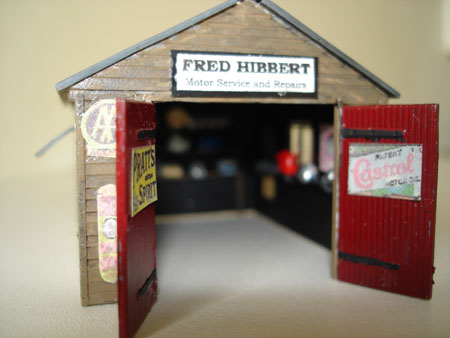
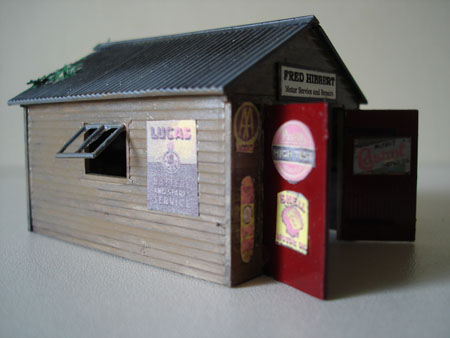
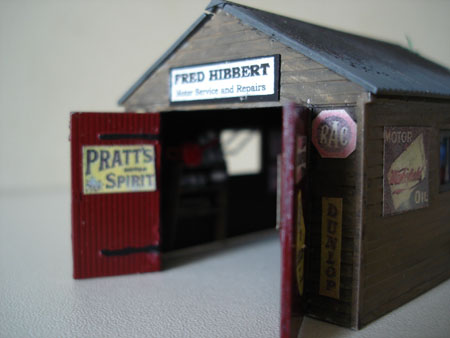
He asked about the signs on my little garage – and the interior detail. Those who have seem my previous posts have probably noticed that I like to spend virtually nothing on modelling so that I can bankrupt myself buying locos and rolling stock. What follows is cost free.
SIGNS
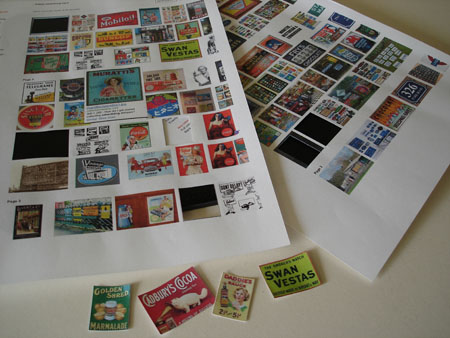
There are some out there who would like to sell us these. Yet all we have to do is search the web for them. Try googling the following: –
ENAMEL SIGNS and/or
VINTAGE ADVERTISING SIGNS
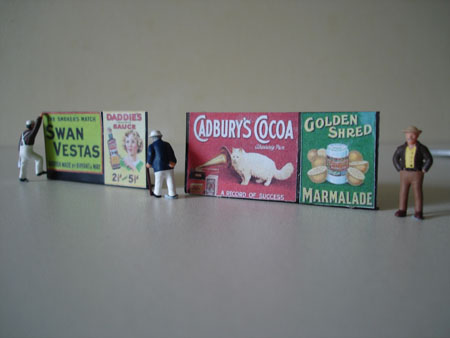
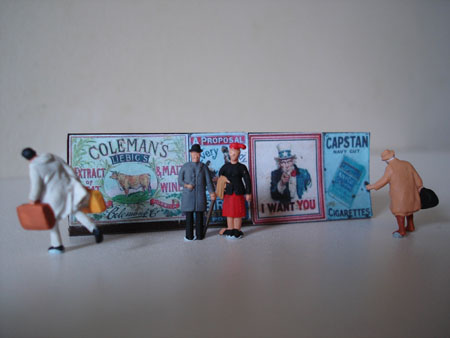
On the left of the screen, click IMAGES. Pages of little reproductions will appear.
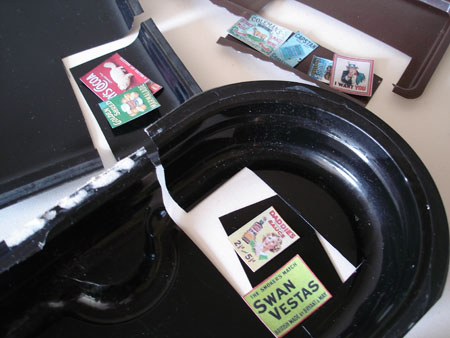
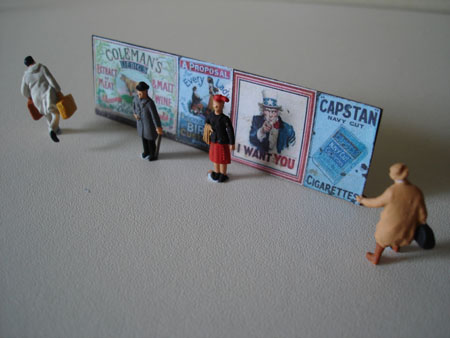
Print off a page or two. Put them on the scanner and shrink or enlarge – depending on your scale and intended use. In OO/HO reduce by 50-75% according to taste – for display on buildings, that is.
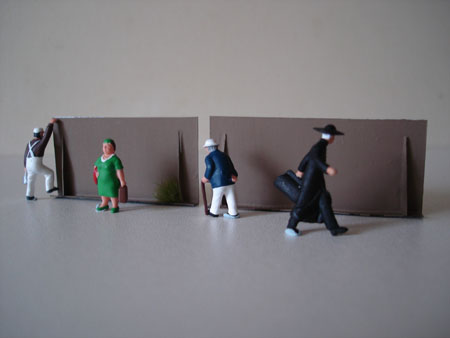
For advertising hoardings (and there are those who would sell us these too) increase size a little on the scanner and cut them out. Make the hoardings from pieces of plastic food packaging (see photo). This material will bend, crease and hold the fold. So you can bend to form a base. I stuck the posters on them with ordinary UHU general purpose glue.
After something specific? Google it and bring up IMAGES.
You’ll notice when you glue that (depending on the paper you print with and the type of glue) they fade a little. Fantastic. In fact I like to distress mine further by wiping over a little dilute matt black with a bit of sponge.
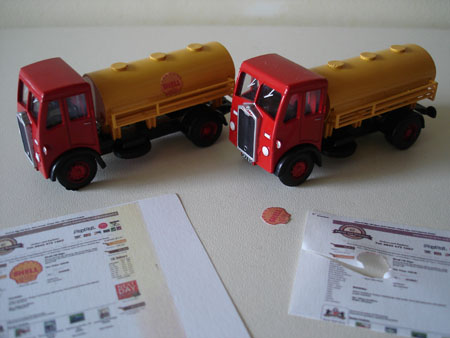
The Shell Tankers (see photo) were bought for a few pounds each – new. I think they were cheap because, though red and yellow, they were not signed. The Shell emblem was found on a site called SWEET AND NOSTALGIC! There are plenty of trucks and vans available in OO unsigned – pretty cheaply – so you can personalise them with a little internet investigation.
INTERIORS
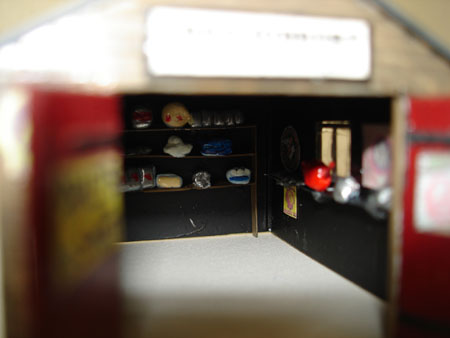
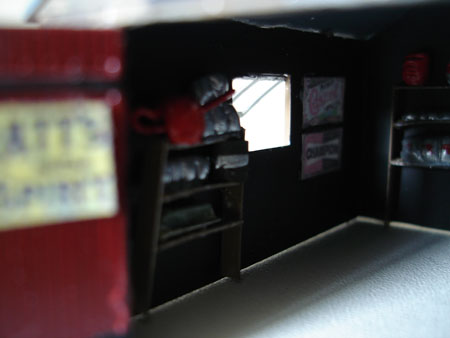
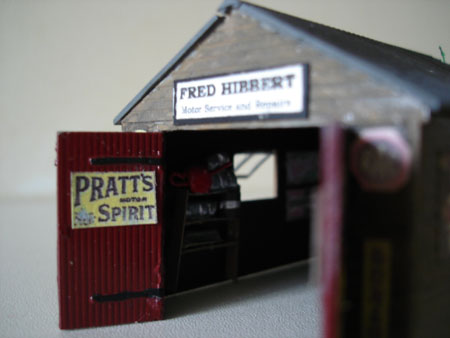
I guess these are important when you have large open doors on a building – garages, petrol stations, fire stations, bus stations and factory doors. I reckon these look more interesting with the doors open. This is my approach.
– Paint the interior matt black. Viewed from a standard distance – or even close up – this will make the contents stand out.
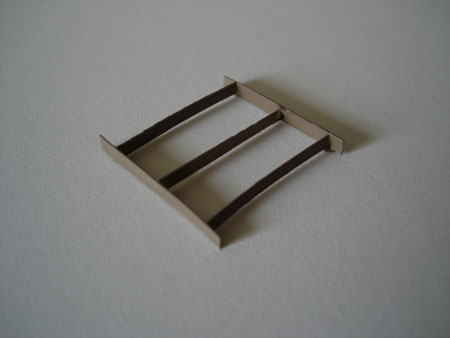
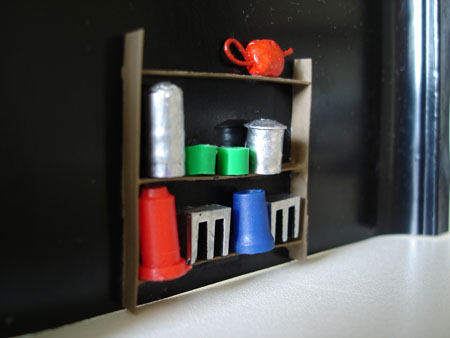
– Make up shelf units with strips of our old friend – food packaging (see photo). Glue with superglue. Add tiny objects to the shelves. These can be modelled in plasticine and dipped in glue to harden. Or little chips of plastic – tiny offcuts do equally well (see photo).
– Never chuck away used ballpoints. Take them to bits and keep the pieces. I used some in the demo-photo. The interior ink tube is perfect for lots of things – loads, piping – also the metal writing section – and particularly the plug to the outer tube.
– The shelf items are very small and will be inside the building so vague shapes will suffice. Paint in suitable colours to represent stacks of cans, oil containers, batteries, exhausts – whatever is suitable. Invest in tinlets of silver and gold paint. You’ll get good use out of them for this and for all sorts of things in the future.
– Attach to an interior wall. Easier to do this before you assemble the walls of the kit.
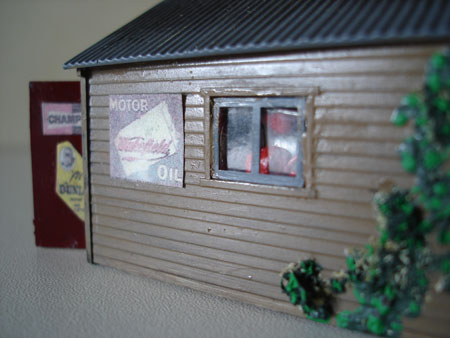
– Add some signs and posters. Mounted inside, detail will not be seen – so content is relatively unimportant unless they’re hung near the door.
– The use of mini-cams, mounted on trucks, travelling the line make work on interiors well worth while. Folks will marvel at your attention to detail – when in fact you have spent very little time and not a penny on it!
– If you light your buildings this could look amazing – all the detail picked out. Shadows too.
– The oil can is simply a tiny blob of plasticine – little piece of wire pushed through – curled for the handle – smeared in glue to harden – painted red.
Hope this is of interest, Dave.
Best wishes and Happy Jubilations to all.
Roger.”
Just brilliant! Thanks Roger. Any questions? Leave one at the bottom of the page.