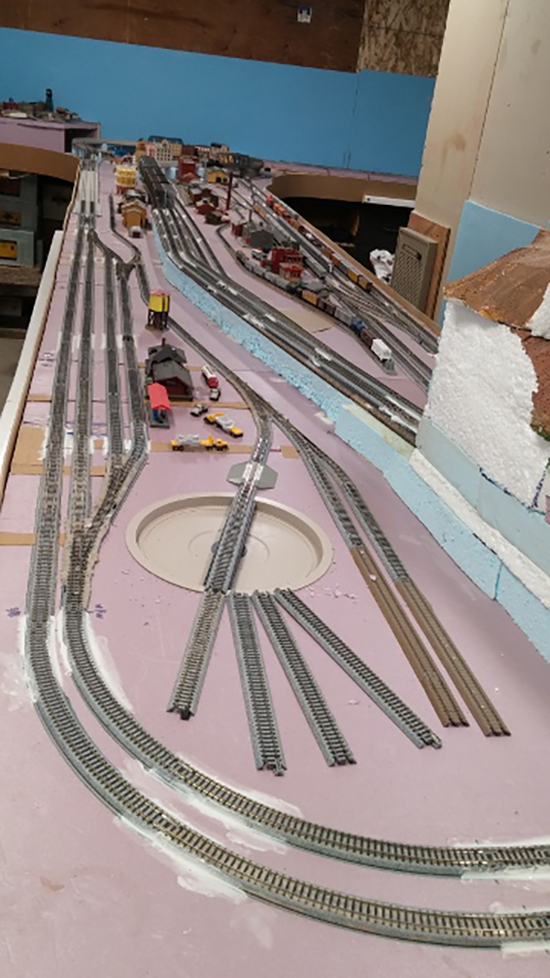
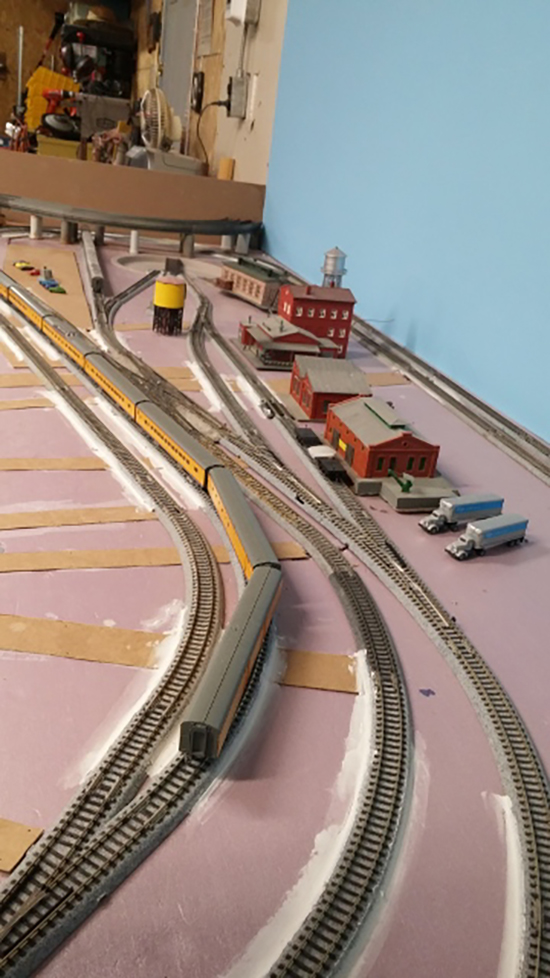
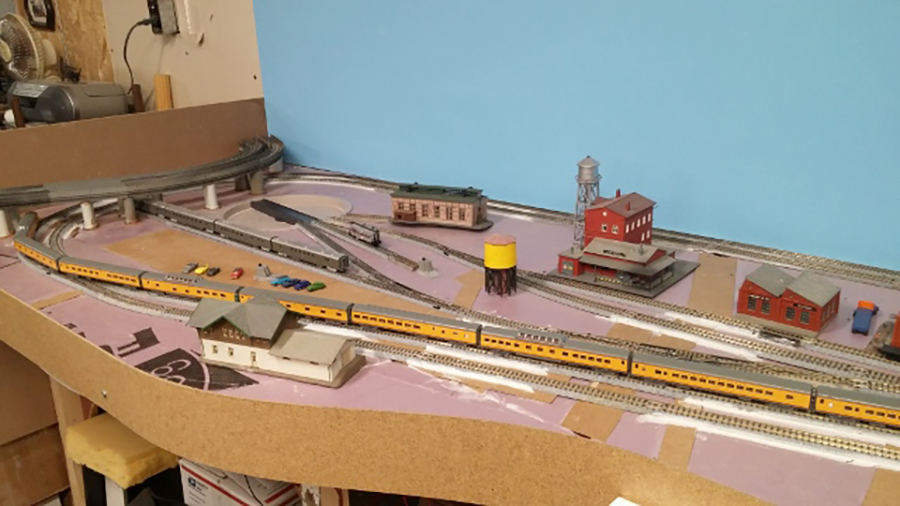
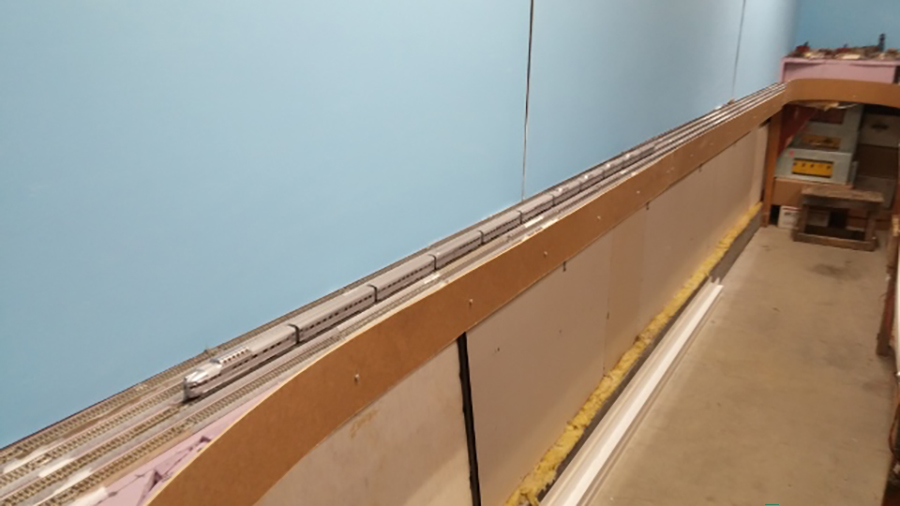
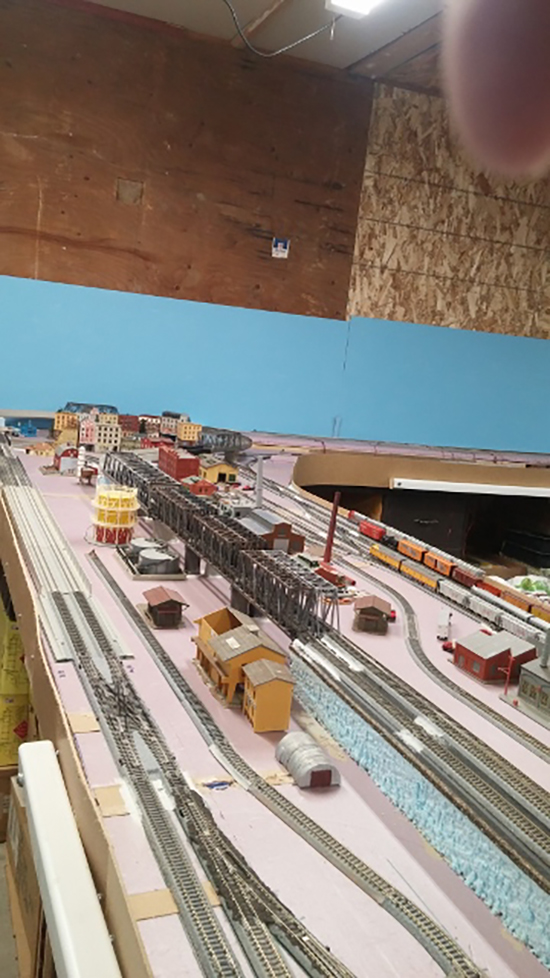
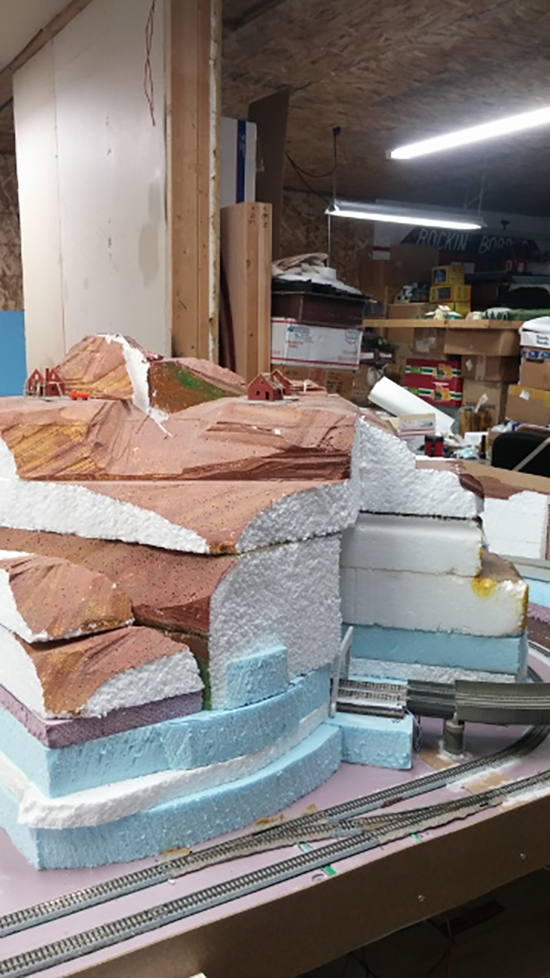
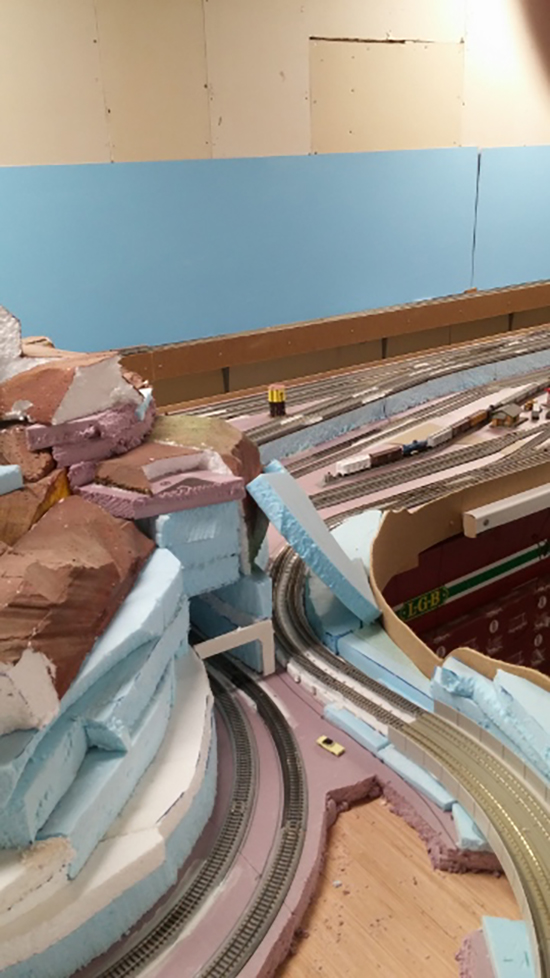
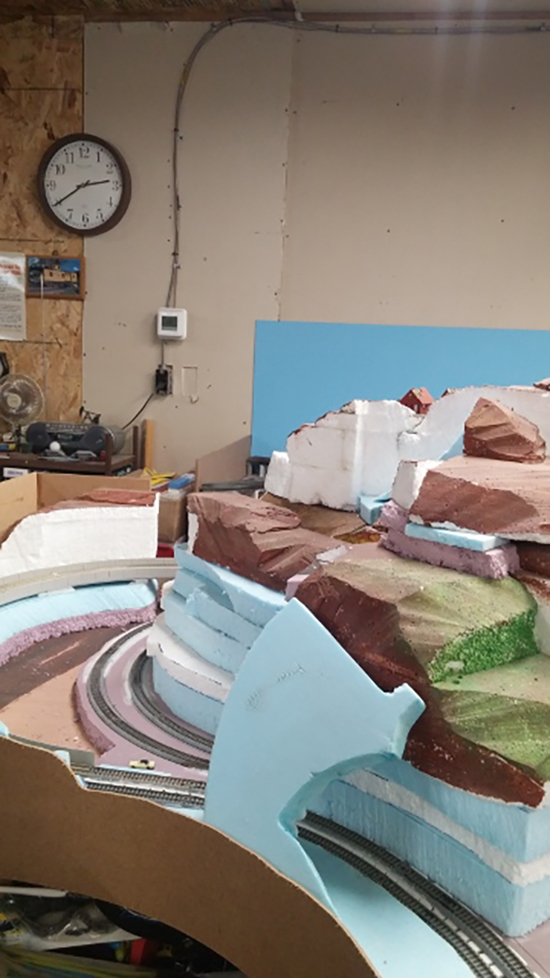
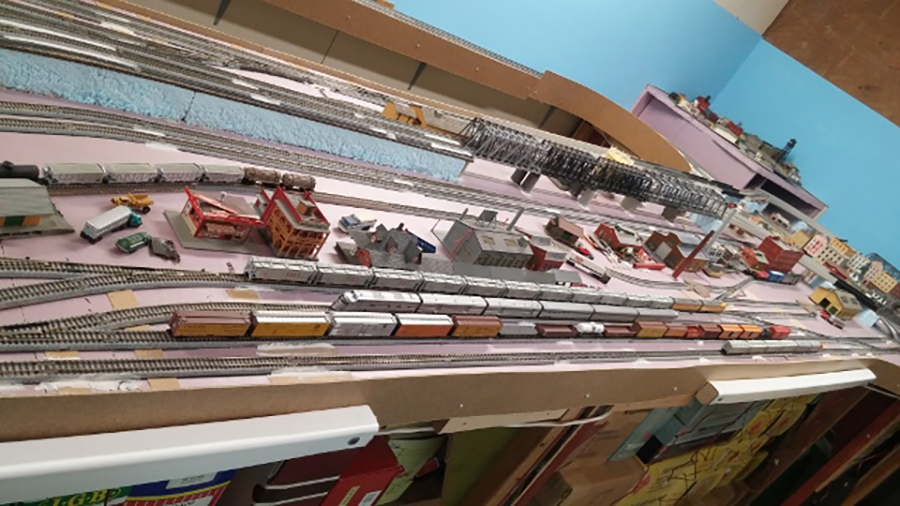
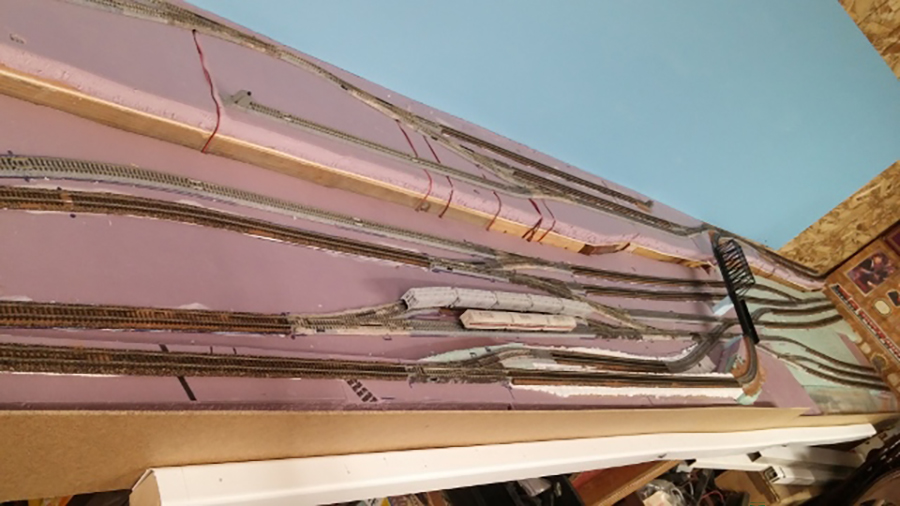
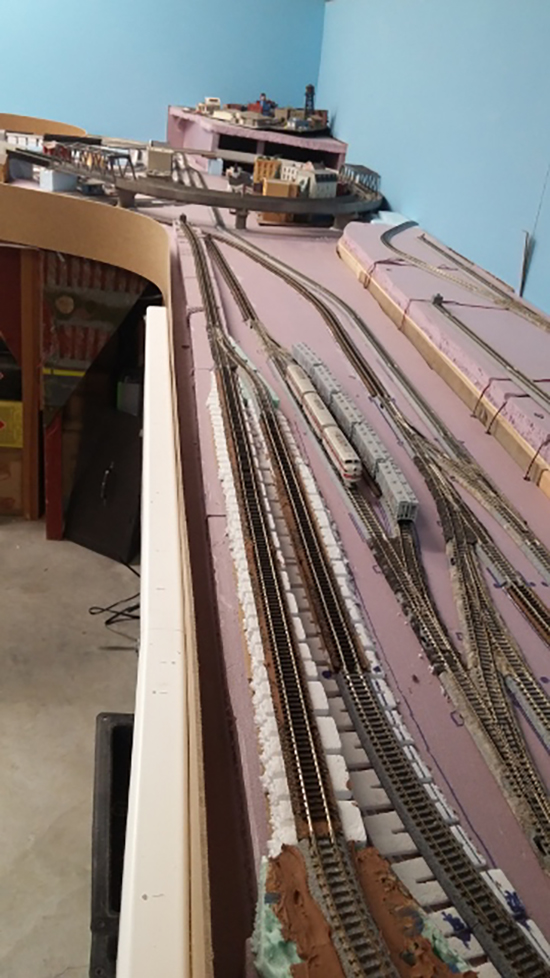
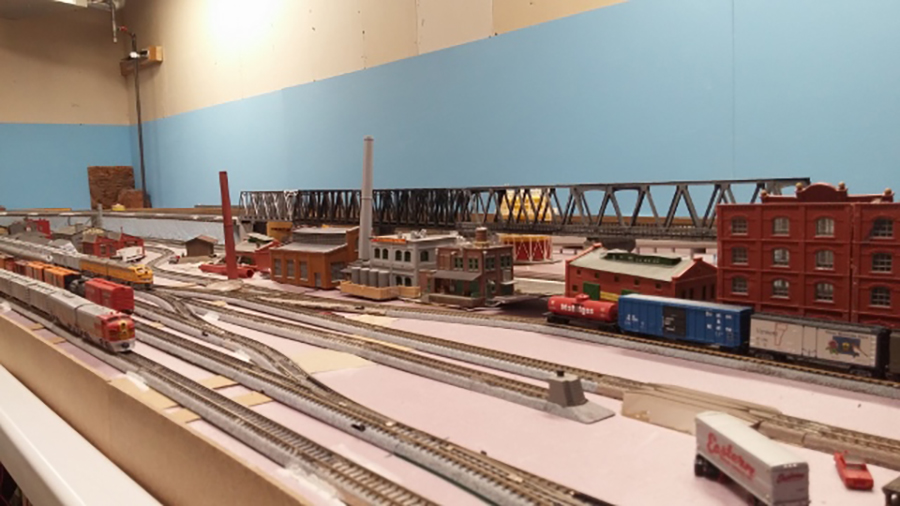
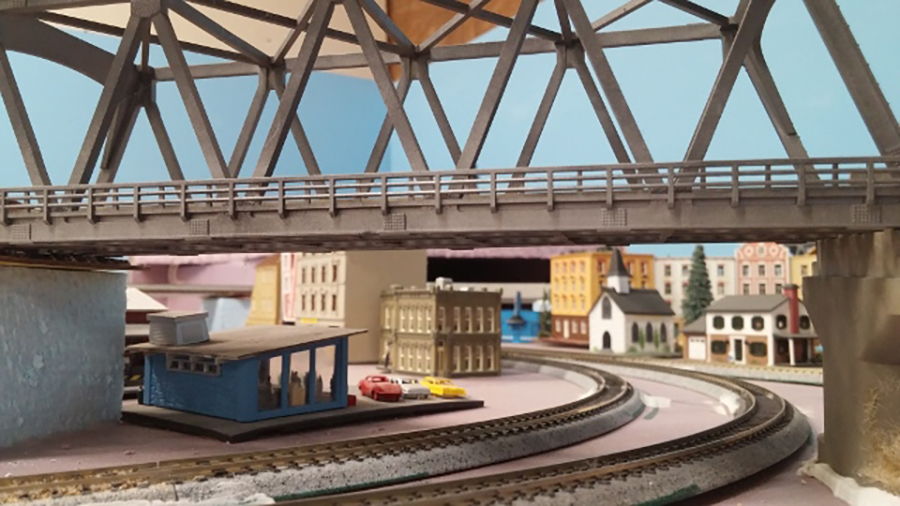
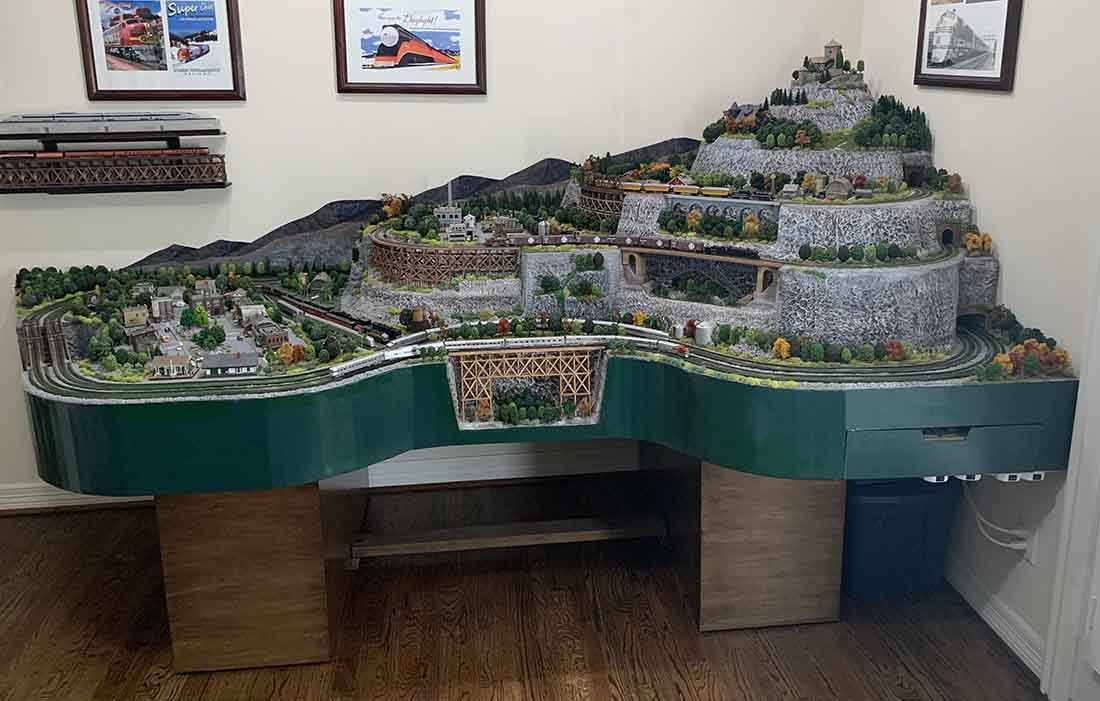
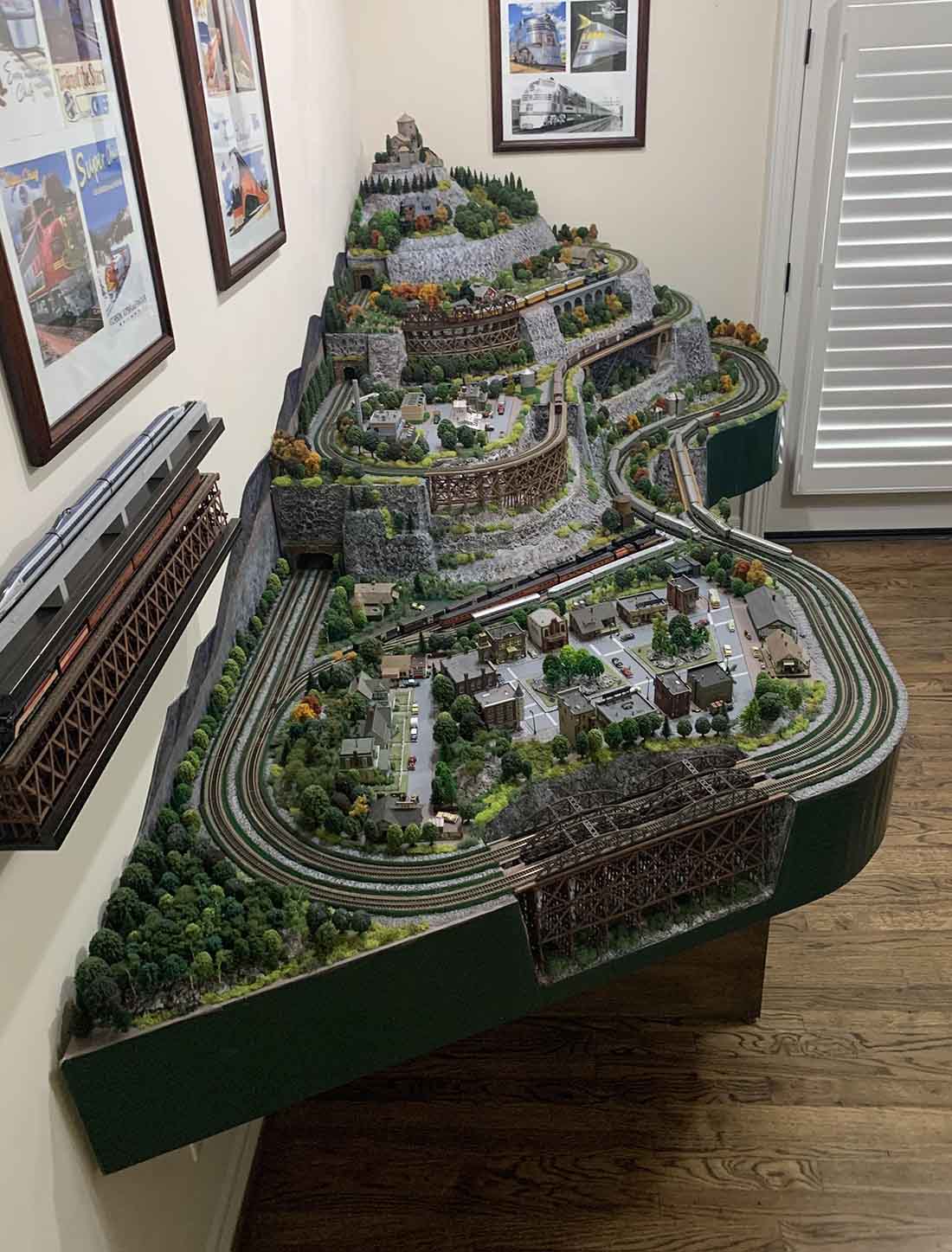
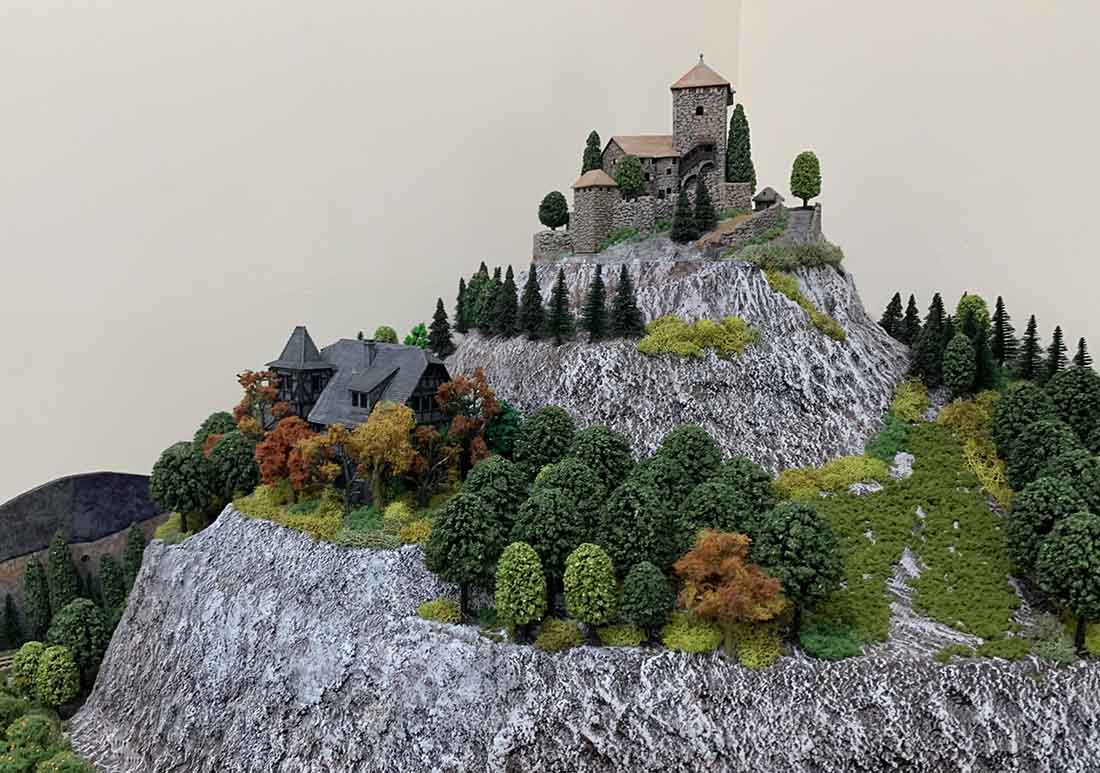
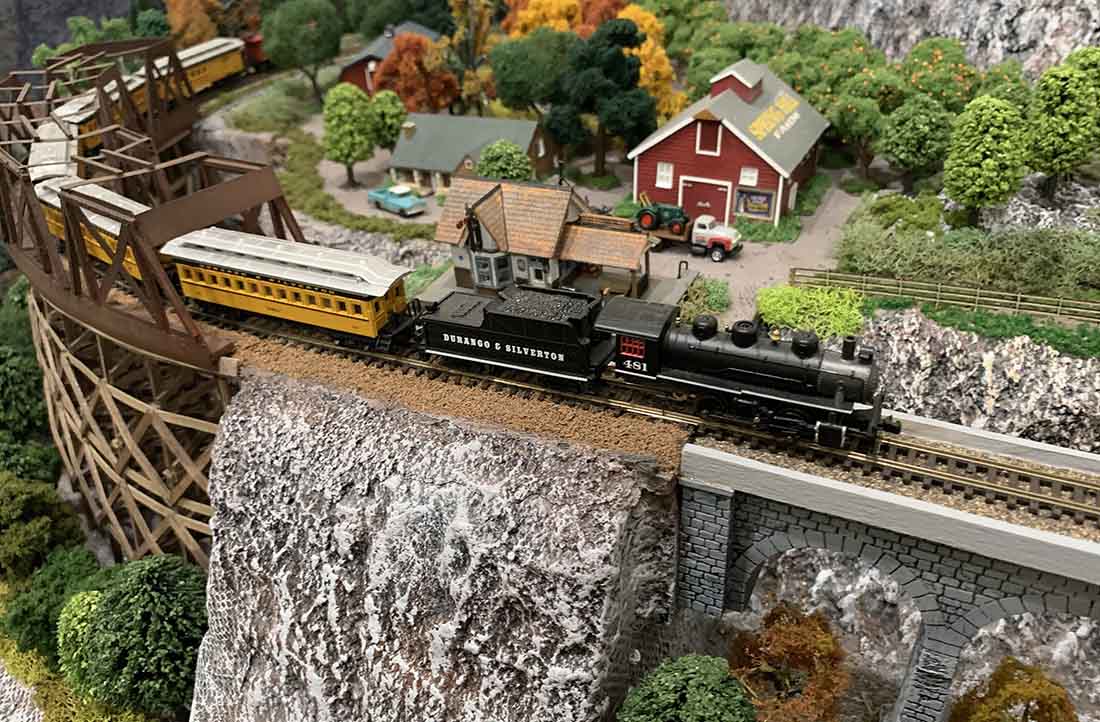
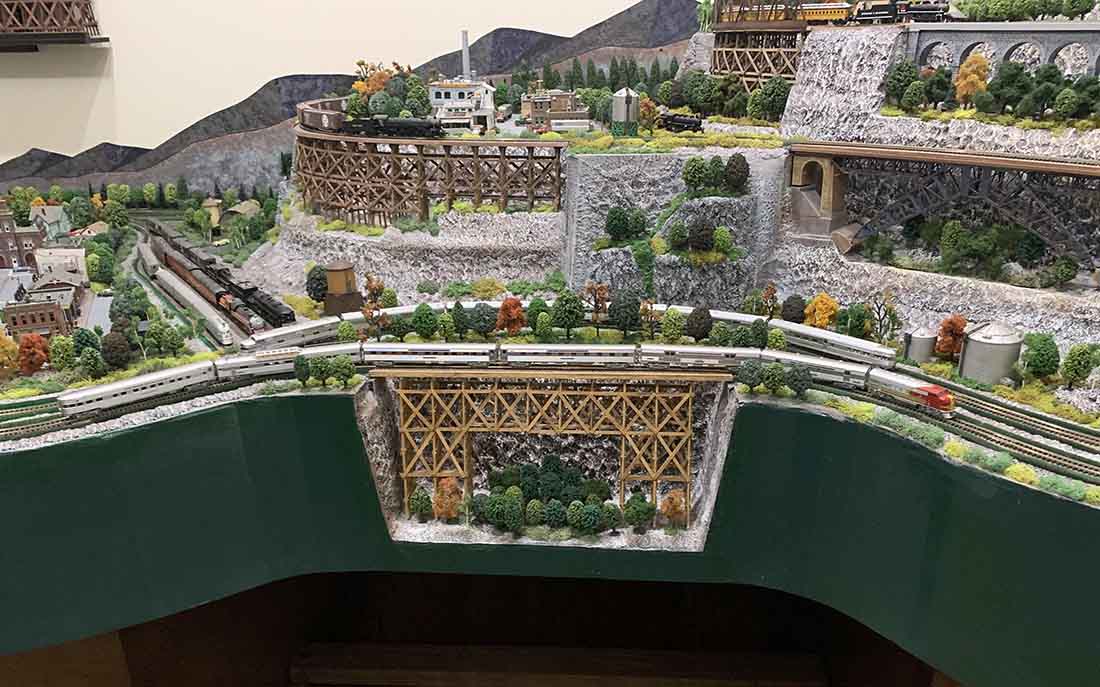
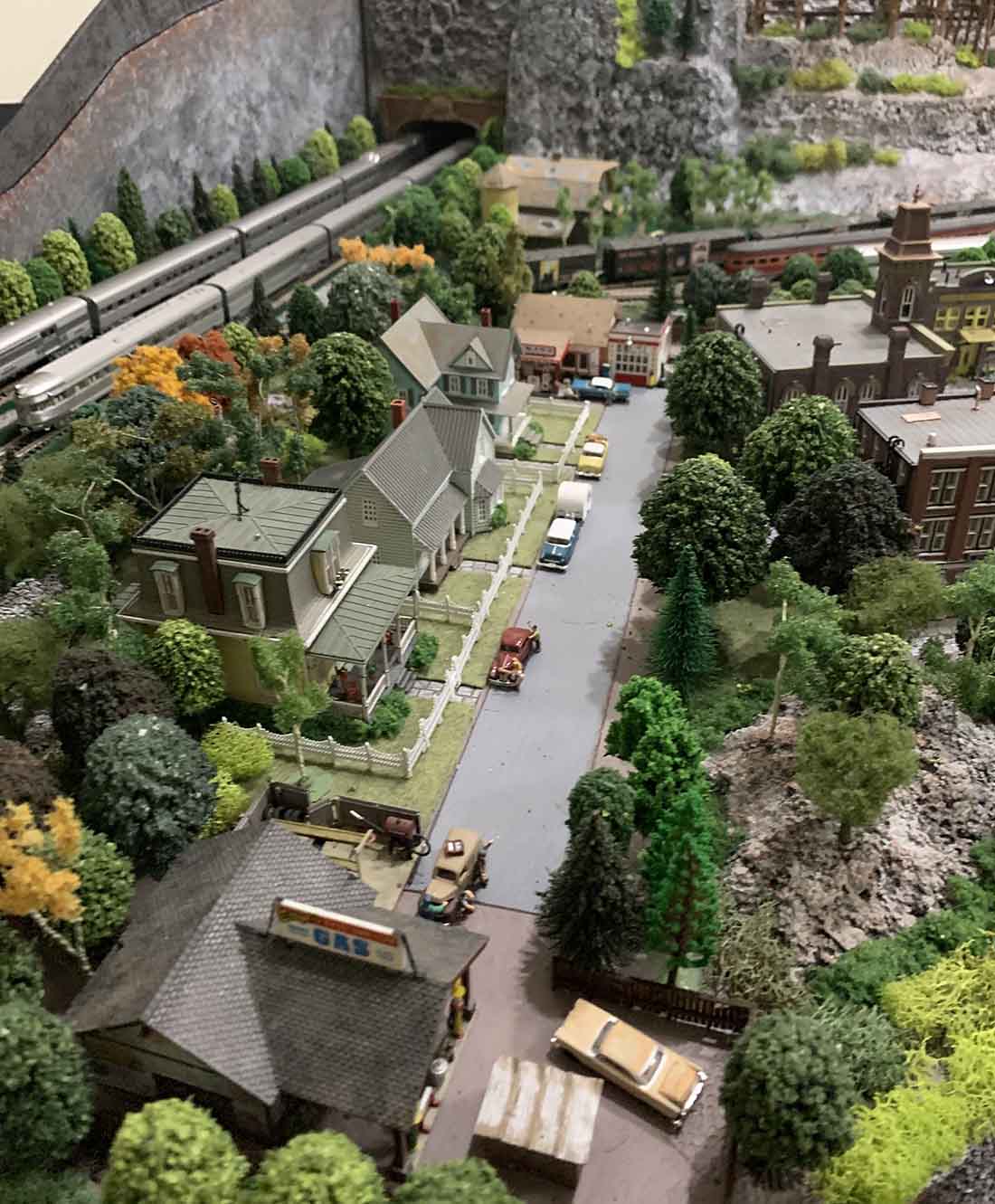
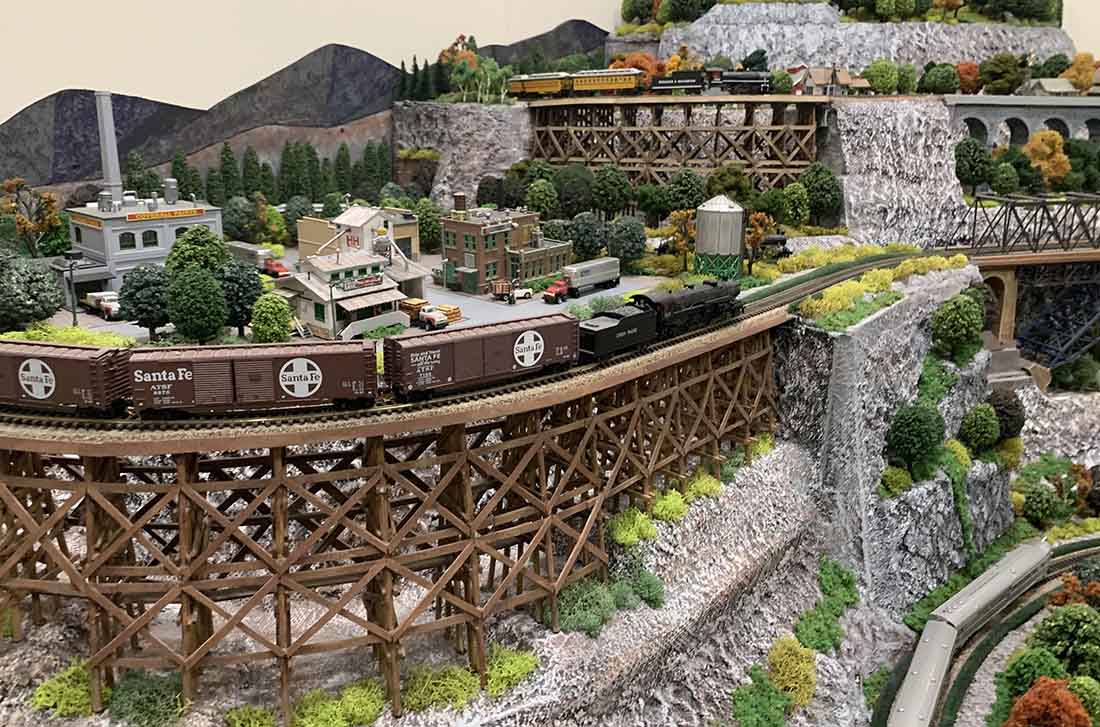
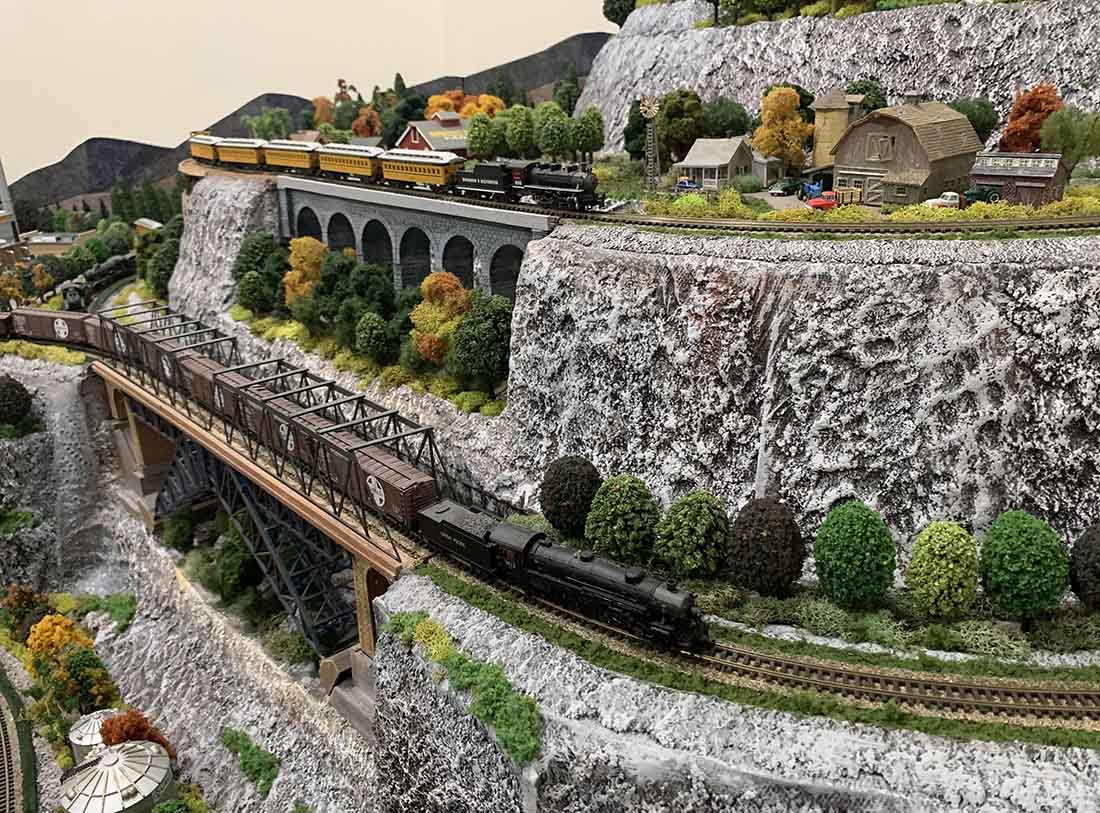
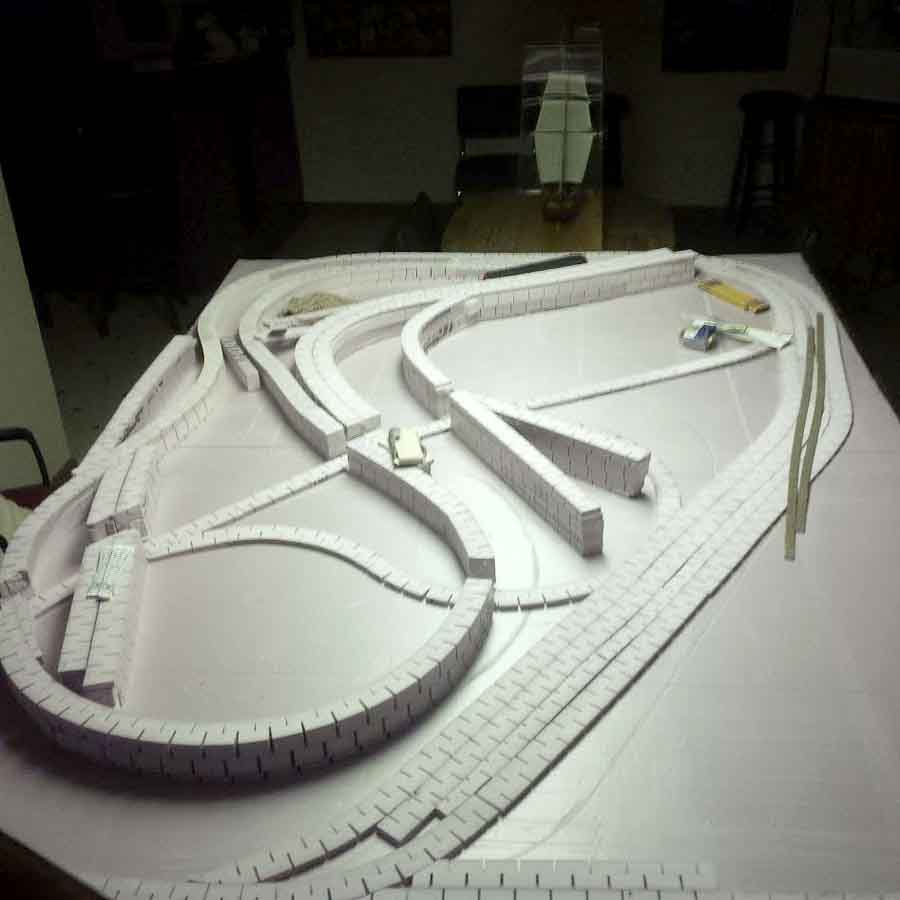
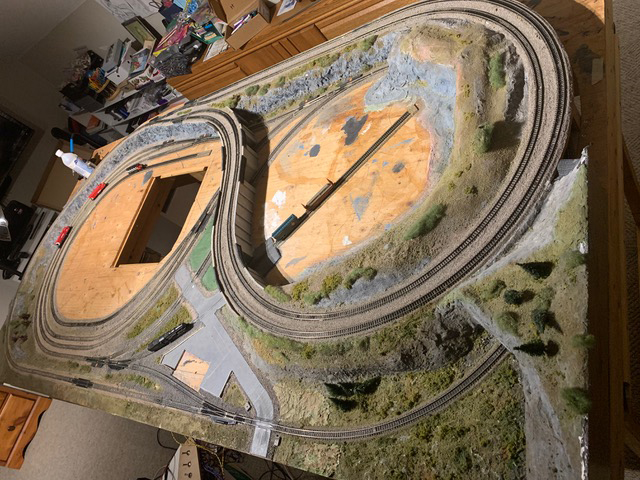
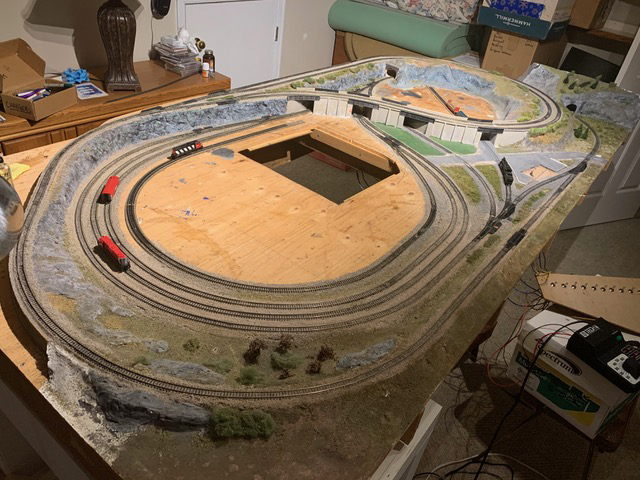
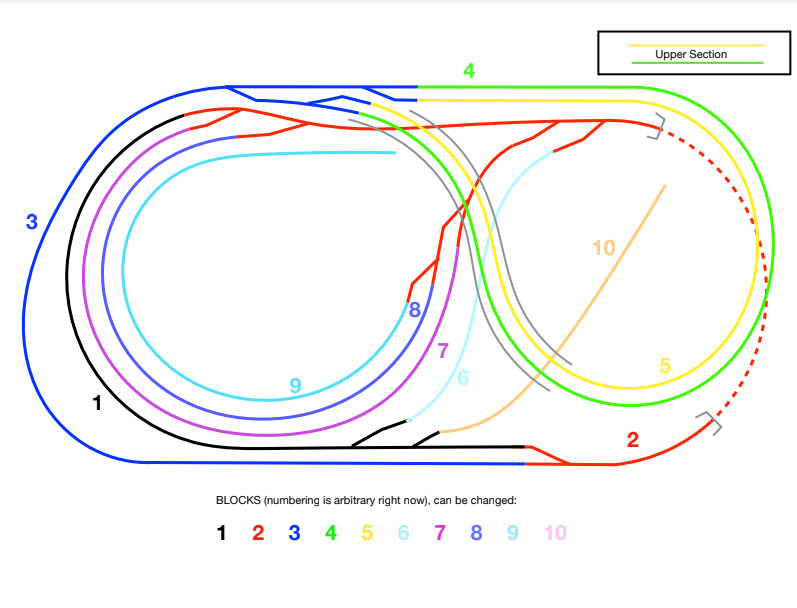
For anyone wondering about the size of the layout, it is 8′ long by 23.5′ by 16′ along the walls. Isles are 3′ wide.
Since my last entry, I have added an Oakland California division, so now there is representation of Chicago, Denver, Salt Lake City, and Oakland.
All areas are freelance so they may not have any resemblance to the 4 cities, this allows fair operations.some layout changes include adding a turntable in Chicago, and Denver, an EL in Chicago to help hide the mainline turns, and a very long legged wye between Salt Lake City and Oakland to turn passenger trains.
One journey around from any city and back now takes about 9 1/2 minutes plus time involved getting in and out of Oakland as it is stub ended there.
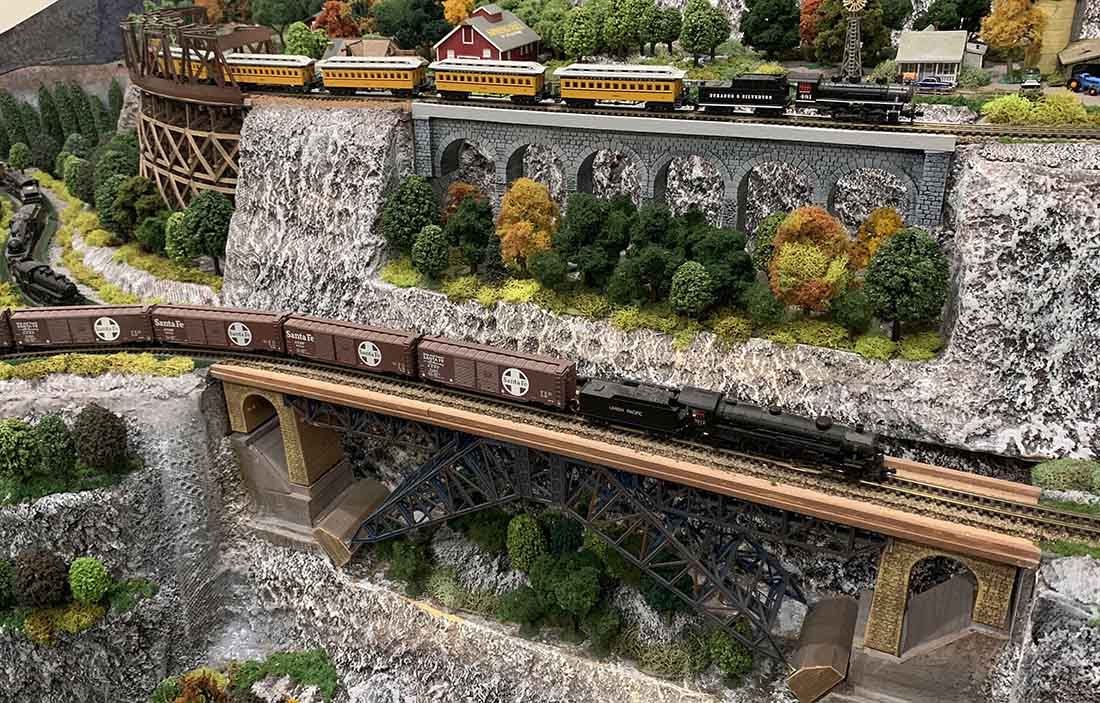
The upper level in the Oakland division is Union Pacific trackage, not realistic but this justifies my U P passenger train on the layout so it can run from Oakland straight to Chicgo and back, bypassing Salt Lake and Denver. I may even slip a Santa Fe passenger train in there once in a while.
I have added fascia board to the layout, switch controls will be installed on the narrow plastic boards on the fascia. Simple turnout diagrams will be put on the fascia.
The whole layout is operated by NCE DCC with four electrical divisions.
Also added backdrop board all around, temporarily in place at the moment, still need to add more board at the Oakland end.
All track operates well. The addition of the turntables and stall tracks need to be wired yet.
I’m chomping at the bit to get some scenery work in place along with backdrop scenes.
One thing I did that I would not do again, when I did all my wiring above board, it worked very well, saving tons of backaches and not having to be upside down underneath the layout trying to see what I am doing, but to save time I slipped thin cereal box cardstock underneath the track also to cover the wires. I should not have slipped any under the track. At the time it seemed okay being so thin, but it is still a thickness I don’t like under the track. It leaves mini rise and falls with sectional track to deal with.
That is it for now.
Thanks Al for all your labor of love holding this great online community together.
Be well and safe.
Sincerely
Dick Sr
Hardin Mt USA”
A big thanks to Dick. for sharing his L shaped n scale train layout. As you all know, I do love an update.
That’s all for today folks.
Please do keep ’em coming.
And don’t forget the Beginner’s Guide is here if you want to take that first step to making your very own layout.
“Al…first let me say how much I enjoy your blog. I owe my love of model railroading to my paternal grandfather.
As a young man he started working for Texas and Pacific Railroad as an apprentice dispatcher. He ultimately spent more than 40 years working for T&P and never left Texas. It is not an exaggeration to say that railroading was his life.
My grandfather’s parents emigrated from the United Kingdom to Texas while my grandfather was still a baby. They came from a small town in Devonshire called Totnes.
My grandfather once told me that there was a famous castle in Totnes and he was certain that it belonged to our family. I had my doubts, but perhaps that is why I have always had a castle on my layouts.
My grandfather was not only my inspiration, but my namesake as well. His given name, which I share, was James Robert. He was burdened with both nicknames and answered to Jim Bob all his life (using two nicknames was not uncommon in Texas at the time…what am I saying? It’s still not uncommon).
Thankfully for me, my parents decided to just call me Robert (Bob). However, I must say my grandfather was philosophical about his double nickname. Later in life, If someone made a disparaging comment about his name he would simply say, “I don’t care what you call me…just don’t call me late for supper.”
Thanks to Jim Bob I have been involved with model railroading for more than 50 years.
Like so many other hobbyists of my generation my first model trains were Lionel. HO scale came later. For more than 20 years, my wife, three children and I lived in a house with a 400 sq ft room over the garage.
My son put a sighn on the door that said DANGER! DAD’S TRAIN ROOM.
MY HO layout eventually filled more than two-thirds of the room. But, then we moved into our new house and I had to start over with no room over the garage.
The only dedicated space I had available for a layout was a corner of my office/library, so I am now an N scale modeler.
My current layout is approximately 5×10 N scale layout and built on a movable table for access.
Because of limited space I decided to build up instead of out as you can see in the photographs. I typically run four trains…a mix of steam and early diesel locomotives. I hope you enjoy the photographs and thanks again for your hard work and dedication to this marvelous hobby.
Bob (not Jim Bob) in Texas”
Want to see hundreds of more posts like this? Just jump on the newsletter:
A big thanks to Bob. Loved the way he built up instead of out, and what a super narrative too.
Want to see hundreds of more posts like this? Just jump on the newsletter:
Bob’s N scale reminded me of Steve’s 5×7 logging layout.
Here’s a quick pic if you want to refresh your memory:
“The Ohio Western & Lima Shortline (OWLS) layout is in N Scale and designed to fit into a spare bedroom with about 2-1/2 feet walk-around space – so it came out to 5’ x 7’.
It is loosely (OK, very loosely) modelled after my hometown, and set in the late 1940s to early 1950s.
Choosing this period allowed me to use early diesel powered and steam powered locomotives.
The track is Peco Code 55, with Peco Code 55 Electro-rail turnouts. Power to the rails is DCC supplied by a LENZ 100 system.
And if you’d like to see how Steve’s layout turned out, here it is:
“It’s hard to believe it’s been over 3 ½ years since I sent my original email regarding the OWLS (Ohio Western & Lima Short line).
I continue to plug away, focusing on the scenery, landscape & buildings. Alas, age has taken it’s toll and the old hands aren’t as steady as they used to be!!
Here are recent photos of the OWLS Short line, mainly the progress I’ve made with the above mentioned areas.
Again, THANK YOU for all you do!
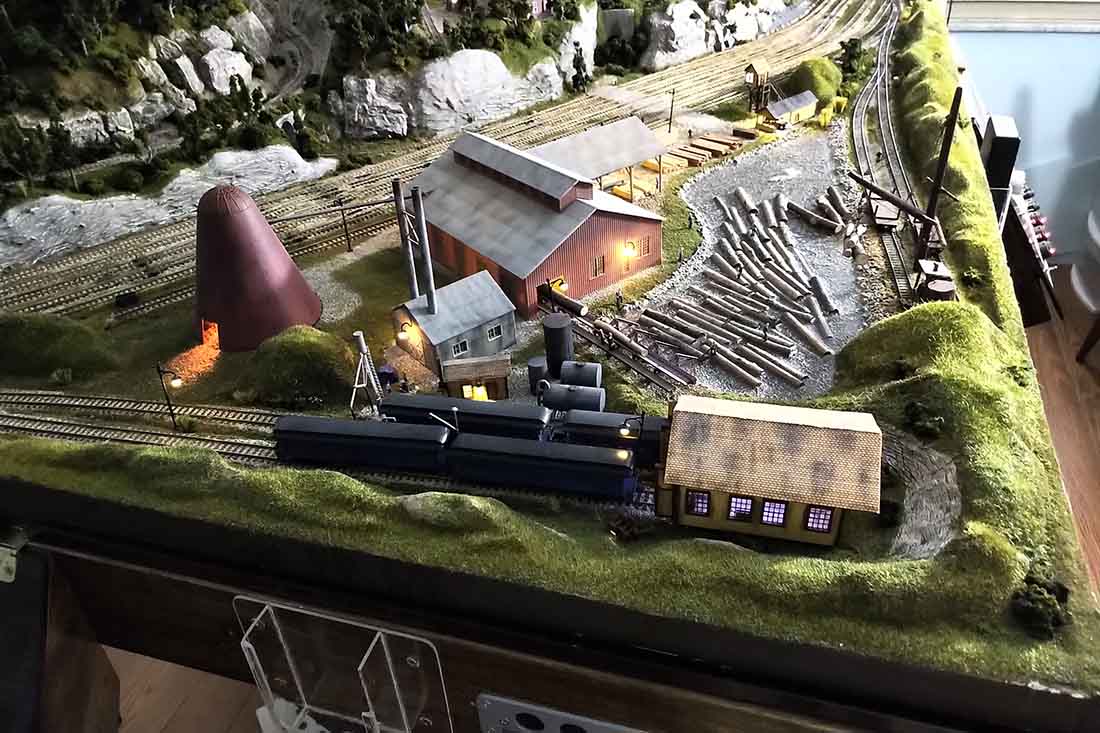
The layout is from about the late 1950 – 1960 time period and centers around a local logging/ lumber industry.
He’s sent this video in a while ago now, but I still love it. If N scale is your thing, it’s very much worth watching.
“Hi Al,
I finally finished my video on the American Freedom Train (AFT). I created my own replica in N scale of the original 1947 AFT locomotive and added to it 6 passenger cars of my own original paint scheme and my custom designed decals.
(These cars have their own Freedom Train locomotive I designed to complement them in the style of the 1947 loco. But, if I can find the time, I am now thinking of creating a loco using a more modern diesel style.)
But here is my video of the newly created AFT loco of 1947-1949. Once again, I am continuing the story line of Heritage celebrations and having the restored 1947 AFT loco lead an Excursion Train on a one day run through the Susquehanna Valley region.
I hope you will find it interesting and enjoyable.
Thanks again to you Al and the readers for all the support and encouragement to continue my modeling efforts.
I so appreciate what you continue to do for this hobby and your passion. Thank you.
I inherited my Dad’s N scale 8×4 layout he started building in his late 70s. Since 2002 I have had it tipped up on its side and stored…. only last month did my son and I right it, cut out the birds nest of mixed wiring, mars connectors and clips (bless my pragmatic dad!) that had been really compromised stored in a daily-used playroom by my kids!
Anyhow, we have re wired the 10 blocks, and 12 switches up to the point of building the control panel. I need experienced chaps to chime in and help design the schematic that makes sense for this layout. If this is something you can put out there, I will send you a nice drawing of the layout.
Let me know and thanks again all the way from the west coast of Canada!
Cheers,
Bruce.”
A big thanks to Bruce for sharing his N scale 8×4. There’s quite a number of these on the blog now. Here’s a few more:
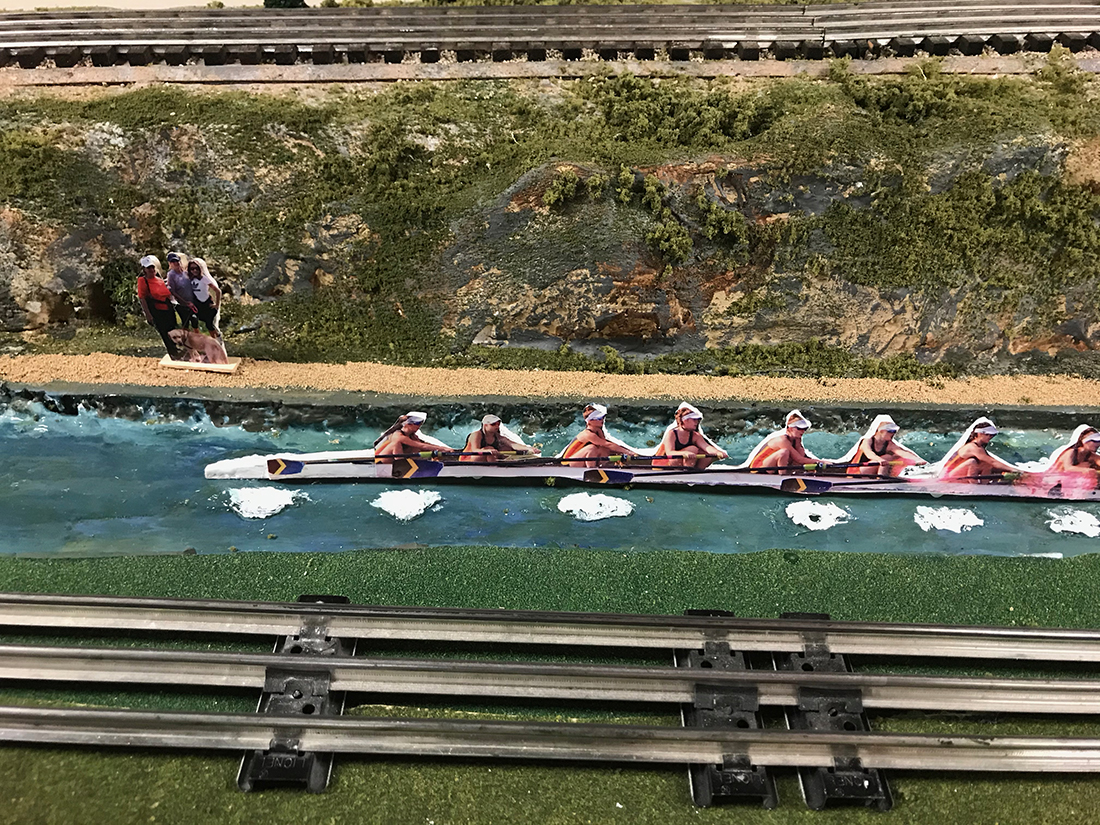
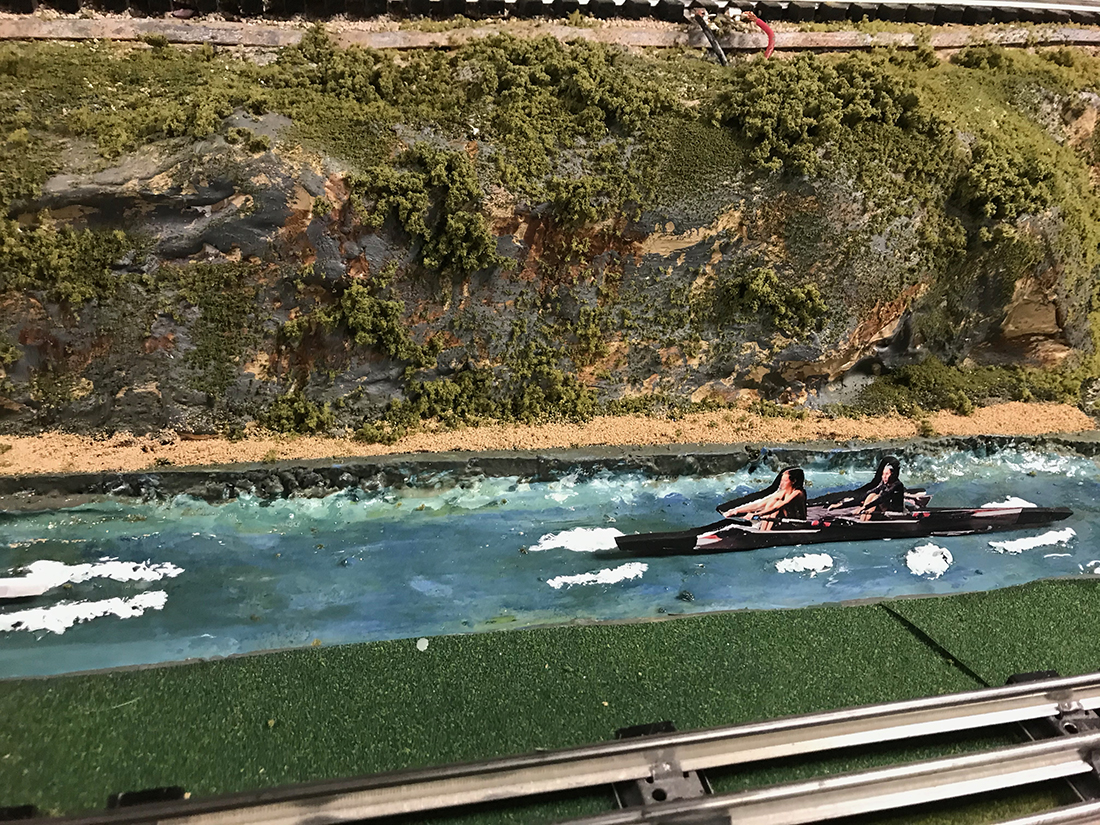
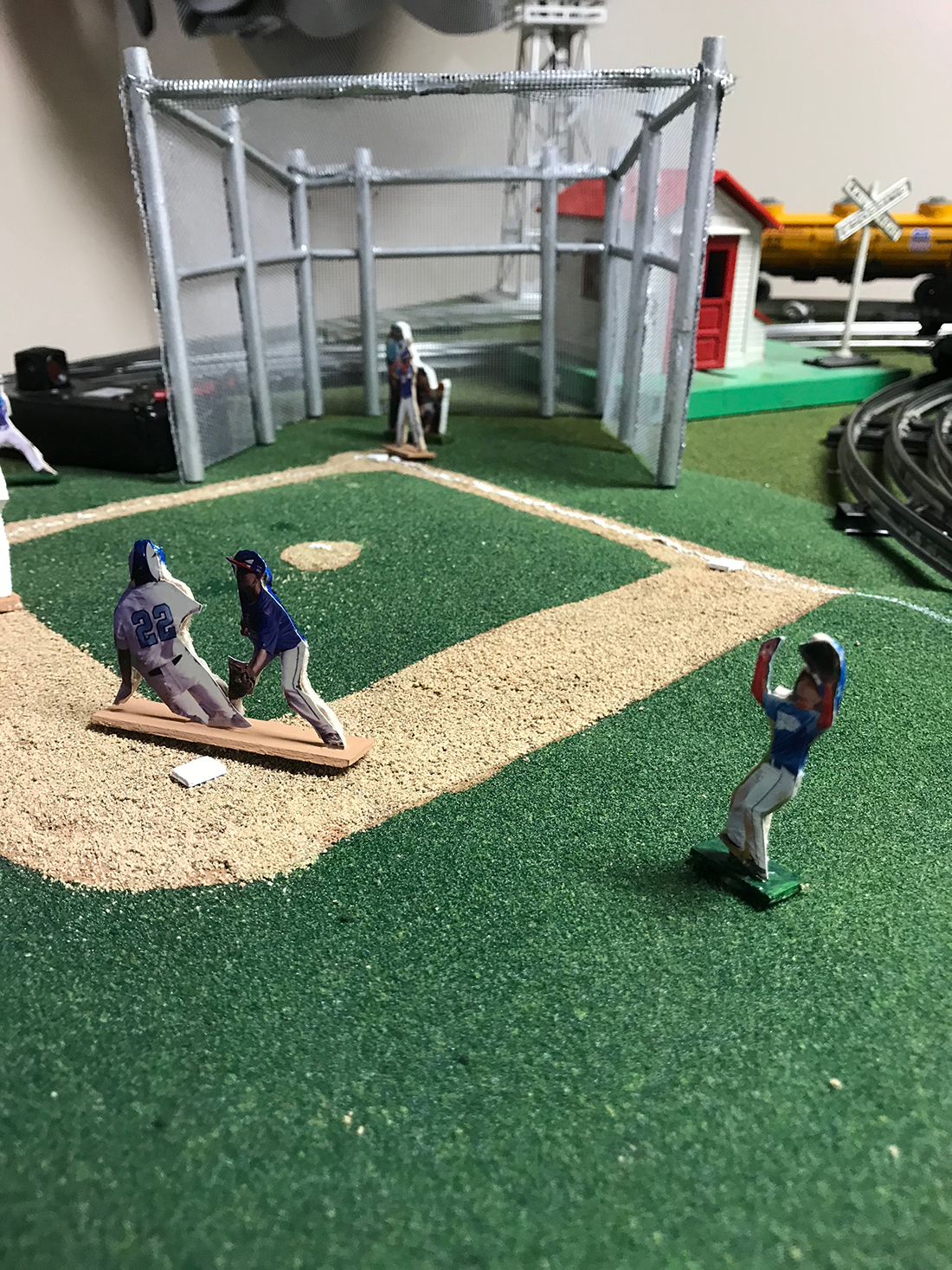
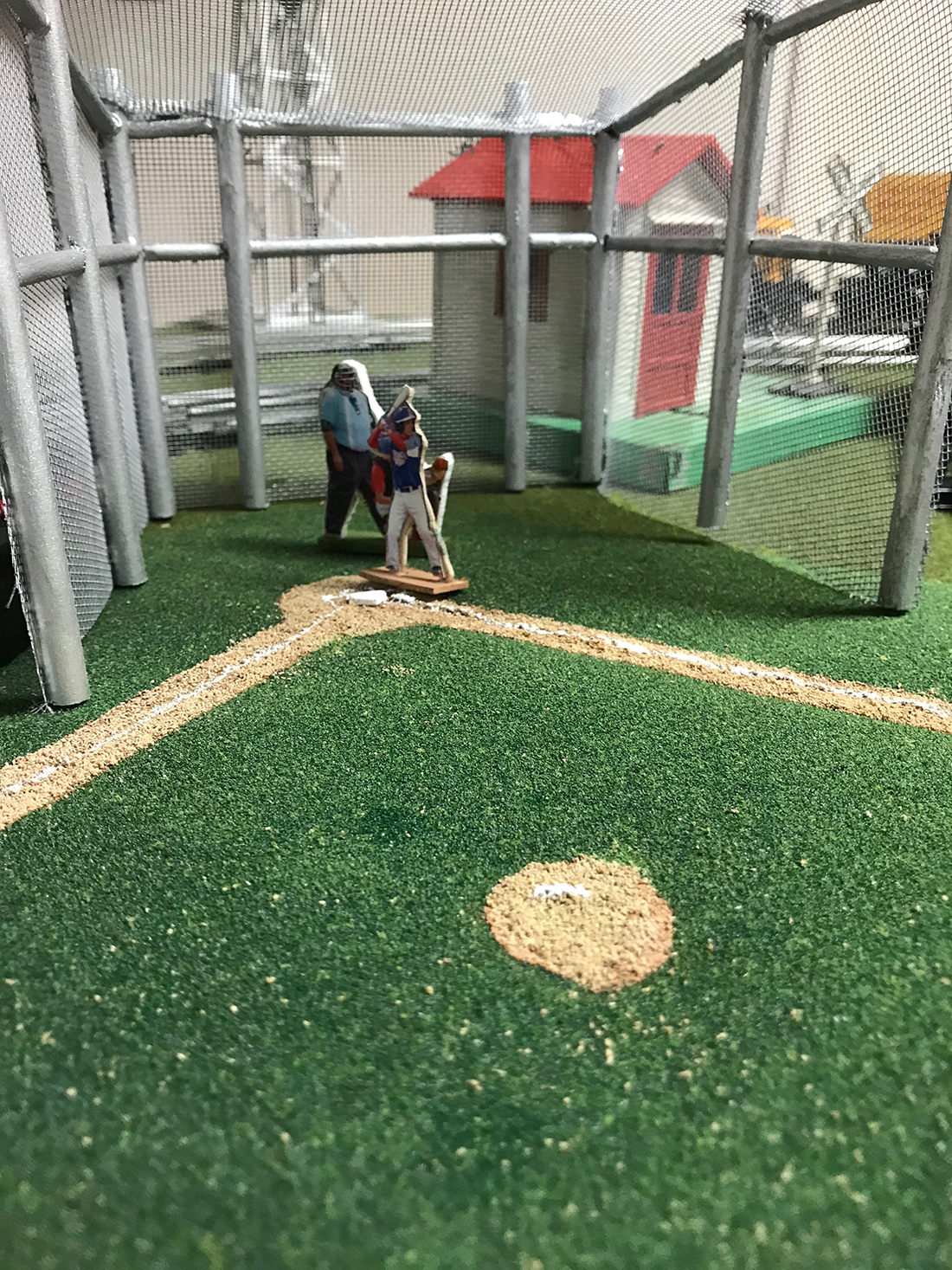
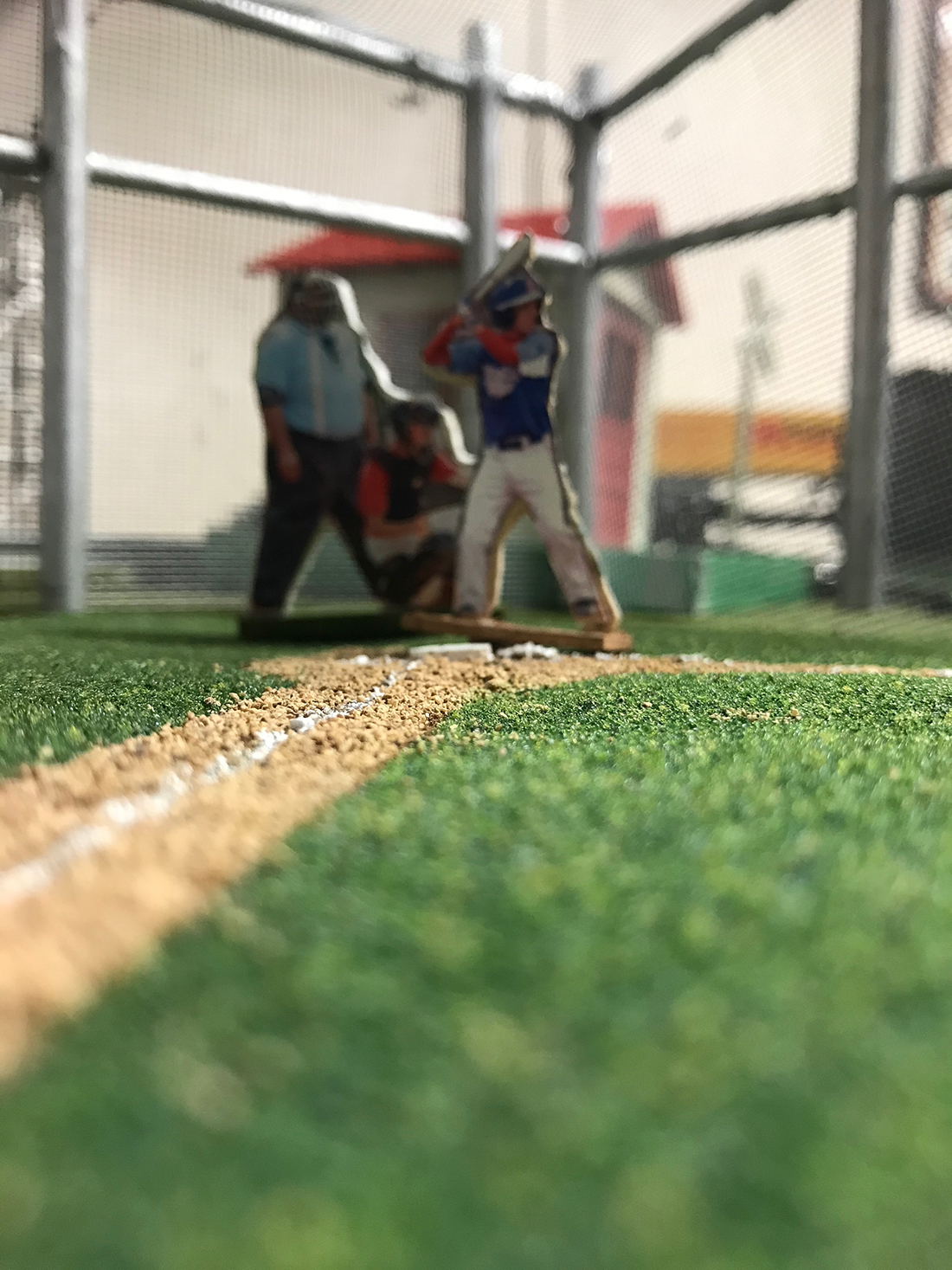
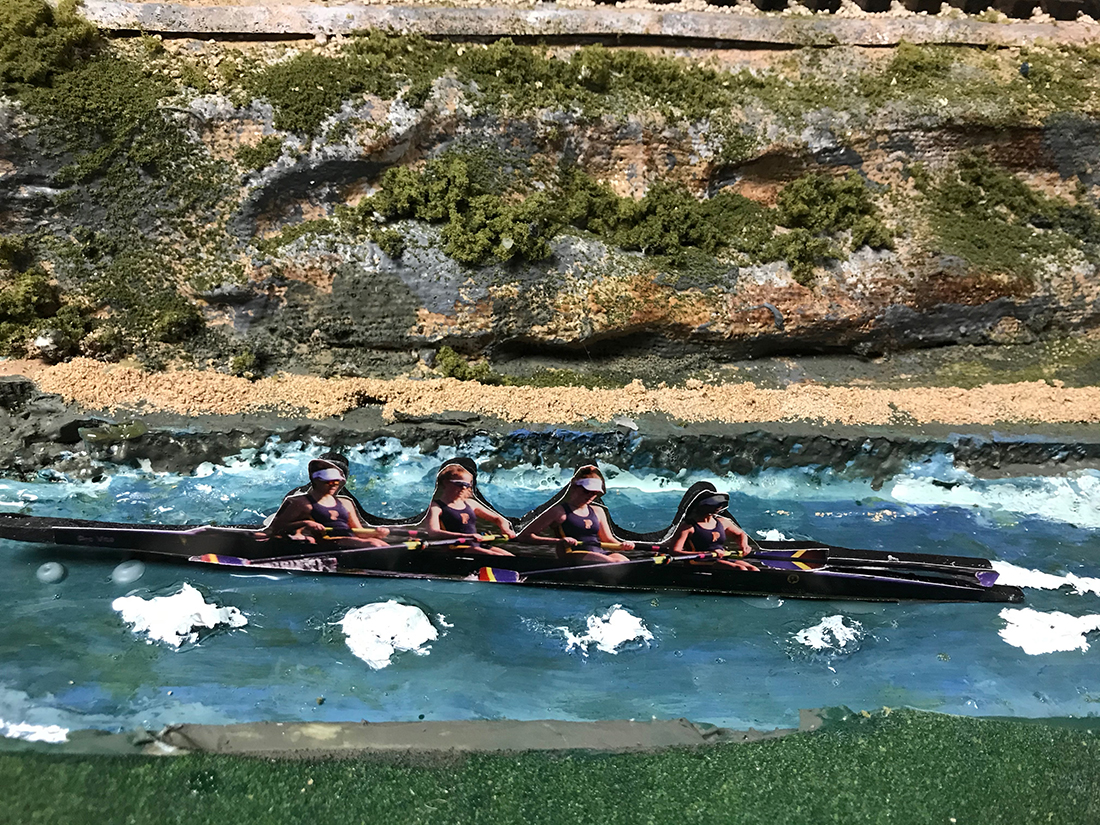
I have set up my original (old) Lionel trains and as I added to the board I decided to scale down some photos of my grandchildren in sports, cut them out with a jigsaw, and work them into the landscape.
I have attached several pictures of my grandaughters who are on the Pittsford NY crew and put them in a canal and on a bulletin board.
Mt grandson plays baseball for Stamford CT and he is on a billboard, but also I made a ballfield and screen and used his image in several positions.
The kids all like this and look forward to see where they will be!
Richard
Rochester NY”
A big thanks to Richard. There are many, many posts on this blog reminiscing about the happy hours spent playing with trains with parents or grandparents.
Fingers crossed in 50 years time it will be no different.
And who can help Bruce? Please leave a comment below if you can.