G scale train layouts plans – Fred’s

Fred’s been in touch and added to the G scale train layouts plans on the blog:

“hi al and thanks for all of the good info all tho I am in (G scale) garden railroading and doing all of my lay out, out side in the nice Az, heat, but we don’t have heat all of the time. believe it or not we do have cold weather out here to.

I am 77 and I have ben working on my railroad for about 10 years. making and remaking till I same up with something that I like but that can change to ?

I have 3 trains that I run in a small area in a mobile park but I am able to lay down 223 feet of track, with about 40 feet of trestle one over other, and 3 long tunnels where I store the trains at night, the water falls that you will see in the pictures is just over 5 foot hi, and runs down in a 50gal lake, then down in to a 15gal pawn, then river runs down under a road bridge and on down to a nether 15gal pawn under a railroad bridge and is pump back up to the falls and starts all over again.

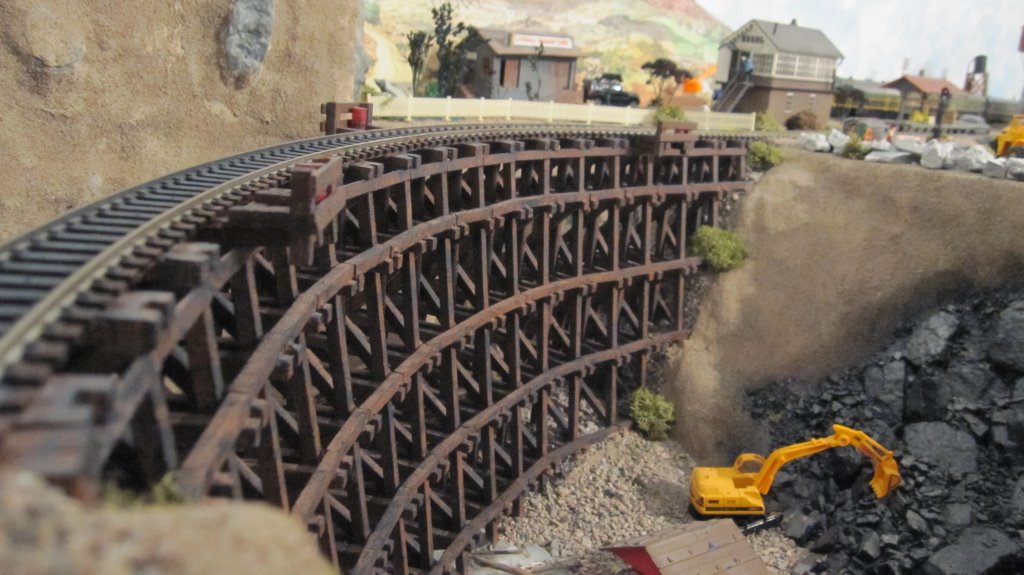
The trestles I am rebuilding and going to put more detail in the structure of it.

It was put up quickly just to see how the train would run on it. every thing runs good so I am putting the detail in it now.

By the way there are fish in the lake, sorry to say, we do not have a salmon run in the fall. LOL

OK here are some of picture hope you in joy as do.

Fred”

model train g scale

model railroad g scale

garden railway

garden railway

garden railway

garden railway


g scale train layouts plans

g scale train layouts plans

g scale train layouts plans

g scale train layouts plans

g scale train layouts plans width=

Big thanks to Fred.

I get lots of mails asking for me G and O scale stuff. Just so you know, I’m happy to publish it when it comes in!

And now I quick word from Hall of Fame member, Mark.

He sent me a quick mail on his last post, which is here

“Hi Al. Yes, seems to have created a stir.

I just noticed on YouTube that there are over 7500 views!

Amazing for a simple little project, however I mostly enjoyed reading the responses on the main point of not getting overwhelmed by the project.

One interesting side note emerged – there were a number of requests as to how the flashing was accomplished.

I sensed that some readers perceived this to be beyond their ability. (possibly adding to the frustration)

About mid way through the responses I gave the information, but I don’t think everyone got it.

Anyone, including the beginner, can duplicate this by using a readily available, completely assembled product from NOCH GmbH Part #17520.

If anyone should inquire, please feel free to share this info with them.

Also, as time permits, I’ll send in links to some more videos, but with “Tips” always included to encourage others to get involved in building! Cheers!

Mark”

Mark’s absolutely right – there’s some real gems of advice in the comments, including his explanation of the camera flashes.

(Don’t forget, Mark was very helpful indeed with the guide).

A big thanks to Mark, and to Fred for adding to the G scale train layouts plans.

That’s all this time, Folks. Please keep ’em coming.

Latest ebay cheet sheet is here. Still going strong.

Best

Al


HO scale DCC locomotives with sound – Jim’s

Jim’s been in touch with his HO scale DCC locomotives with sound:

“My layout was started in after a long break from railway modeling.

It is entirely 1/87 scale and is all dcc with most locos having sound.

It is based on a area somewhere in Germany around the black forest area, but I like to run french & Austrian trains and also American trains.

I know this is unrealistic but this layout is not a serious prototypical setup.

I have electric, gas turbine,diesel and steam locos and many high speed trains from trix, marklin, fleischmann and roco.

The layout has a 12 foot terminus station Area a small shuttle station, three goods yards and a 27 exit turntable which is all opperated by dcc connected to a esu ecos and a Z12 which work in tandem.

The system has no catenary as this was to not installed early enough when building and was also a extra huge cost so I run all electric loco with there panagraphs I the down position.

The layout is HO scale DCC locomotives with sound and is shaped like a number 9 with the large terminus station branching off.

Thanks jim.”

HO scale turntable

HO scale DCC locomotives with sound

HO scale turntable

HO scale DCC locomotives with sound

HO scale turntable

HO scale DCC locomotives with sound weathered passenger carriage

HO scale DCC locomotives with sound


A big thanks to Jim for sharing his HO scale DCC locomotives with sound – I loved it.

Now, if you want to model like Jim – and you haven’t got off the starting blocks yet, don’t forget to have a look-see at the guide (or even if you are just after inspiration).

That’s all this time, folks. Please do keep ’em coming because it’s getting a bit thin on the ground this end.

Best

Al

PS More HO scale train layouts here if that’s your thing.


Need buildings for your layout? Have a look at the Silly Discount bundle.

Model railroad rock mold – Brian’s

Brian’s been in touch with much more than just a model railroad rock mold.

He shows’s how to make a mold for many shapes – walls, logs, workbenches…

In fact he shows us step by step how to create the molds.

So whether it’s a model railroad rock mold or whatever, here’s how to do it:

“Hi Al

Here are photos of some of my rubber moulds (I must have about 80 different ones) the small trackside shanty moulds, I have about 4 or more of these as they can be put all around the layout and I can never have enough of these, just paint them different colors.

The items shown in the rest of the photos are:- vertical boiler, black horizontal boiler next to its mould, rock walls, shelving, drums, logs for my log cars and used at the log loading area, workbenches and wall racks to name a few. Will send photo of the shelving filled with odds and ends.

model railroad rock mold

model train scenery mold

model railroad rock mold

model train scenery

model railroad rock mold

model trains

This photo shows 3 of the items made in my rubber moulds that have been painted and placed on my layout. I have different ones all over the layout where required.

model railroad rock mold

From L to R, a small trackside shanty (red), a small sand bin for the sand house and an oil tank carrying oil for my oil fired locomotives.

model train scenery mold 2

A resin cast shelf rack filled with odds and ends and some of the details (castings) inside a 2 stall engine house.

Everything on my layout is in HO scale in case anyone asks.


Making molds

Method 1: the cheapest one with readily available silicon.

Once a master is made – does not matter of what material it is made of, I mount it on prestick (blue tac) usually, to any flat surface (I use a piece of glass). I bevel the bottom edge up towards the master. I normally have a few masters ready for this process. Helps when waiting for the silicon to dry.

Use a paint brush and paint a thin layer of Vaseline over the whole master as well as the blue tac and be sure to get it in all the crevices. This acts as a release agent for the silicon.
I use clear silicon (bathtub sealer) from a tube and squirt it (starting at the bottom and work it in with a lot of pressure) all around the master working up to the top and seal it across the top. Put it on fairly thick all the way up and on the top. Then play the waiting game for the silicon to dry (usually about 3 to 4 days).

Once the silicon is dry, it is very easy to peel it off the master. (Vaseline).

I use mainly plaster of Paris to fill the mould and make as many products as i see fit. The mould will last indefinitely (I have some from 30 years ago and still as good as new). The use of plaster of Paris allows me the put dents (if for instance if it is a motor vehicle and remove fenders, bonnets, doors etc. It is also very easy to stain or paint as required.

Method 2: a more expensive way and not so readily available product.

Use a 2 part silicon (pink) usually bought in 500mil tins with the equivalent hardener. Be careful of shelf life.

Again mount the master on a flat surface and build a box around it leaving about one inch all around it as well as above it. Make sure that it is ‘watertight’. When this is done, mix up the two part silicon according to the specs of the product and then pour into the mould box right to the top of your box. This usually takes about an hour to dry. After that, remove the box completely from the master and you will now have a mould.

You can fill these type of moulds with a 2 part epoxy or plaster of Paris. Be aware that these moulds do not last as long as the ones described above if using epoxy.

I will try to find the photos of some of the moulds that I made and send in for posting.

Hope this help in making rubber moulds.

Many thanks and keep up the excellent work.

Cheers for now

Brian”


A huge thank you to Brian for showing us how to make a model railroad rock mold or any type of mold.

Now take a look at the ebay cheat sheet, and look at the price of some of the scenery – I think Brian really is on to a winner. And it looks stunning too.

I hope you can all see why I put Brian in the hall of fame. He was also very helpful with the guide too.

What’s more, Brian is really quick off the mark when it comes to answering questions. So feel free to post some below.

Best

Al


model train answers