Brian’s been in touch with his latest project, a HO scale double track bridge for his club:
“Hi Alastair,
Once again thanks for the emails every day. Please keep up the excellent work that you do for all the Modellers around the world.
Having sold my home layout for the intended house move, a group of model railroaders here in Knysna, got together and decided to form a module group to enable us to display the modular layout at shows and hold an exhibition in July of this year.
There is a module group in Johannesburg (RSA) who have built up a big module group there. Upon enquiry on their website, we managed to get hold of the gentleman who manufactures these modules (laser cut MDF). They are designed for HO scale.
Cut a long story short, our group ordered 18 of the modules – 6 corner ones and 12 straight ones. The straight ones measure 500mm by 300mm. Corner ones are 700mm by 700mm. These consist of 2 sections.
Shown below is one corner (left) and one straight module.
Everything is included in the kits, track bed, backdrops, wiring, connector plugs as well as all the screws, nuts and bolts to put the units together.
Below is a straight and corner one connected. The back drops are supplied in the kit.
It is up to each individual owner to scenic and populate their module.
The only criteria that cannot be changed is the track alignment and spacing.
Below left is my corner and straight module about to be connected to another set.
Below is one of the members modules that is almost complete with track and scenery. The wiring and connectors can be seen at left.
Another view of same set-up.
This is where it got interesting, the supplier came up with a bridge module to be used in a group setup. So the group purchased one.
Below is the ideal set-up using all the groups modules for exhibition purposes. As can be seen below there is what is called a reverse curve unit (Dirks) to enable us to come up with this design.
Fortunately a few members have 3D printers therefore they could print a 3D bridge for this module. Below is the subframe of the bridge. The gap in the middle for a bridge or trestle is 500mm by 300mm by 100mm deep.
Test fitting one side (consisting of 4 pieces).
The opposite side temporarily held in place.
Test fitting the bridge with a heavy high speed train on it.
A view from above to check alignment and spacing.
Top bracing glued in place.
Another view showing the bracing. This is where the complete bridge becomes very sturdy and no flexing at all.
There will be a3D printed boat house and dock below the bridge.
Another view of the boat house and dock.
All modules have the owners name 3D printed and this one is owned by the group. (I put the boat house and dock together).
The almost complete boat house and deck. I will do a separate article on the building, painting, weathering of this 3D printed kit.
It is 1 metre long by 300mm wide by 100mm deep. My intention is to put a double track 3D printed bridge across the 500mm gap with water and some scenery on the sides and back.
Drawing below is the size (6 pieces) supplied by the supplier/manufacturer in kit form.
HO scale double track bridge:
It is supplied complete with all the nuts, bolts, wiring, backdrops and connectors. No glue required as it is extremely solid when assembled. Manufactured in super wood.
Here the 3 D printed base girders are being test fit and held together with small clamps.
One side of the bridge clamped in position and glued to the base girders. The total number of 3D printed parts is 18 that need to be glued together. (I used super glue)
The sides have been glued to the base girders and being tested with a heavy high speed HO scale train to see if the bridge can handle the weight without any sag. It turned out to be very strong indeed.
The top bracing has been added, glued and it increased the strength and stability very well. As can be seen here, under the bridge, a 3D printed boathouse and deck.
As seen below, front facia has been painted (the groups name plate added) and a fisherman’s shack added on the right.
The bridge has been spray painted with a red oxide colour and ready for weathering.
Polystyrene foam has been shaped to form the scenery.
Greenery added to the foam and a sand base on the water bed.
The bridge has now been weathered with very light rust. It took four and a half hours of dry brushing to weather it to my liking.
This photo shows the top bracing of the bridge giving it the strength that was needed.
Checking the placement of two of the buildings below the bridge.
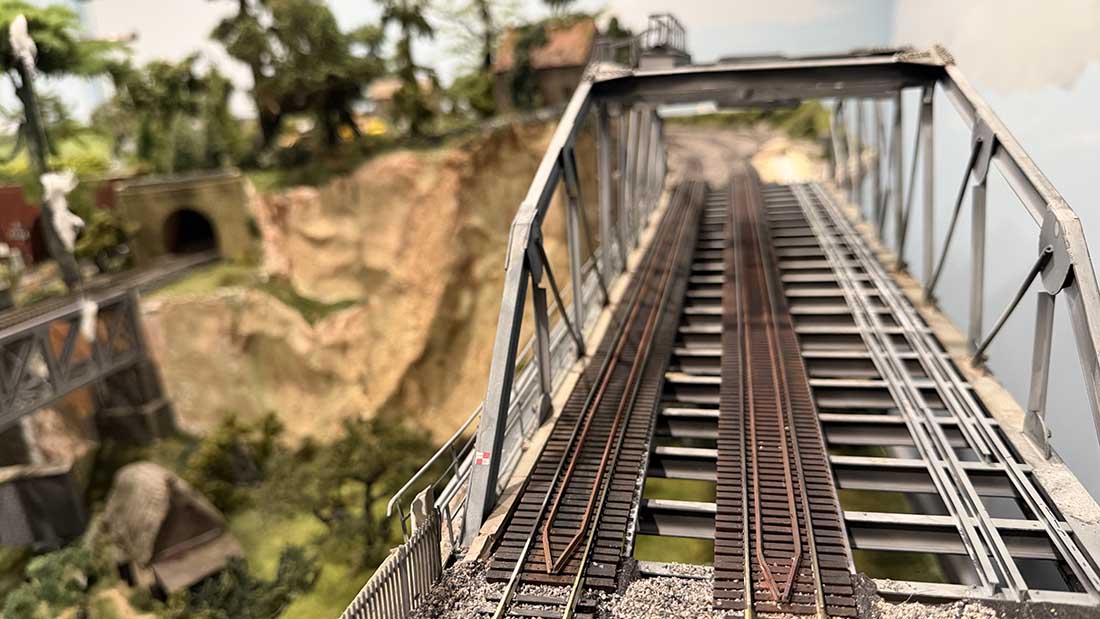
Placement of a small boat at the dock with an old time train passing above.
Woodland Scenics realistic water in place with some empty drums in it.
A closer view of the boathouse and the stairway leading up to the boat rental shop.
This “was” a 3D test print of the staircase leading up to the small business above but unfortunately my measurements were wrong. It was 30mm too low.
A better view of the mistake. Easily corrected by printing another one to fit.
A re-printed staircase now at the correct height. Supports will be added under the platforms.
A old (also 3D printed) standby wharf in the middle for holding loads waiting to be picked up by small boats.
An officer checking to see if all is okay on the deck.
Water level is now correct and the three buildings settled in nicely.
A fisherman has pulled up at the fishing shack and is waiting for the ‘big’ one to bite.
Many thanks to Alastair for all the hard work that he does for the modelling fraternity worldwide.
All the best till next time.
Brian the HOn3 guy from Knysna, RSA”
A big thanks to Brian for sharing his HO scale double track bridge module – it’s looks great now and I’m sure it’s only going to get better.
There’s quite a few bridge posts on the blog now, here are a few:
Ned’s been back in touch with an update on his O gauge scenery and track:
“Alastair,
Two years and 3 months ago I started my O-Gauge layout. Most of the major construction is complete.
Now it is time to add the details and clutter that enhances realism and tells the story.
The model is primarily a representation of Milwaukee Road in North Idaho. My original intention was to model the Avery, Idaho Milwaukee Road exchange where they shifted from electric to Steam or Diesel.
I determined early on that my 24 ft x 14 ft train room was insufficient to accurately model Avery in O-Gauge. I settled for a representation of the North Idaho railways.
As I explained in previous submissions, the time period is 1930 – 1960, the season is all of them – Winter through Fall counterclockwise. The trains are an eclectic mix of road names based on what I found and purchased in the years before I settled on Milwaukee Road.
Although no model is ever complete, it is close. I have a couple of buildings to construct so I can try my hand at putting model kits together.
So far, it has been an enjoyable learning experience for my first attempt at all the modeling techniques.
Enjoy!
Ned”
A huge big thanks to Ned for sharing the latest on his O gauge scenery.