I’ve just had a good clear out of my inbox and uncovered these model trains tips and ideas – some have been sitting in my inbox for a very long time indeed.
And what are the chances of three different Brians on the same post!
“I appreciate your emails and helpful tips. Everything on my end is a work in progress and will be for several months. Here is what I have to share at this point so far….
….Use the “extra” vinyl slats from plantation style mini-blinds after you have trimmed the blinds to custom fit your windows at home. Some uses are: Supports for hillsides, mountains, tunnels, embankments, bulkheads. Also used for roofing on buildings, roadway bases, and for making sliding doors on garages, cattle gates, billboard signs, etc…..
Recycling products teaches our youth to respect mother Earth and to keep expenses down. …..Use fibre optic cables to illimuniate tunnels, buildings, and other accessories…. Reduces number of bulbs or LED’s needed, therefore electrical current useage….
……Recycle wine corks…..paint to look like storage tanks, pillars, bases, etc… Place a small brad tack in the end(s) so they can be picked up by magnet at end of crane or derrick.
…….Mushroom shaped champagne corks can be painted and coated to be transformed into trees, shrubs, etc….
…… Split rubber or vinyl or pvc tubing down the middle to create troughs or gutters or aquaducts that are easily formable to contours and grades. Plus you could use real water in them!
……. Use color images from sales ads or brochures (on good quality paper stock) to create sigs, billboards, container labels, etc…. Just cut to fit and shellac or glue to attach and protect them.
Brian”
“I wish to add to your model trains tips and ideas. Mine is when laying curved track, lay a row of matches (used of course) around the outer edge of the curve just under the sleppers, this will give a good camber on your curves just like real life and will mean you can run trains faster through curved sections.
Just lay the curved track (without fixing down), draw a pencil line around the edge of the sleepers, remove track and glue matches on the inside of the pencil line.
Fix track on top of this and ballast in the normal way. Result is a better looking curved track, trains will also lean slightly into the curve. Can’t do this in curved station areas.
Brian”
“Some more Model trains tips and ideas, my parents home had real fires and burned smokeless fuel, I took the chance to get some on the basis that the smokeless lumps can be put in a bag and broken down with a hammer until quite fine – useful for filling coal wagons (with real fuel), for stocking a coal merchants yard and for scattering around where coal is loaded, unloaded etc for decorative realism.
Brian”
“Hi Al,
I don’t know if this is new but I use all my old phone chargers to supply power to lights etc. the chargers are a variety of 5 to 12 volts and great for the 6 volt lights as you don’t require resistors. Jaycar ( a local electronic supplier) has an adaptor to suit all charger pins.”
Rick”
“I cut round toothpicks, paint them silver and use those as fence posts. I also use 3/4 inch wire brads for fence post. Push into layout 1/4″ and you have a 4 foot fence post. 1-1/4″ wire brad pushed in 1/4″ and you have a standard 8 foot fence post.
1/8″ dowels painted brown cut to 2.75 inches. Cut 2 -1″ pieces paint brown. On the longer piece cut 1/2 ” from the top a groove about 1/16″ deep. Repeat making a second groove 1/2″ below that. Glue in the groove the two one piece cross members.
You now have a telephone pole. String black thread from pole to pole for telephone wires then glue a piece of thread from the pole to the building as the power lead. 1″ from the bottom of the pole you can glue a 1/8″ X 1/4″X 1/8″ piece of balsa painted red. That is a fire call box. You can also paint one blue for the U.S. Mail box.
Roll fine steel wool in your fingers make it about 1/4-3/8 inches wide tapering at the bottom. 1/2-1 inch long. Paint dark green. let dry. Then use a pointed small dowel and put small dots of pink, yellow or orange paint. You now have a flowering bush.
Use 3/8 inch dowels. Taper bottom of the dowel a little with a pencil sharpener. Cut about 5/16 inch in height. Paint brown for a wine barrel planter or terra cotta red for clay. Glue some short bushes to the top. Flower planters.
A 1/4 sq dowel painted brick red. Make horizontal lines with a very fine marker 1/16″ apart than make vertical lines in a staggered pattern looking like laid brick. Top with a 1/4 in piece of round toothpick painted black. You can then top off the toothpick with a piece of cotton ball touched with a gray marker to look like smoke.
“i use blue rope ligts along my ceiling in my train room.shut off the main lighting and its nite time but you can still see to operate.and its nice to see it looks like the real world with all the building lights”
Dan”
“I don’t know if someone has already suggested this for train weights, hints say hammering lead flat is the way to go, but I have found that Duck or Goose Decoy weights are easier, they are about 8-10 inches long, already flat, about 1/8 in. thick, and 3/4 in. wide. The lead is very soft and cuts easily with a large wire cutter.
Lee”
Model trains tips and ideas:
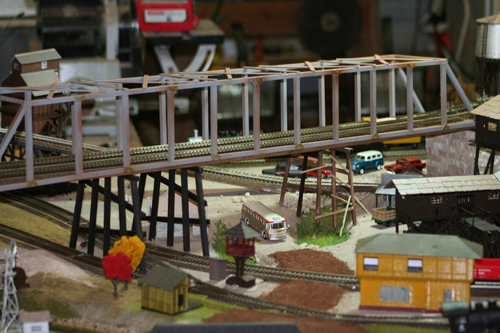
“Al, I have attached a photo of a bridge i recently build for my HO setup. Everything is still in progress but I thought I would share if you are interested.
It is all made from balsa wood sticks from the local craft store. I just measured the length of the bridge I needed and cut all the pieces with a razor knife. There was no master design just some photos off the internet as a plan. After gluing it was painted to look like a steal bridge that was rusting. The bridge will just lift off the track if needed.
Gary”
“Considering the relatively high prices for Model Rail-Road Bumpers (this applies to all Brands European as well as American), I decided to make them myself from material every railroader has in his or hers “Yard Scrap Bin”.
I, more or less, copied the bumper from German “Bundesbahn” styles and added my personal twist to the design.
This design works for all gauges! Just scale it up or down.
Read this entire document first and look at the pictures!
What’s needed: A couple of tools and a lot of patience!
-
Soldering iron with raisin and a bit of flux
Old tracks (you decide how long, curved or straight)
Metal file (small)
Needle-nose pliers
Side-cutter or cutting-wheel
Telephone wire, about 30 cm (1 foot) (you actually won’t need that much, but it makes it easier to work with.)
Glue for plastic models as well as epoxy glue or something that’ll glue plastic to plastic and metal to plastic.
Measurements are Metric and US Standard.
Pull out the I-Beams, which make the track, from the rail ties. (10 cm or 4 inches will suffice)
File the I-Beam flush at one end and cut off a length of roughly 3.1 to 3.2 cm (1 3/16).
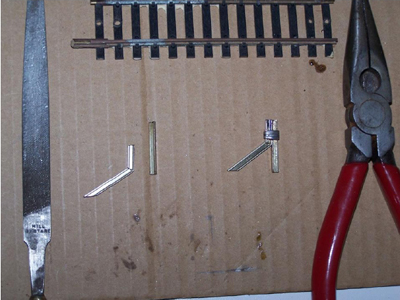
Take the file and V-grove the track at 2 cm (24/32) starting from the running surface of the track to the wider track section where usually the tie-down clasps are located. Stop filing just where the file hits the lower part of the I-Beam.
Slowly (I really mean it) bend up the track to form a hockey stick-like figure. File the long end of the piece flush with the horizontal track you want to mount the bumper on.
Cut off another 2 cm (24/32) length of track (always cut off a tad too long, and then file down to size!) This is the vertical I-Beam.
Pre-tin the upper part of the vertical beam and the small part of the “hockey stick” where they will face each other later. (Bottom of the track)
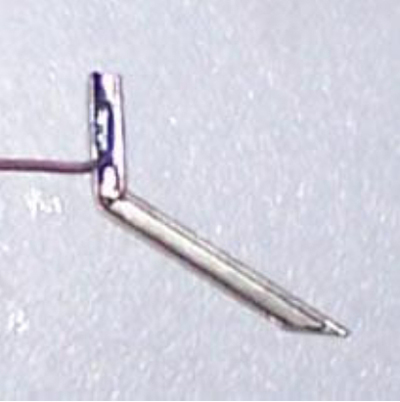
Take the telephone wire and strip off about 10 cm (4 inches) of the insulation.
Bend one end 90 degrees (about 4 mm or 3/16) and solder the bent part into the track grove just above the angled section. After the joint has cooled down, wind the wire 4 times around the vertical beam and the short hockey stick section, making sure that the I-Beam surfaces touch each other nice and flat.
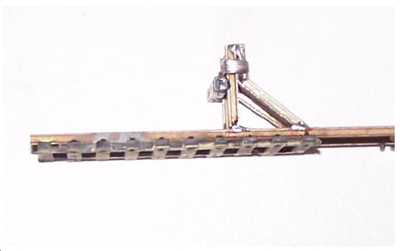
Solder the wire and the I-Beam sections together, by applying the resin and a bit of flux to the wire wounded section. Let the resin penetrate the entire area. You may need to turn the section up-side-down to work also on the back side.
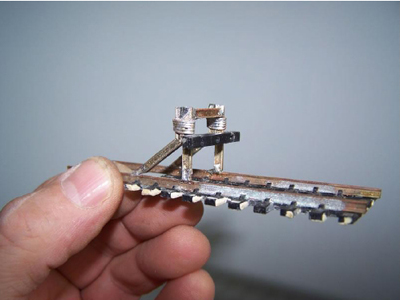
Make the other side! Match the measurements of what you just created so they look the same later. (if not, filing will make things work for you!)
After the second side is done, select a track you want to use as the bumper track. You may want to experiment with short, straight tracks or even round tracks.
Solder the bumper sections on top of the tracks, each side. Make sure that the front part line up properly. (You may need to cut back some of the rail ties on the track, though.
The bumper side can also be soldered to the inside of the tracks. (This makes the entire assembly lower)
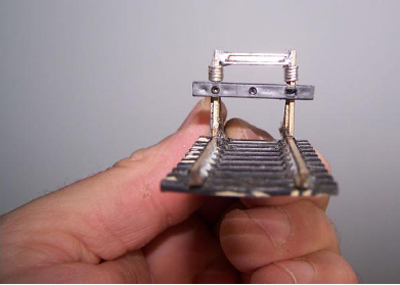
After both sides are positioned and soldered on the tracks, take 2 rail ties from the track you pulled the I-Beams from, file the tie-down clasps level of one of them and glue them together back to back. Make sure you leave the tie-downs on one of them intact!
Measure the height of the bumpers (buffers, Puffer in German) of your rolling stock or Locomotives and clip the double-sized tie to the vertical I-Beams of your bumper. Glue the doubled-up tie to the vertical beams. Let dry! In case that the new bumper is too flimsy, cut out another track piece and solder it in between the bumper sides for stiffening. You could also use another tie down and insert it at the top as an alternative. Caution! If you use a metal I-Beam as stiffener, make sure that you use isolation track connectors or you will create a short across the tracks!
To make the wrap-around wire look more realistic, just flatten the telephone wire with a hammer. This creates some nice looking flat metal bands. This project should give you some ideas. I bet there’re people out there who can do it much better than I. Please, share your ideas and pictures.
All the best
Michael”
That’s all this edition of model trains tips and ideas. Hope you’ve enjoyed them as much as me.
And best of all, I have a stack more that I’ve uncovered too – but they’ll have to wait until next time.
I’ll leave you with a bit of fun. Another one from Dangerous Dave (I think he’s been on the sherry again). I have no idea why his layout and vids are so watchable. I can’t seem to stop myself.
If Dave has inspired you, the Beginner’s Guide is here.
Or perhaps you just want to save a small fortune with the ebay cheat sheet?
That’s all this time folks. Please do keep ’em coming.
Best
Al