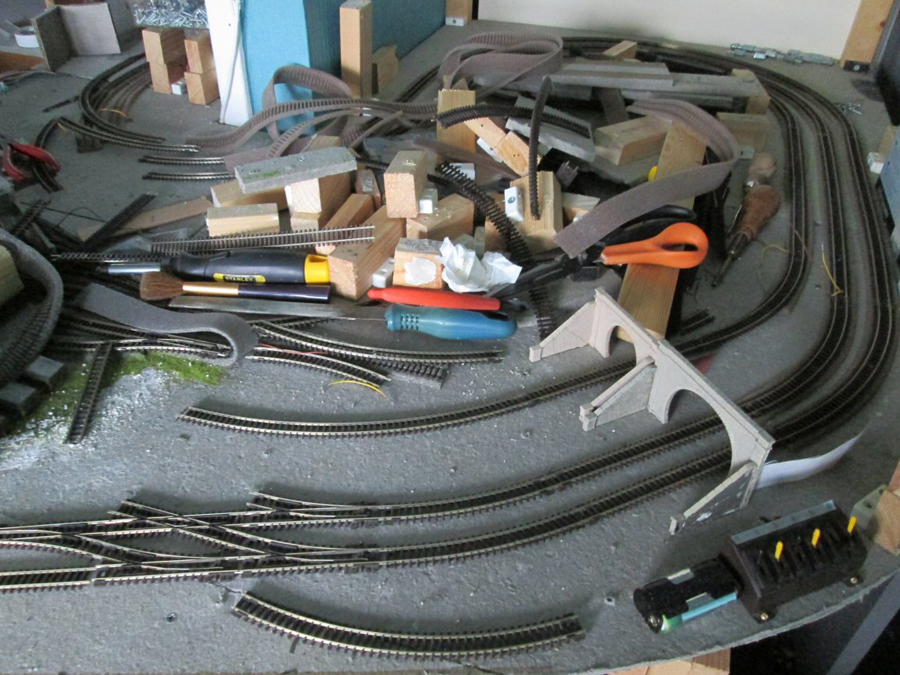
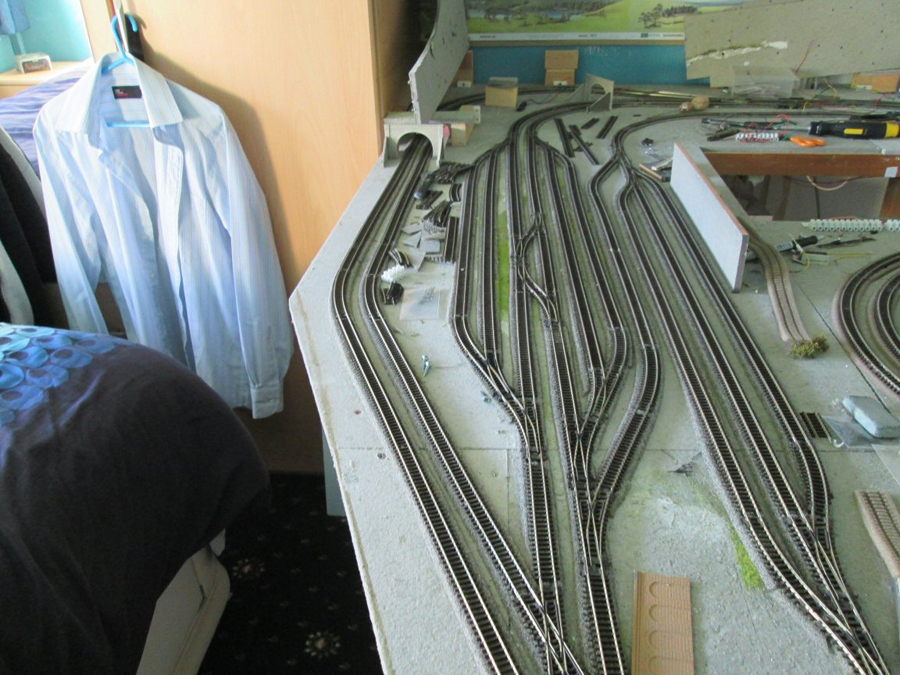
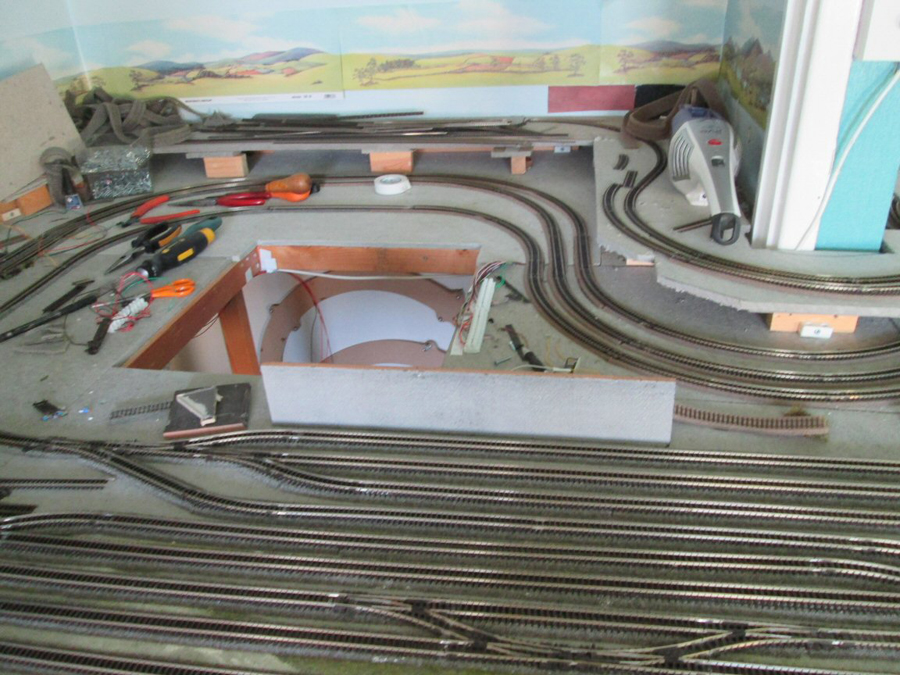
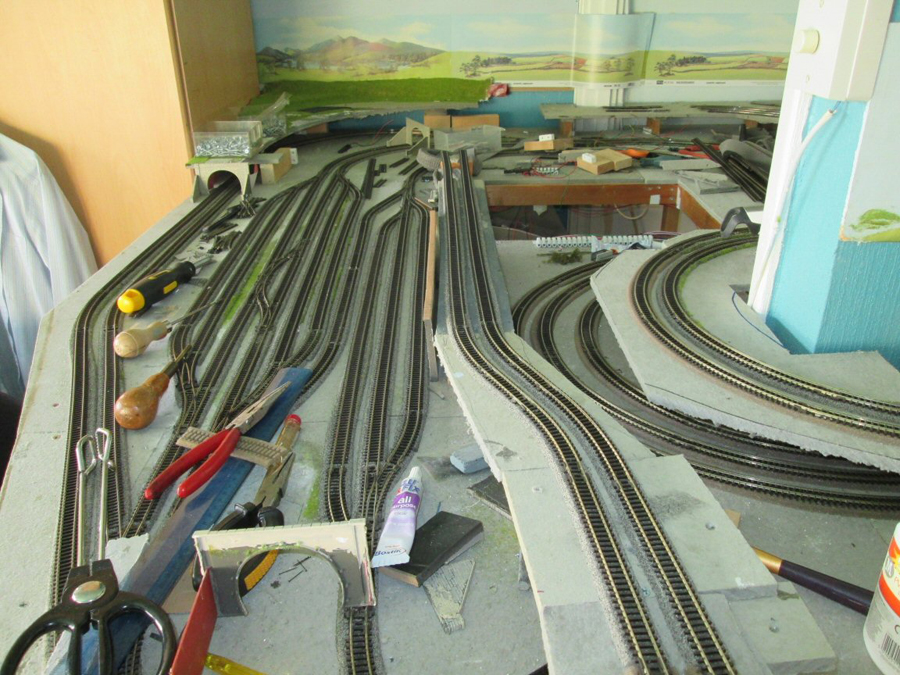
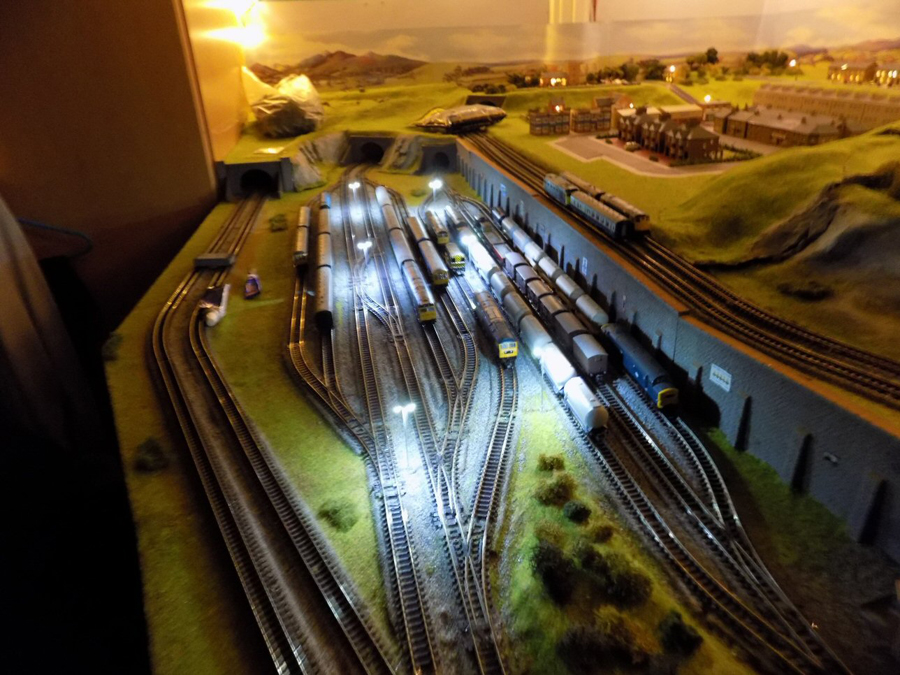
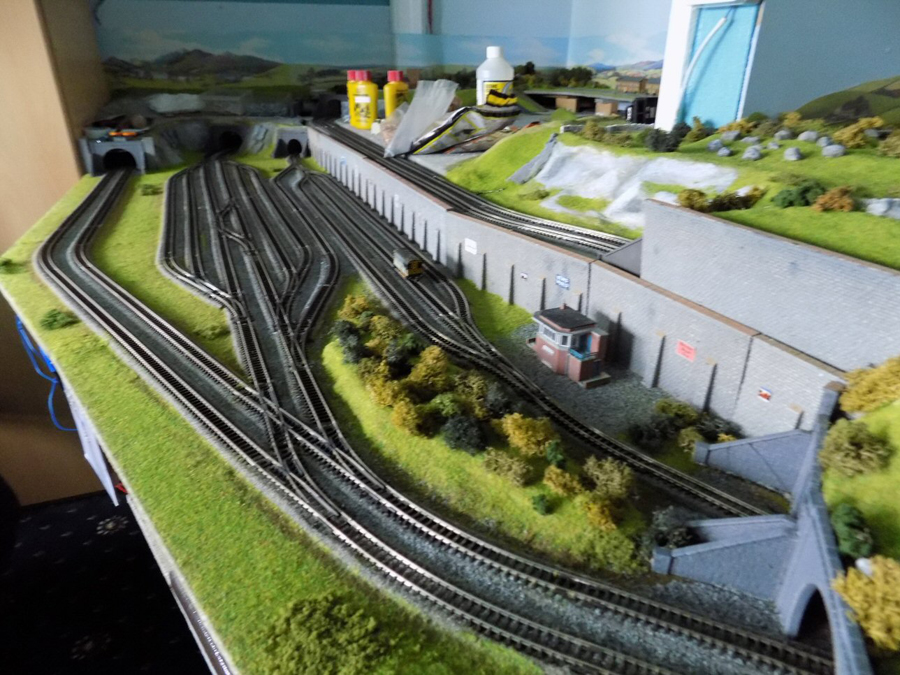
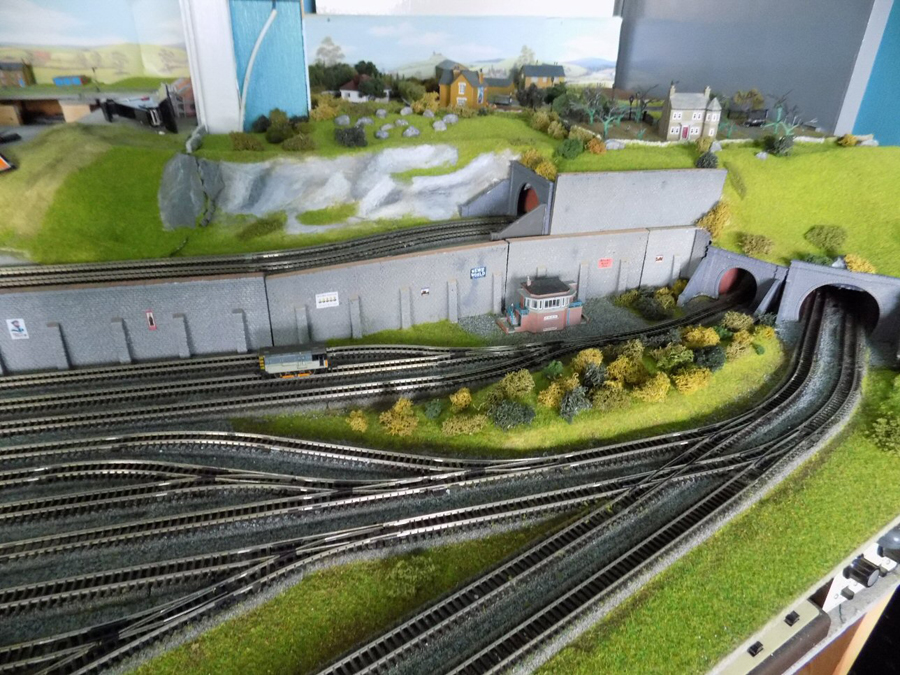
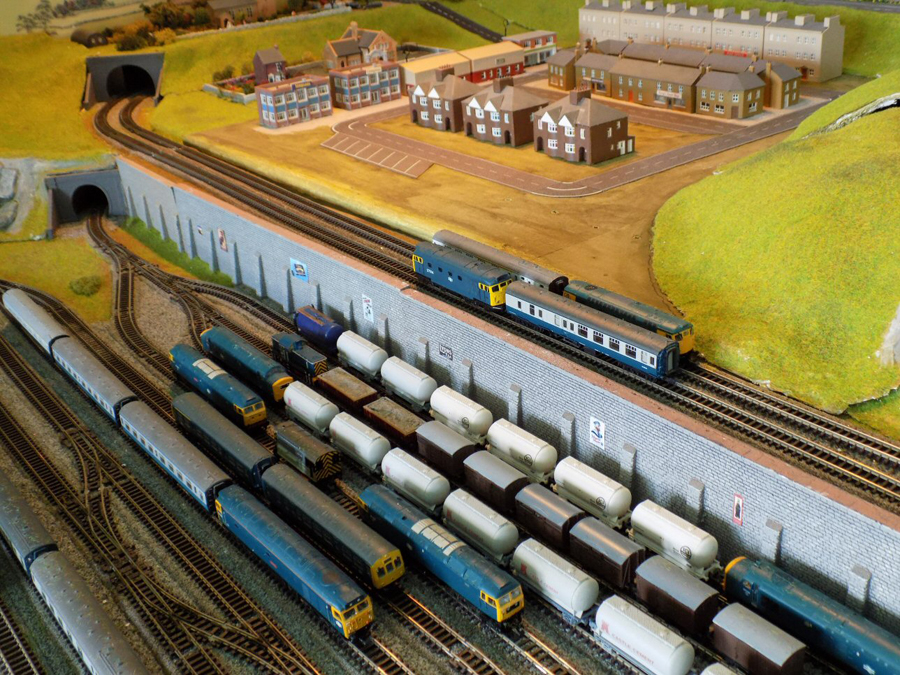
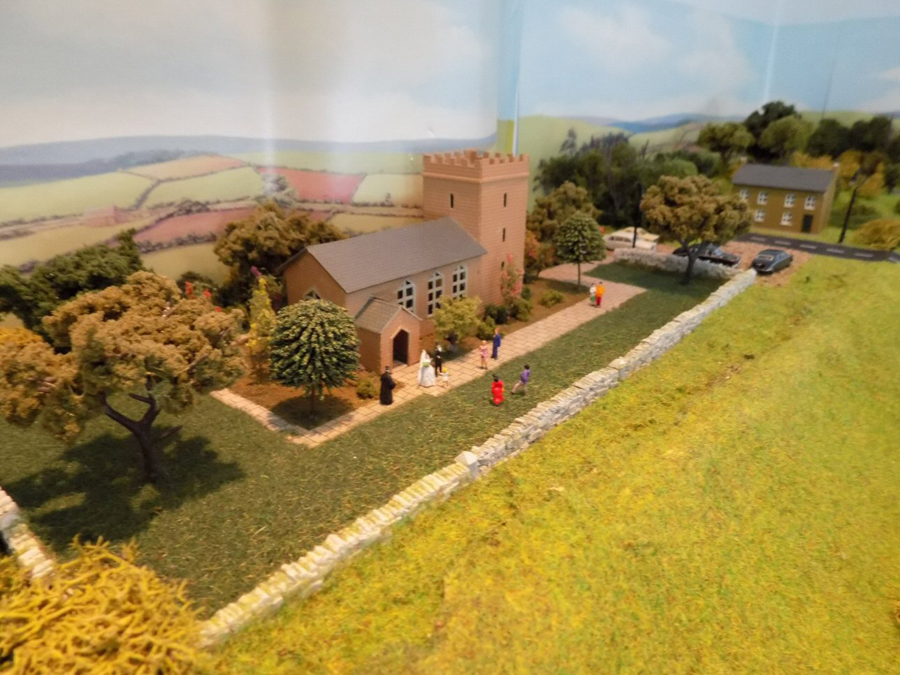
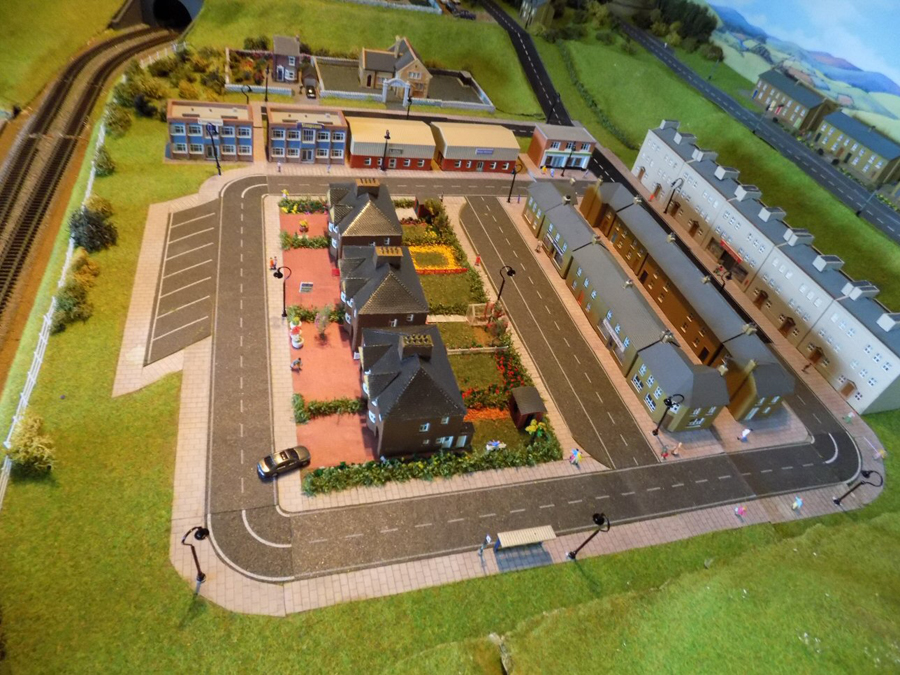
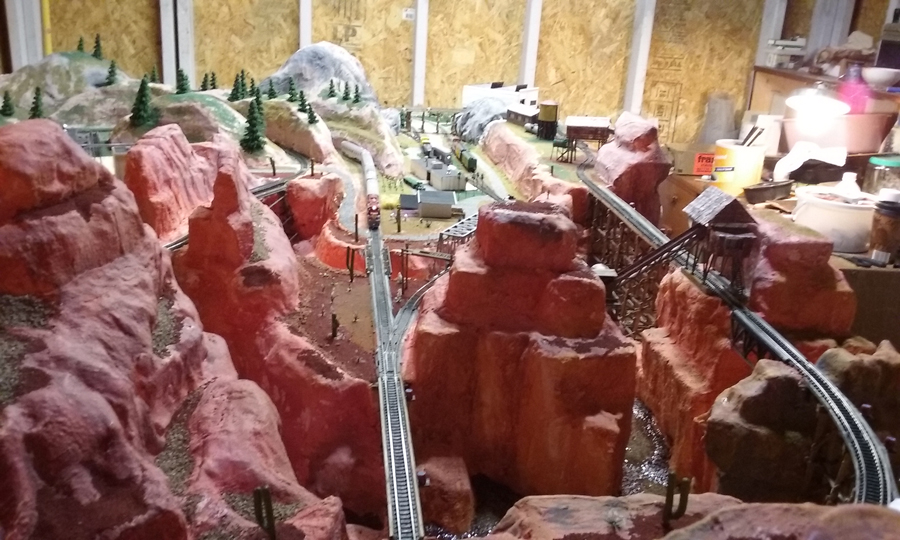
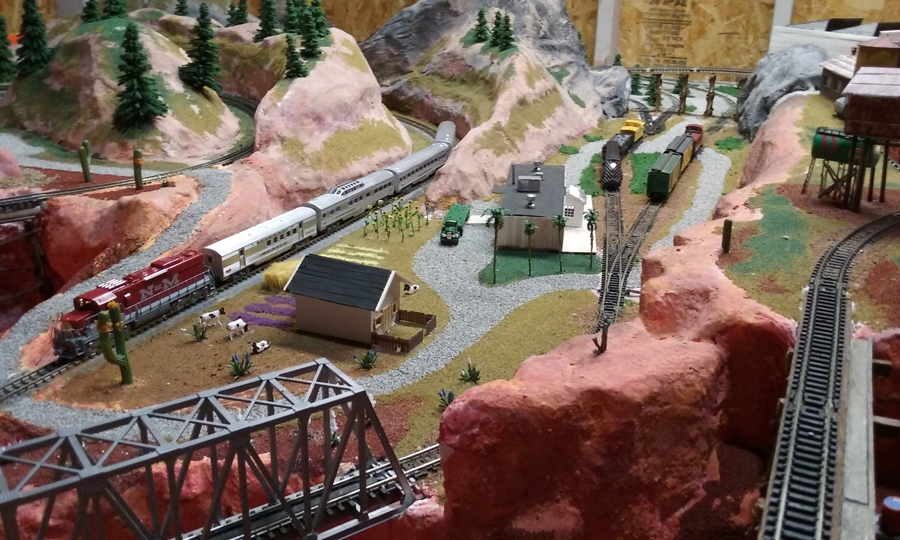
Eric’s been busy on his N scale model train layout:
“Hi Al
I attempted to build a new layout a while ago after having to gut my old Wensdale layout.
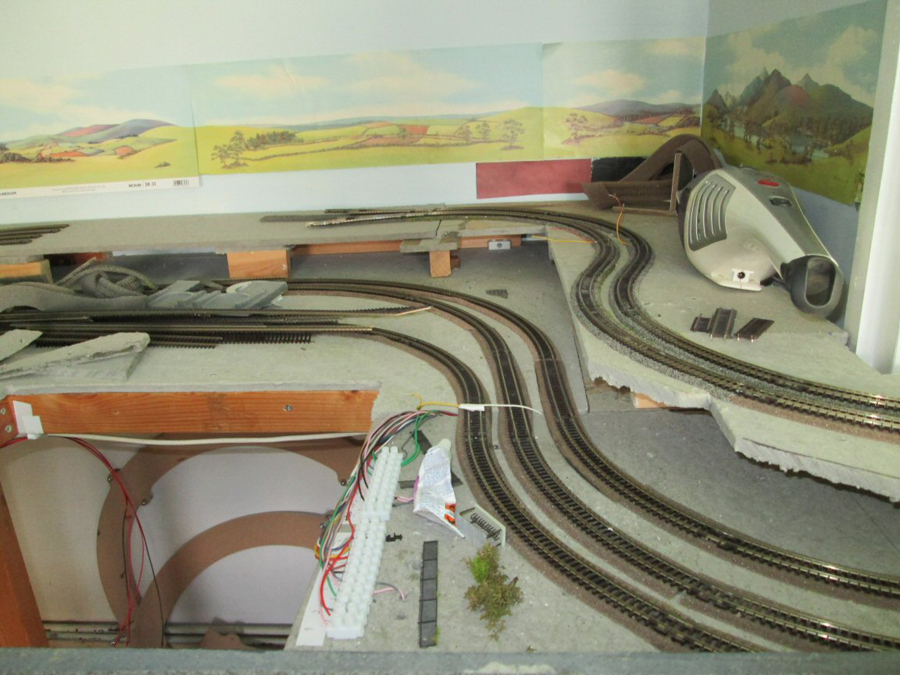
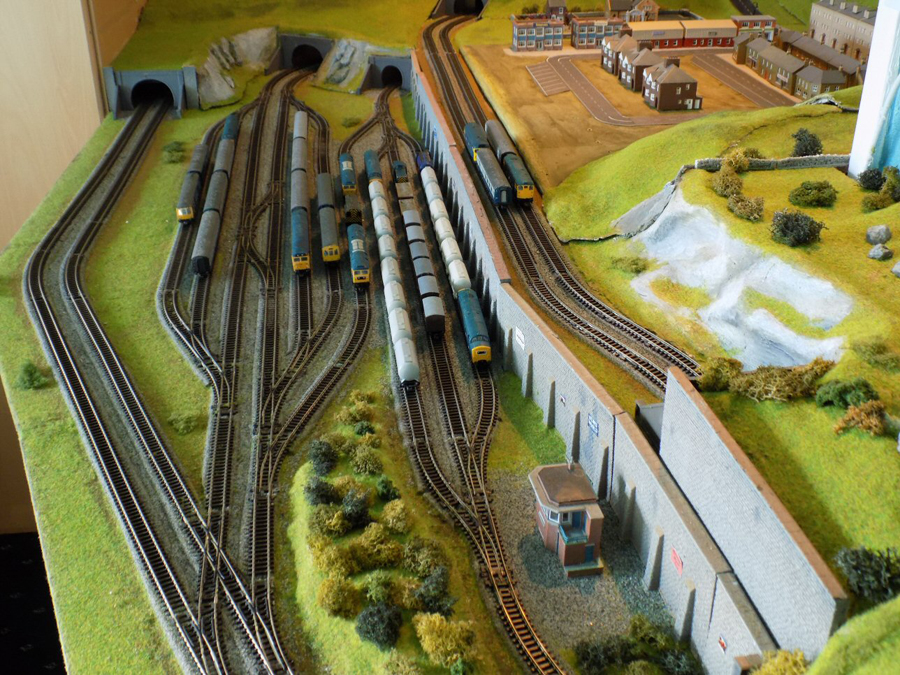
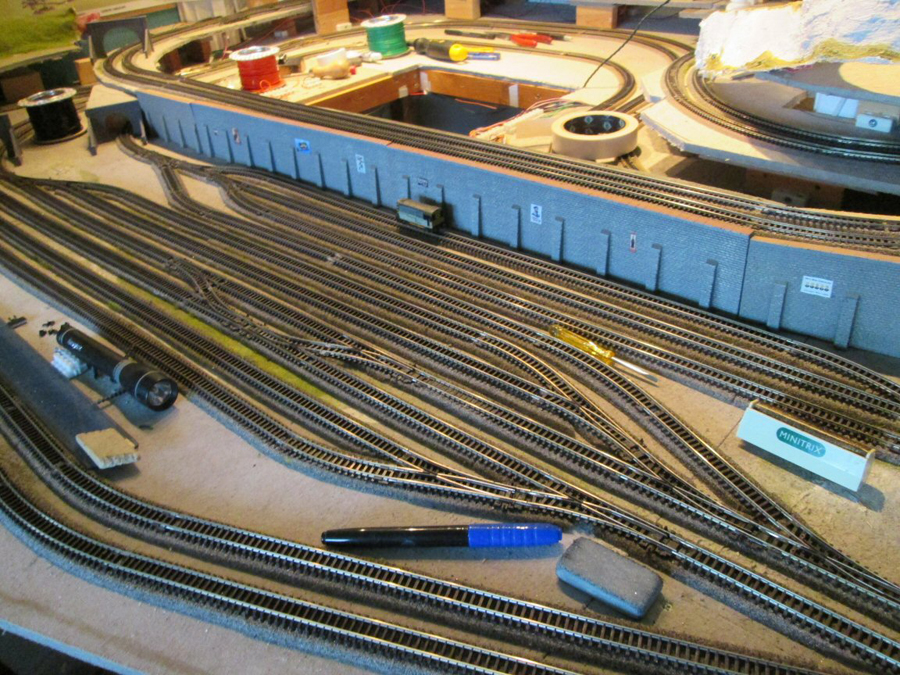
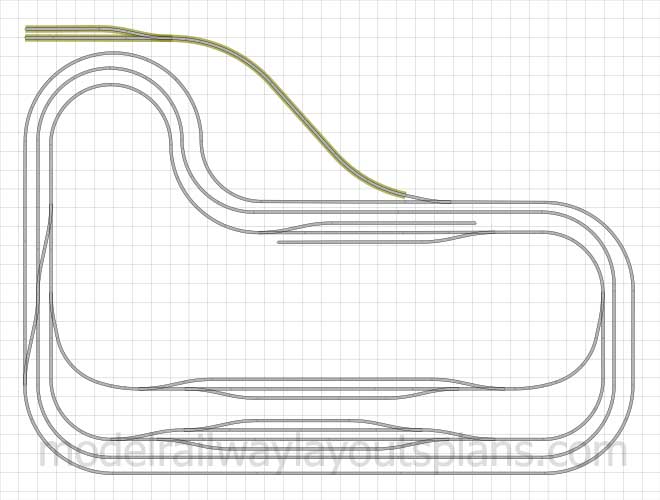
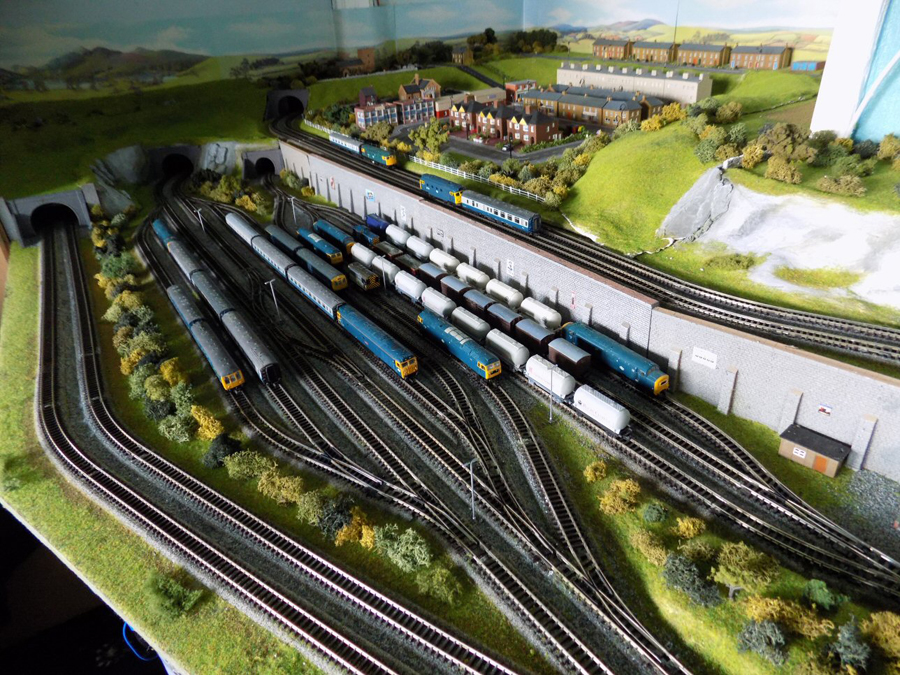
Unfortunately I couldn’t get it to turn out to my liking, so I restarted from scratch, using just normal Peco setrack with gravelled underlay. The pictures show it from the start. figuring out in my head and not on paper how I wanted the tracks to run. Somehow I managed to fit five working tracks into the space. I dismantled my helix but kept the top farm board and also the main road on the back wall. The rest has just come together quite nicely and run well without accidents.
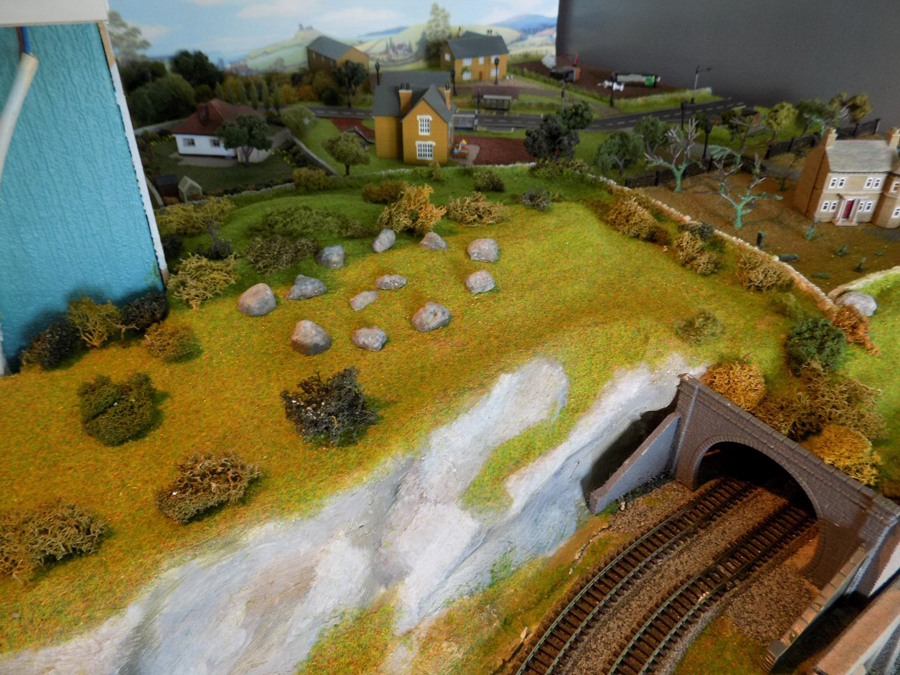
In this new scenario I opted for not having a station but kept a fiddle yard at the front with connecting rails so the engines can go from one track to another. As can be seen in the attached photos how it is coming together, yes even the joins. It has now reached a point where I need to fine tune the scenery. The later pics show less joins but a few are still obvious.
This layout is analogue with conventional wiring running off my eight controls, 5 for the tracks and 3 for the lights. The size is around 7 by 5 feet but with a solid wall by the farm board that the tracks have to go round. This time I have used studs for point switching on the 6 hidden points and find it much more positive than the old lever type switches, the hidden sections also light when the track in powered so I can see the points have changed. One thing I must add is that I have full access to all the tracks around the board, this means I have 8 lift away boards and 5 lift off pasterwork sections hence a lot of joins.
My only concern with myself is that I love designing the tracks and building it, the scenery although essential to give it body, I dislike meaning I am already thinking of a new layout even though this one has a way to go yet. Ah well we have to keep our minds active.
Eric”
N scale model train layout:
And here’s the video:
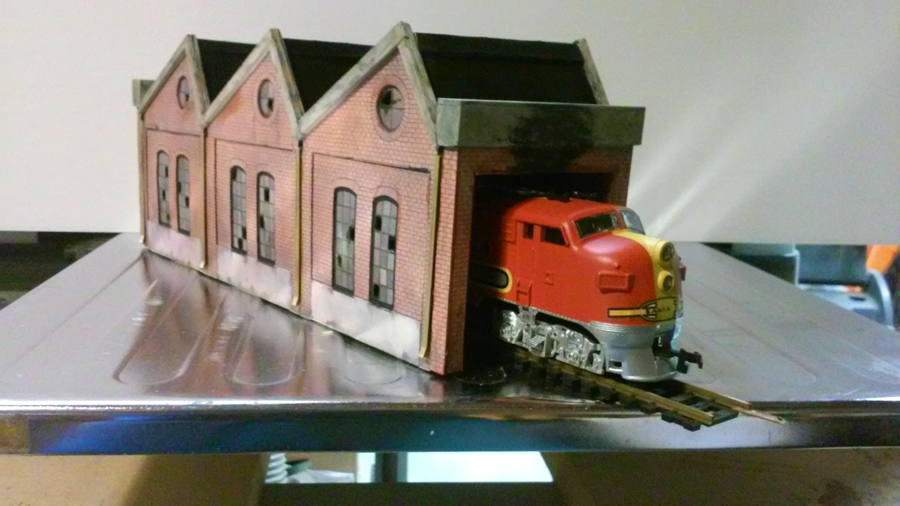
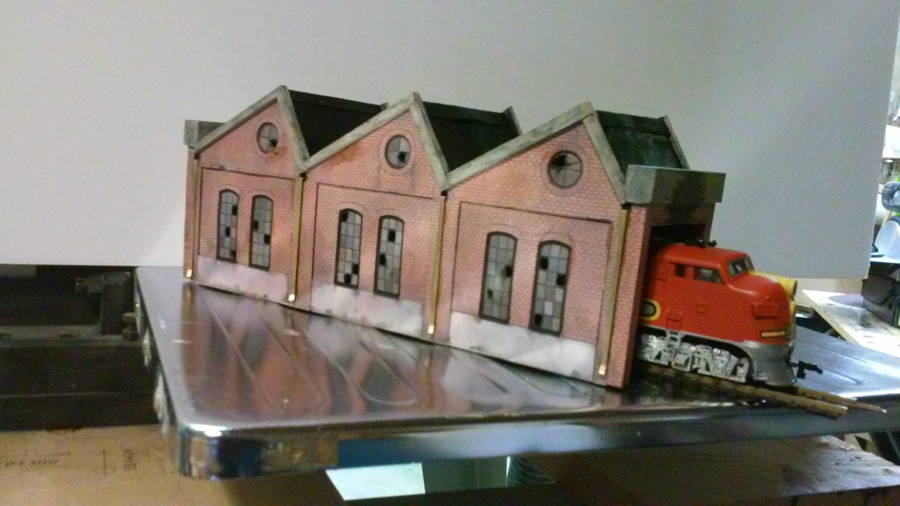
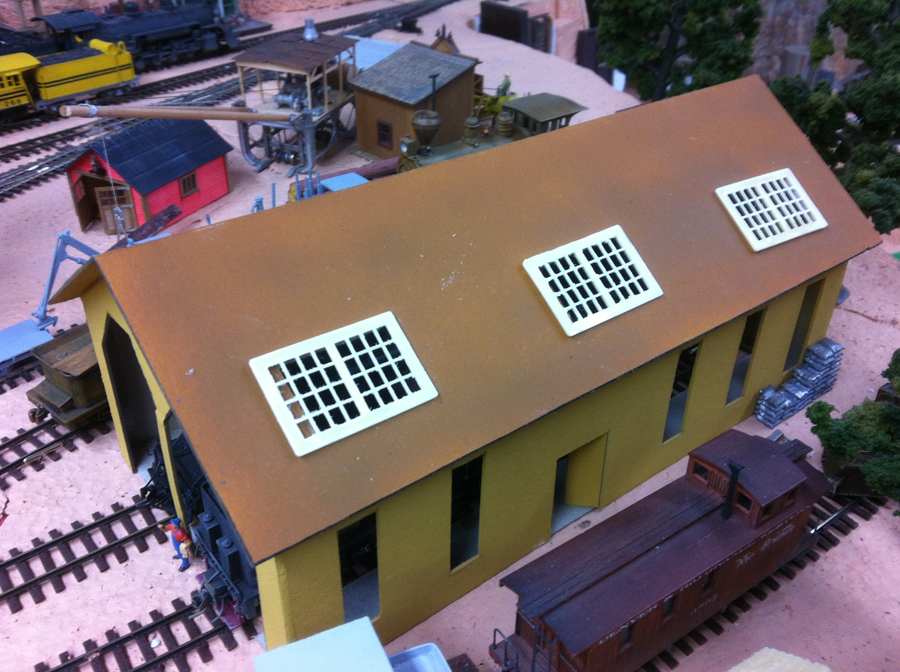
“Hey Al, I’ve been enjoying the pics n the tips. I have one of my own. I got your engine house after watching the how-to-video n thought I’d give it a go. When I finished it up, I thought, it needs down-spouts. I was going to use wooden dowel rods, but thought, years ago a lot of these buildings had brass or copper for rain gutters. I took the rails off 2 old pieces of track n cut to length. I used the rail as the back, sliced a grove down the wall for the rail to set in. Cut just the slightest part of the rail near the end n it turned up ever so slightly n then I super-glued it in the grove. Now I just need to figure out how to get that dirty greenish aged look.
Hall of Fame member, Brian, has sent in this wonderful ‘how to’ for his HO scale engine house. If you want to see more of his layout, it’s here.
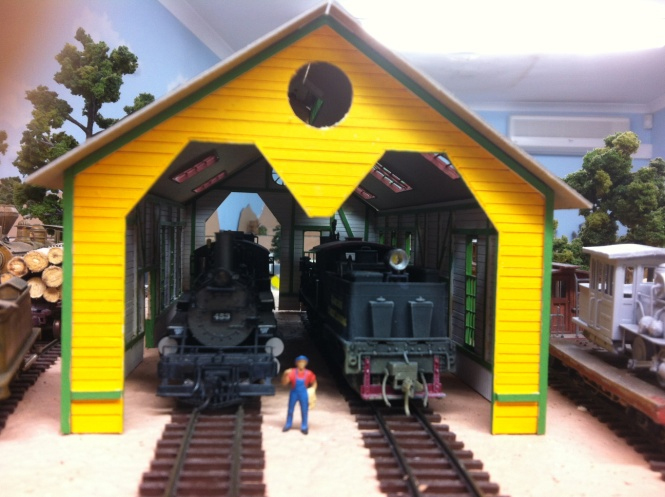
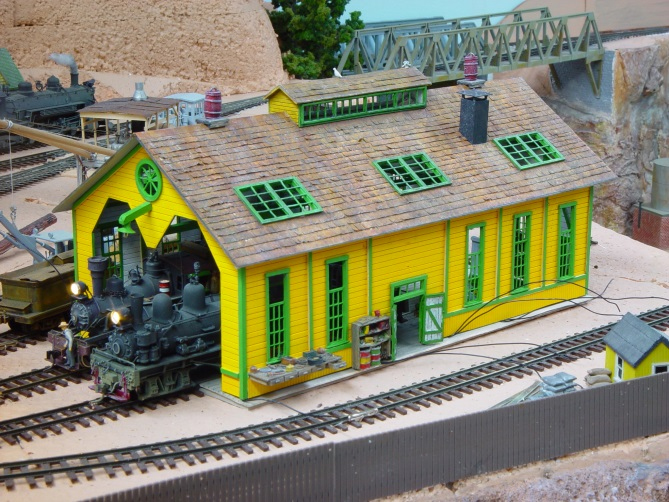
“This two stall HO scale engine house kit is a real classic with the original design by the late John Allen where it appeared on his original Gorre & Daphetid 8 x 4 foot layout and later incorporated into his basement layout. Photo above compliments of Model Railroad Craftsmen.
I have built this kit before for a very good friend and as payment, I was given my very first HOn3 narrow gauge brass, a K 27 Denver & Rio Grande locomotive made by Westside Model Company.
This is what got me hooked on narrow gauge and have never looked back. (More on converting from HO short line to HOn3 and why, later)
As with any kit that I intend building, I make a card stock mock-up full size of it to ensure that it is what I am looking for on the layout.
If it needs kitbashing (modifying), it is easy to add or cut card stock to throw away or add and is cheaper than messing up an excellent kit.
Most of the time, I paint the mock-up a colour that I think would best suit the location and again, it is easy to re-colour the mock-up without having to repaint and loose detail on the kit.
The instructions suggest that you build this HO scale engine house kit on a mini diorama for later installation on a layout. I will not do this as I have my track already laid on the layout and will build the kit on my workbench until ready to install.
The instructions are correct in building a diorama on your workbench as you can add all the fine detail and final painting before installing it on a layout.
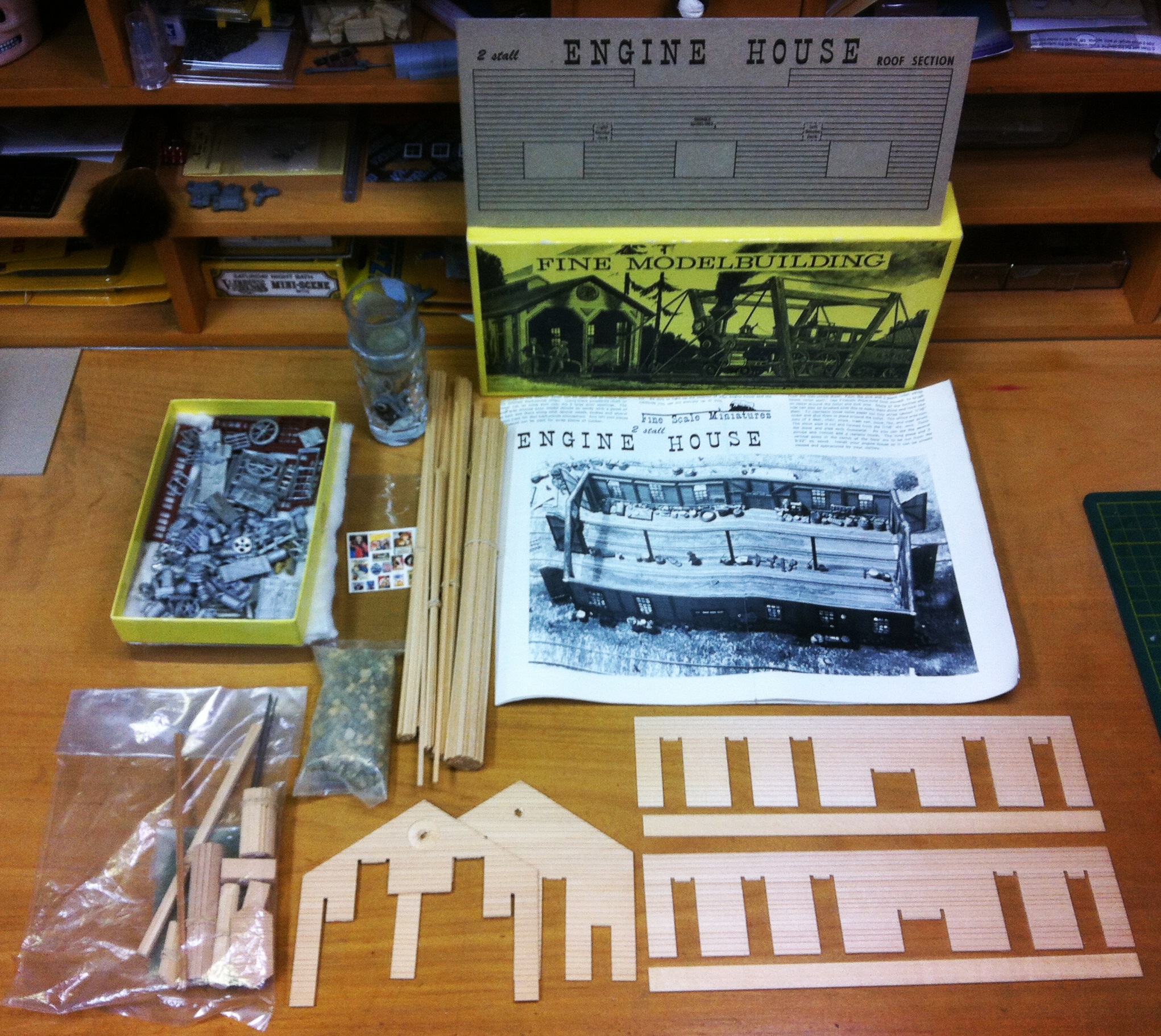
When opening the box, you will notice that this is not your normal run of the mill kit. It is a CRAFTSMAN kit.
This is where I realize that this kit is really old as there is a lot more work to be done than a lot of the newer kits of today.
The instruction sheet has black and white photos with the text and drawings explaining step by step construction.
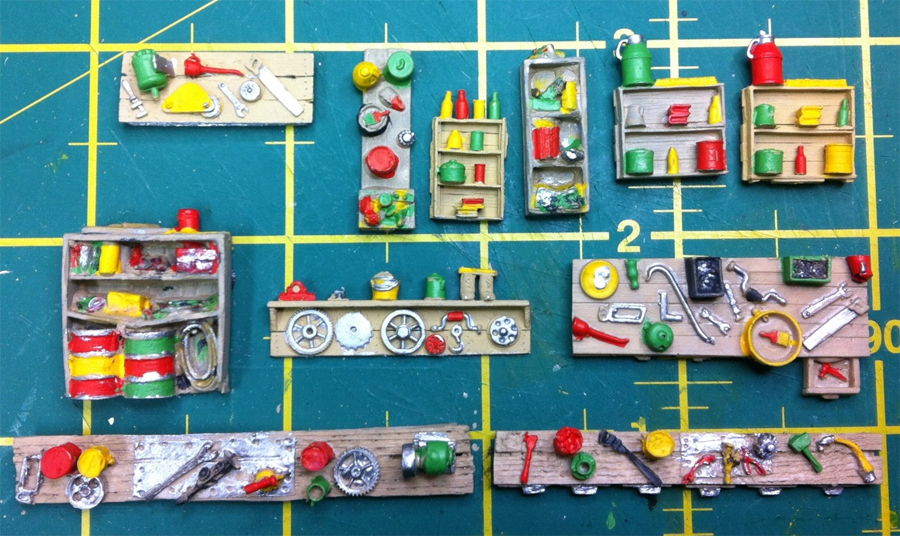
There are bundles of wood, a bag of small stones, four walls, roof card material, a box of many white metal castings, posters, newspaper cuttings, clear plastic for windows and sheets of shingles for the roof.
This might sound like a broken record BUT it is advisable to read the instructions in any kit thoroughly and then read them again to make sure that you understand them as one would not want to mess up an expensive kit. Again, the time spent on a kit is equal to what the finished product will look like.
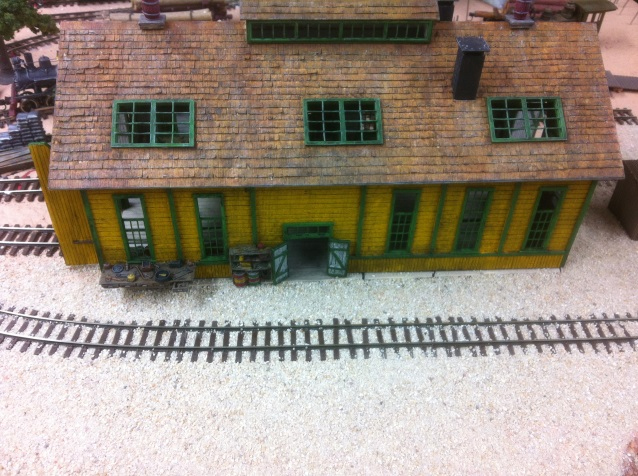
Before beginning the HO scale engine house kit, decisions have to be made on the final colour of it. Is it going to be stained or painted? What colour are the white metal castings going to be painted? I am going to deviate from the instructions on colour as I prefer a wash of Yellow on the outside walls and maybe an earth colour or white on the inside.
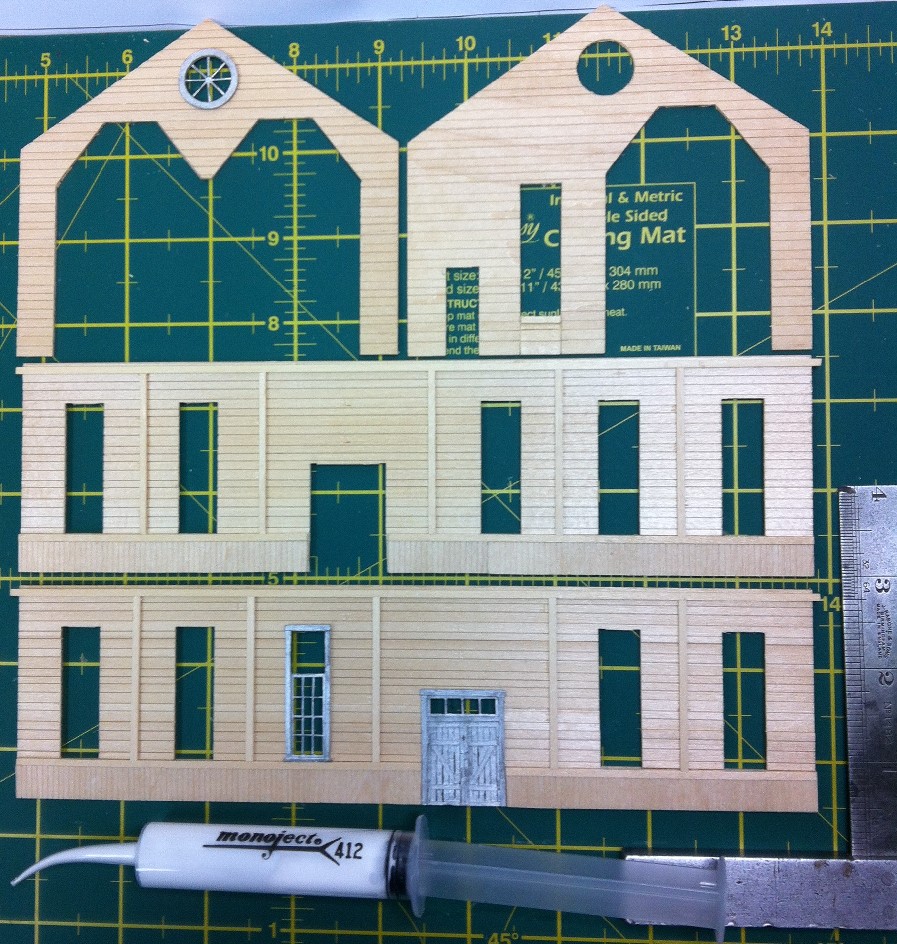
All the trim will be done in a light Green. I use a small syringe filled with white Alcolin wood glue of the fast setting type. You can control the placement of the glue using a syringe and not get any glue where you want to stain.
All my wood parts are going to be stained (washed) first before I glue anything together as this eliminates the glue from preventing the paint colour seeping through.
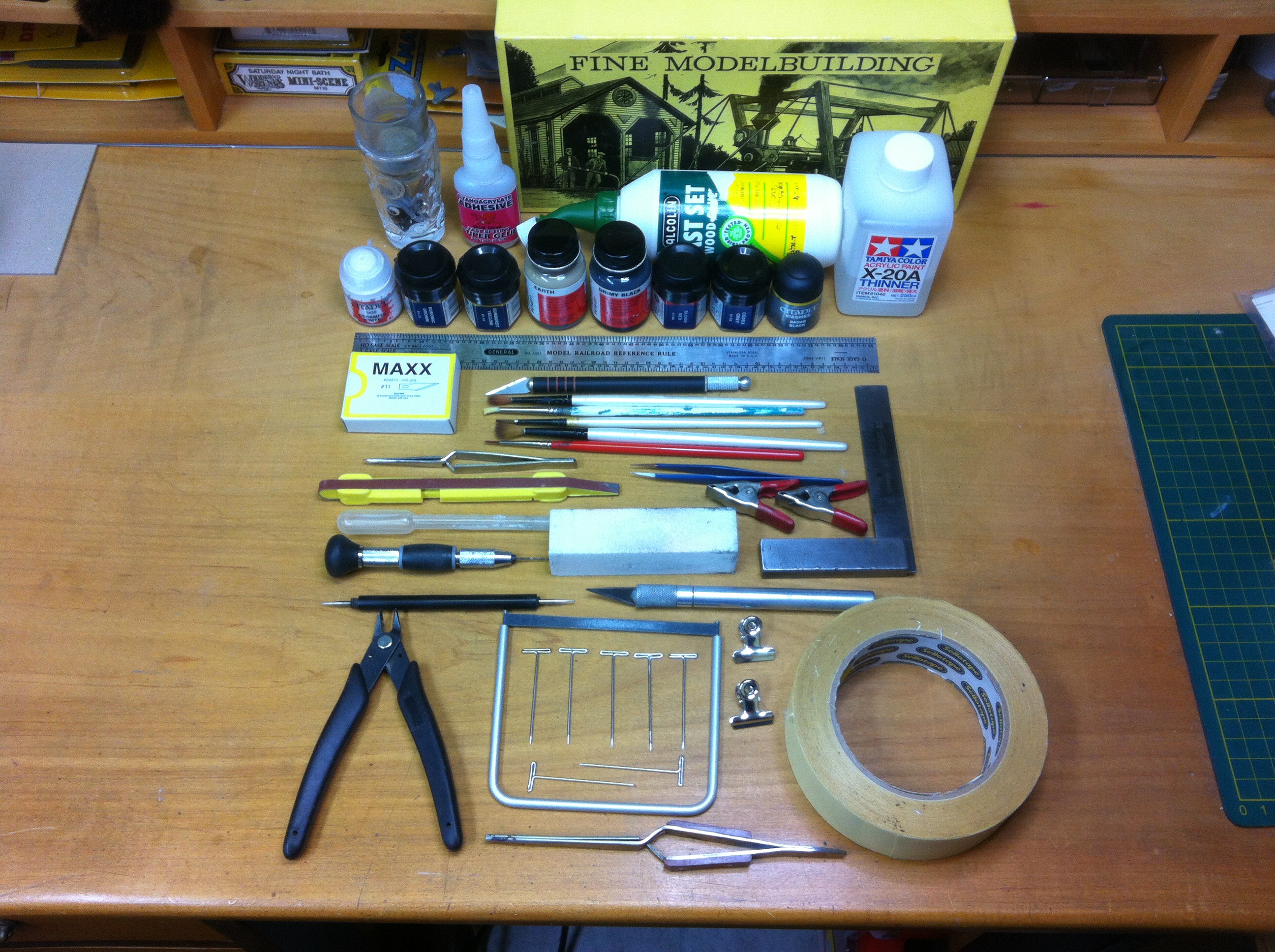
Tools used in the assembly of this kit will be: (not necessary all of them)
A modeller’s knife and spare blades. steel ruler, engineer’s square, syringe, tweezers, various weights, clamps, pin for nail holes, sanding block, flush cutting cutters, paint brushes, double sided tape, wood glue, super glue.
My preference for paint is an acrylic base (water base) as well as acrylic thinners.
The reason I use acrylic paint is twofold, it is easy to clean brushes as well as air brushes using water and you can thin them down preferably with acrylic thinners to use as washes (stains) without affecting the base paint. I keep a Tot glass stuck with Prestik and filled with water to clean my paint brushes.
HO scale engine house kit:
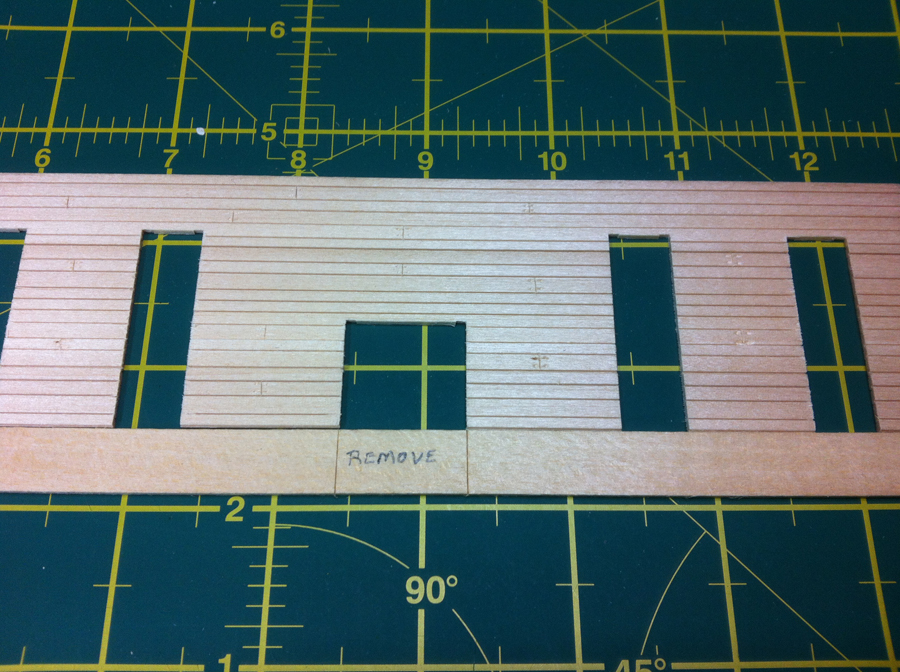
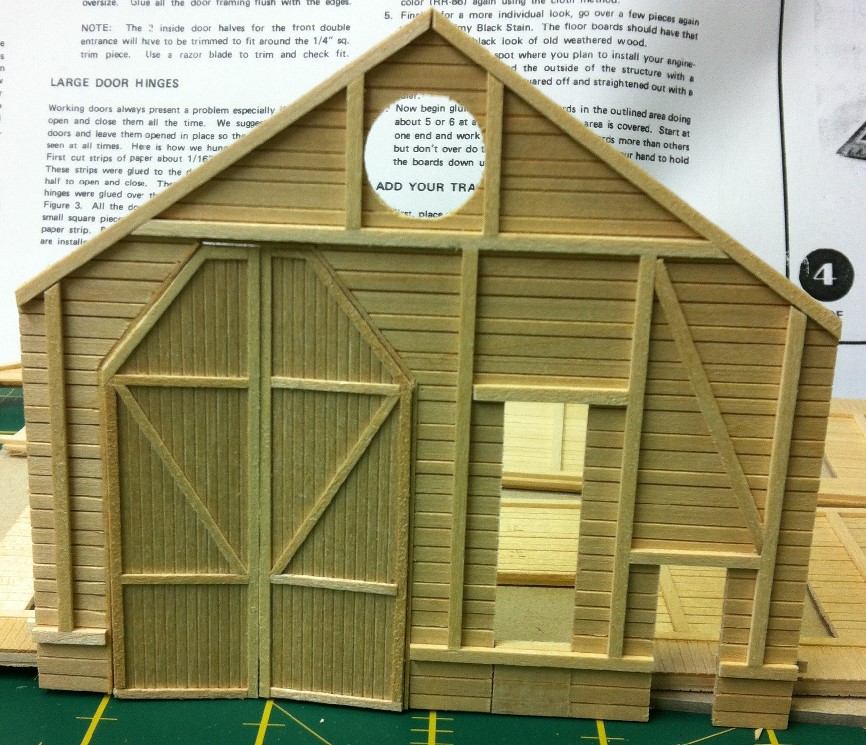
With all said above, let’s start the kit by trimming all the excess wood from doorways and windows. This is where I use the hobby knife to cut odd lengths of board on the siding (both sides) and add the nail holes at these cuts.
I then mix up the yellow wash making sure that I have enough for the whole building. It is difficult to mix the same consistency as the previous mix if you don’t have enough. I use an empty air brush bottle for my washes.
I begin with the washes on the exterior of the kit. Once this is done and let dry for 30 minutes, I then do the interior with either white or an earth colour and again let dry for about 30 minutes. Remember to keep on a flat surface weighted down to stop the walls warping. If warping occurs, the bracing on both interior and exterior will correct this.
I lay all the metal door and window castings on masking tape, sticky side up for spraying with an airbrush (quicker than painting with a paint brush.
I only use my airbrush if there are a lot of parts to be sprayed). Once thoroughly dry, turn them over and spray the unpainted side. Air brushing speeds up the drying time to minutes and a smoother finish is obtained. I then start with the exterior and interior bracing.
The HO scale engine house instruction sheet calls for a stone foundation along the bottom of the engine house. I have deviated from this and added scribed siding vertically to keep the whole structure wood.
Again this is a personal preference and also makes it easier to add the workbenches and details to both exterior and interior flush with the walls.
After bracing the track doorways, I tackled the main doors.
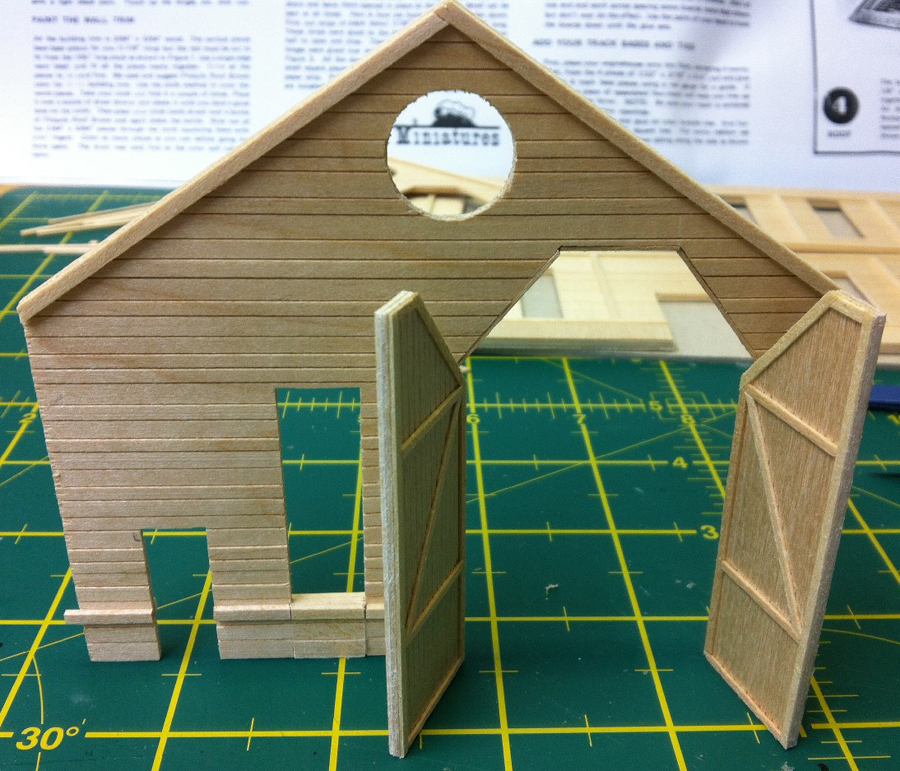
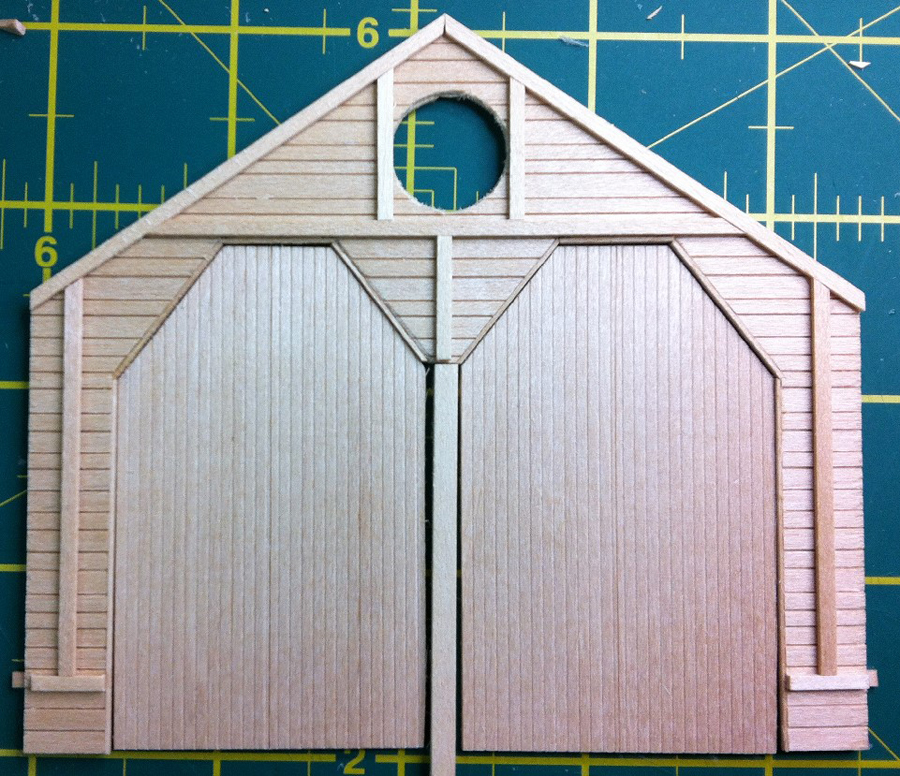
Here the instruction sheet tells you to use the cut individual strip wood supplied to make up the doors. I deviated from this and used thin scribed siding back to back using double sided tape in order to give the inside and outside the individual board look. It worked very well.
I marked out on the scribed siding using the side walls with the doorways as a template, where the actual doors would be. I assembled the doors as a double door and added the bracing. Once complete, I cut the doors down the middle giving me two doors that can be built in the open position. This method was much quicker and easier and speeded up the assembly.
Once all the doors are done, I will then start with the painting of all the built components, walls, doors, trim and spray the metal castings.
I am again deviating from the instruction sheet when it comes to building the floor of the engine house.
As this is not being built on a diorama base and then onto the layout, I am going to cut a piece of card stock the same thickness as a sleeper on the track to use as a base to begin with.
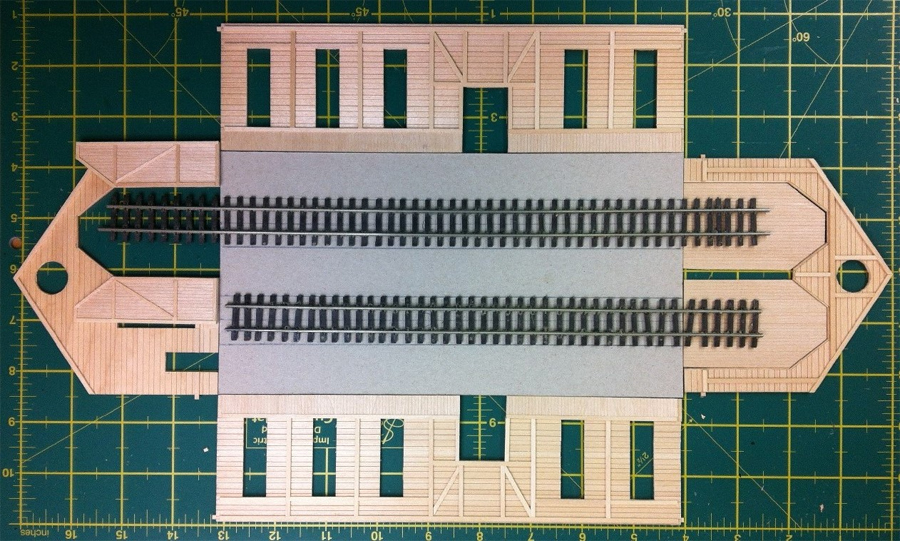
I will assemble the four walls fir the HO scale engine house onto this base temporarily to get the building square.
Once this is done, I then mark the centrelines of the track onto this. The track sleeper width will then be cut out on both tracks leaving me two grooves where the track fits which are already laid on the layout.
The reason for the card stock is to serve as a riser to bring the floor of the building up to rail level so that when all the floorboards are installed, all the flooring is flush throughout the engine house.
Before cutting out the pieces for the track to fit, I have to paint the four walls and then temporarily assemble the structure to get the correct width of it so that all will line up before placing on the layout at completion. Now to just get on with the painting before I get tempted to assemble the structure.
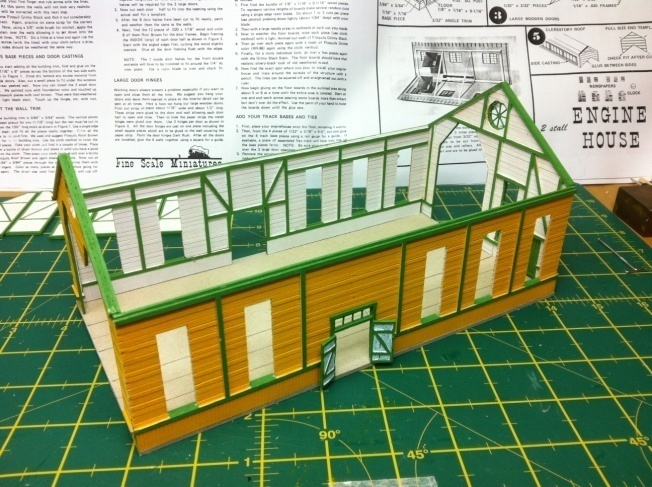
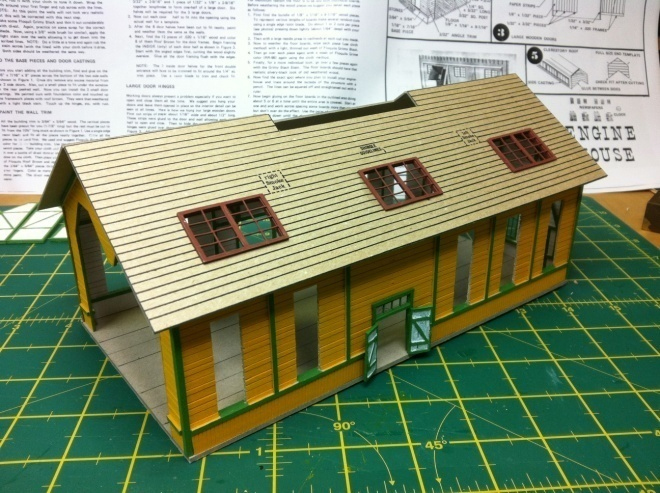
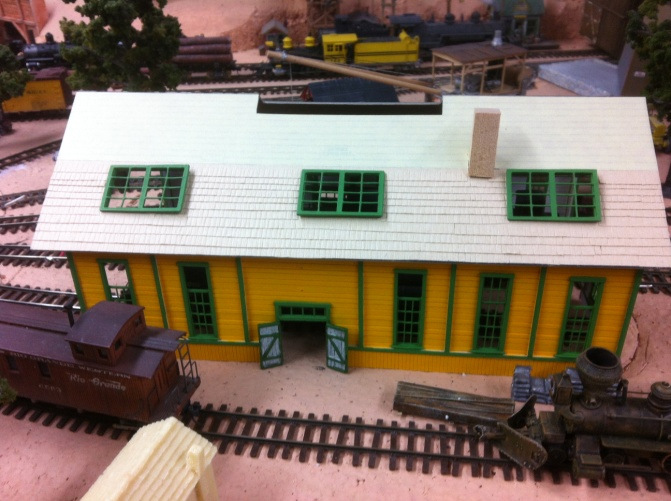
Here we have the walls painted inside and outside and assembled (left). The roof card has been cut and temporarily put into place for a test fit. The cardboard base in place, again for a test fit. The corner trim has also been fitted and painted (right).
HO scale engine house:
The structure has been put into position on the layout to test clearances before it is too late to make changes.
Next was to start adding the shingles to the roof, a long and tedious job. Here it can be seen that only half of the roof half has been done. The eyes end up seeing more rows than there are and need to take a break before continuing.
The next photo shows the completed roof and shingles after being stained and prior to the lifting process for the individual shingle look.
Here I differed from the usual shingle strip mounting with glue and used double sided tape which made the process of laying shingles much quicker and easier than the glue method used previously.
The tape also helped to stop the warping of the roof in the staining process, a very big plus. It also helped when lifting the odd shingles in the weathering process as there is no glue to contend with.
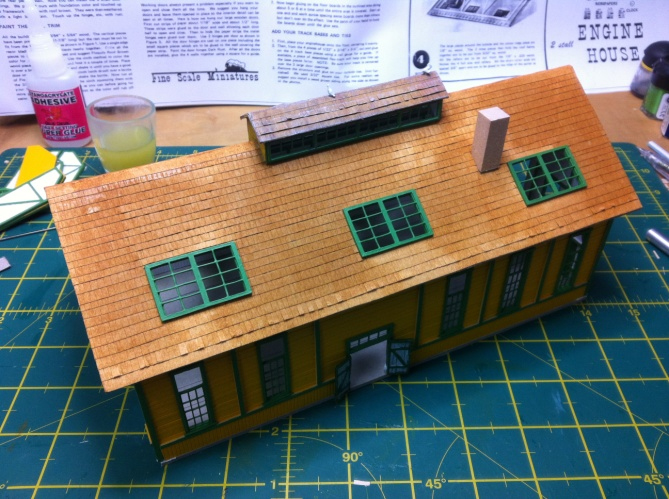
The next set of photographs show the shingles in place and the stain process completed. The clerestory roof has been completed and as can be seen, the pigeons have taken up home already. The bottom row of shingles shows the start of the individual shingle lifting. Again a long and tedious job BUT the end result is worth the effort.
As I have always said, what you put into building a model will always show in the final product. The photograph below shows the almost complete weathered roof.
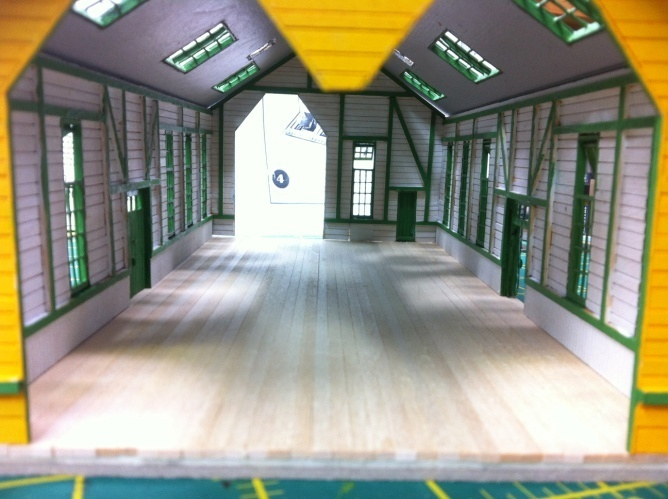
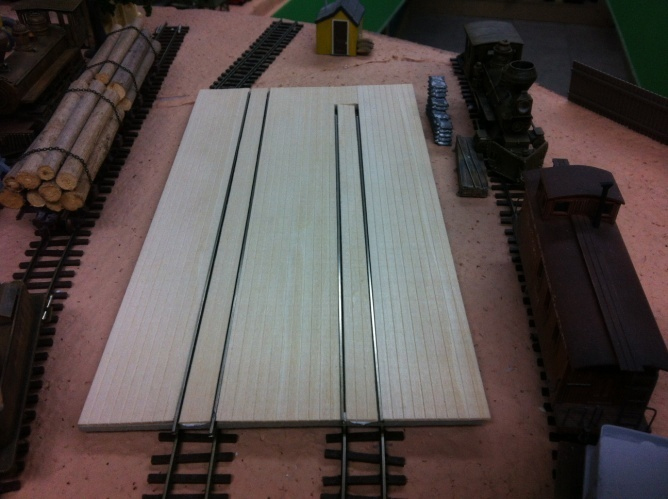
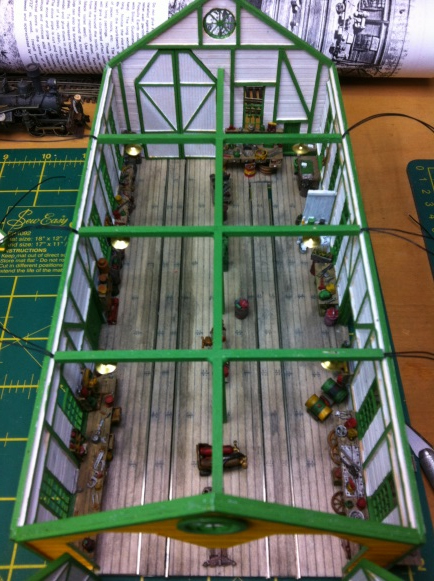
After all the above was done, I started on the floor of the building using the individual boards (below left) as per kit instructions. After much debate, I opted for a scribed sheet floor as I was not building a diorama base for this and had to figure out how to do the interior without the diorama base.
In these photographs below, I have mounted the scribed siding onto a card base to bring the floor up to the correct height of the railhead.
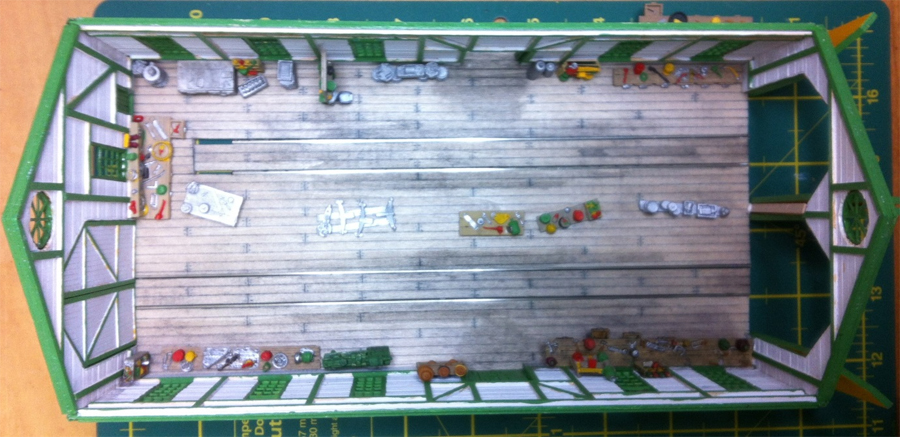
Above is the scribed floor at the correct height of the railhead and right showing the underside of the card cut out for the railroad ties. The next step was to test fit the workbenches in the HO scale engine house to make sure that there was enough clearance for the locomotives as seen below.
After making sure that all fitted and clearances were okay, had to move some of the workbenches to a different place and re test the clearances.
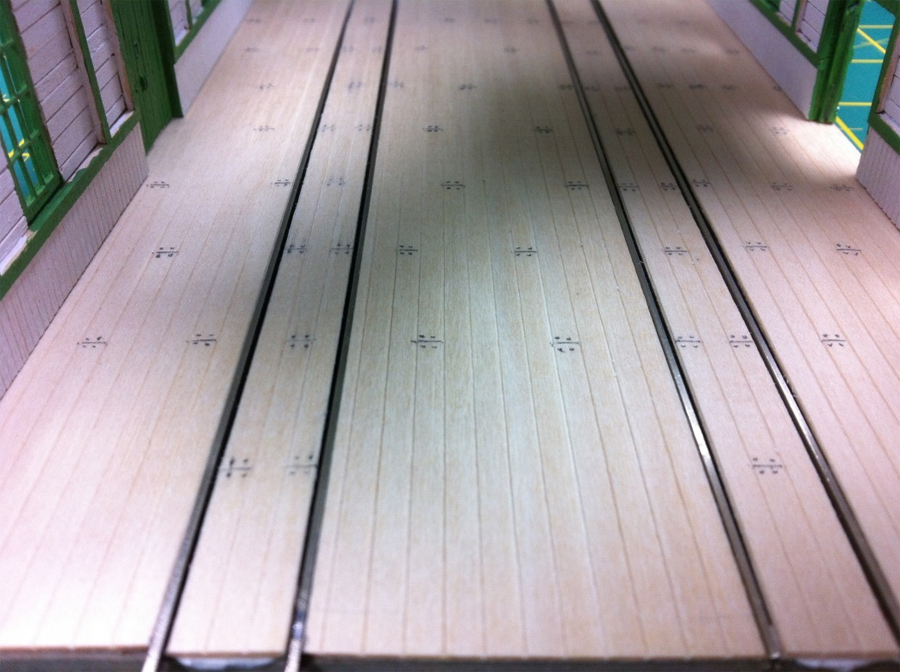
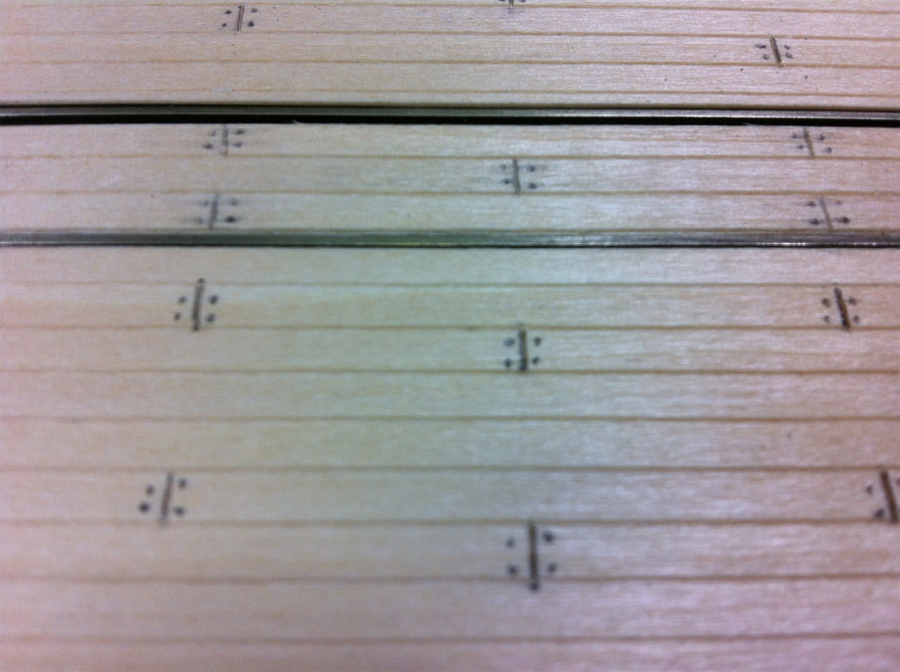
Then I had to remove everything to begin marking out the individual board lengths on the flooring and punching nail heads into it (a time consuming job BUT worth it to get the end result).
Next I will stain the entire floor to give it the aged and well-worn look. When doing this, make sure that you weight down the floor to stop it from warping. If it does, the building will also keep it straight and flat.
The black wash that I use is from the Citadel range of washes produced by Games Workshop.
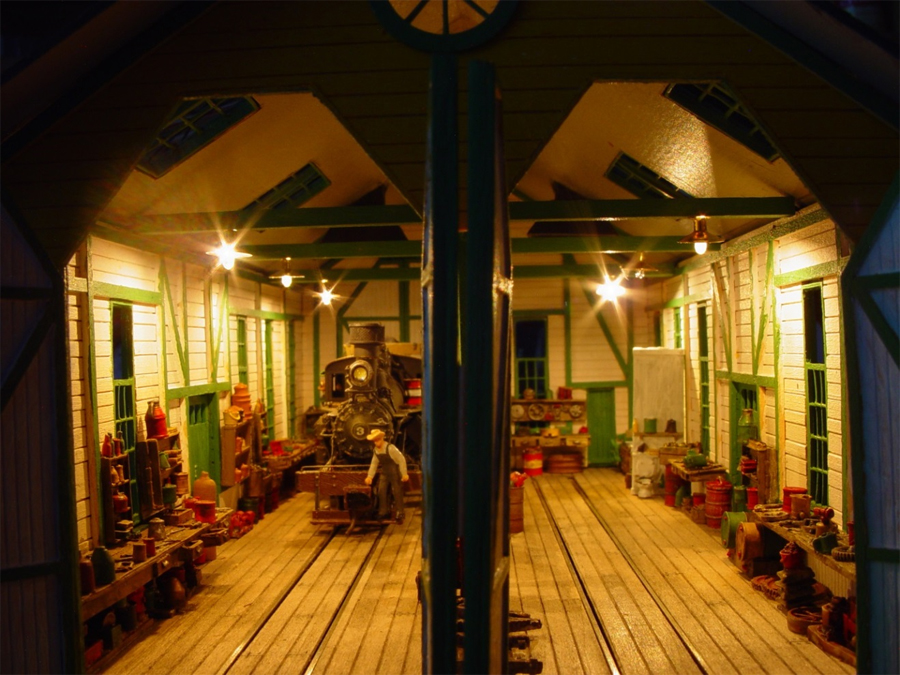
A real time consuming job next, painting all the castings. First of all, I spray all the castings with acrylic earth colour paint as a base coat. I then set up the various colours that I will need to paint the objects on the work benches, shelving, wall cabinets and trollies.
Once this is done, I will place all the objects in position in the HO scale engine house and make sure that the locomotives clear all of them before gluing them in place. Once glued in place, all will get a black wash to give them that used look. This wash will hide any “small” mistakes that were made in the painting process. Note: a good paint job can hide minor flaws but a poor paint job can destroy an excellent model.
All of the items left or any extra details that you wish to add, will be placed around the outside of the engine house once it is put into place on the layout.
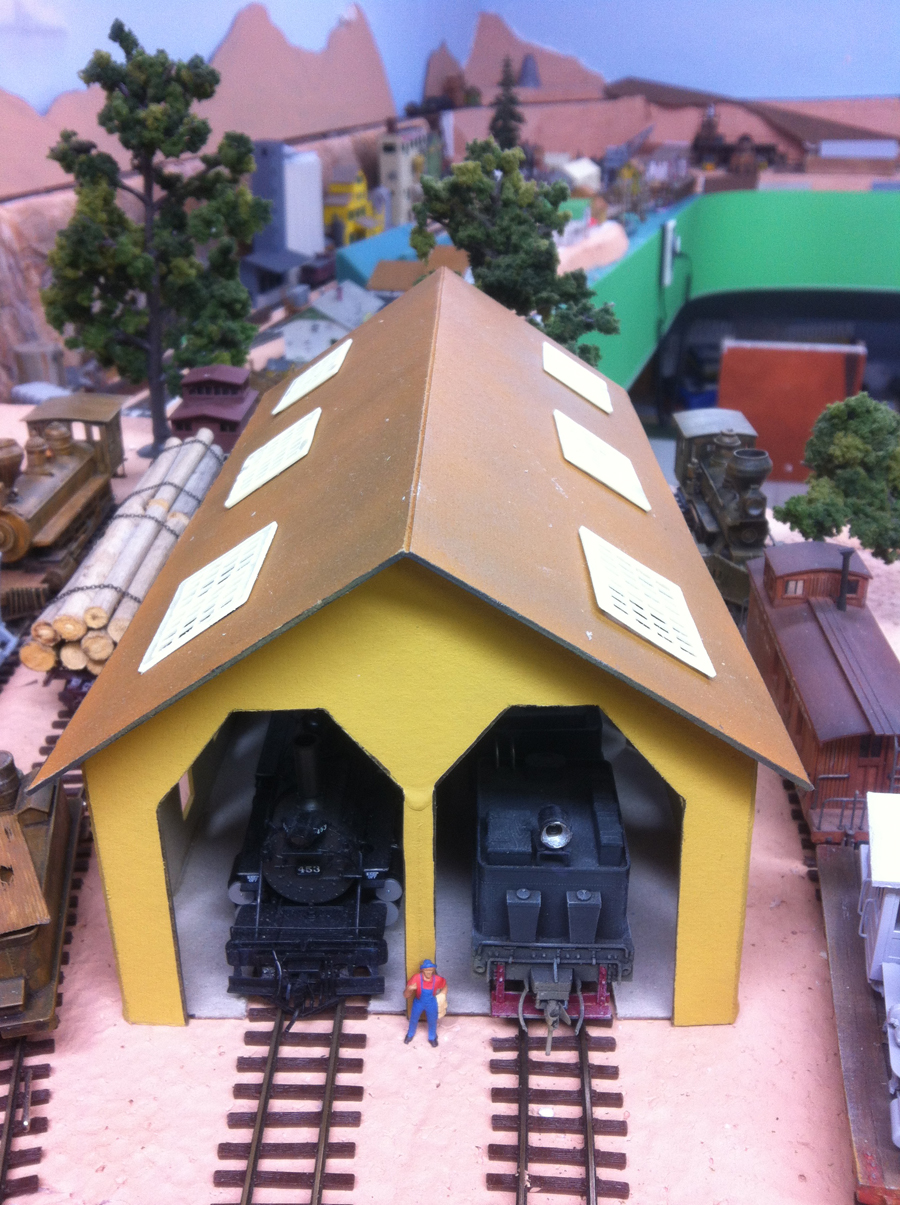
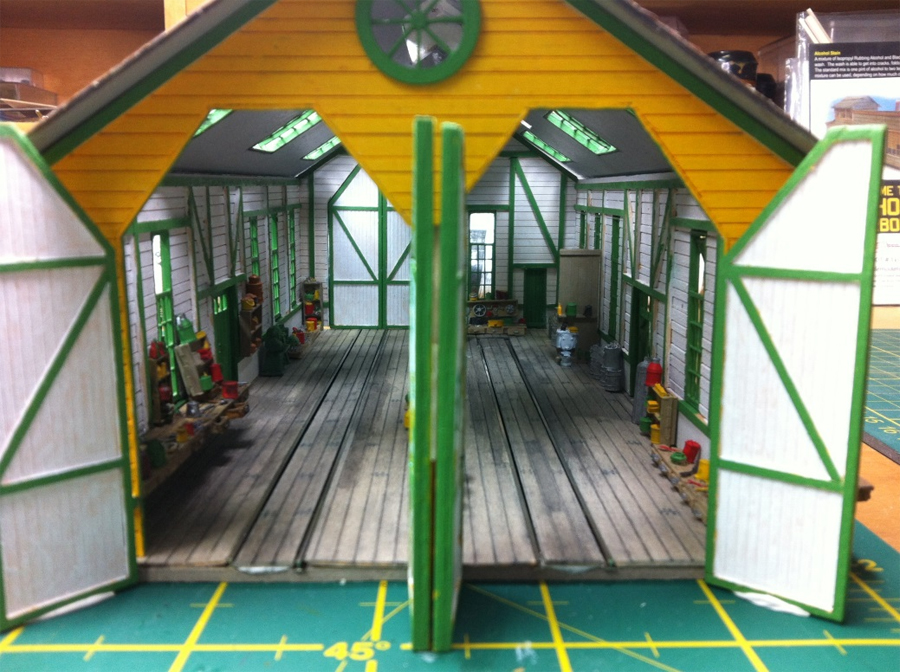
All of the doors will be glued in the open position as this will be a HO scale engine house in use twenty four hours of the day, seven days a week. Because of this, I have elected not to try and make working doors with hinges.
At this stage of the building process, a decision has to be made to light the interior or not.
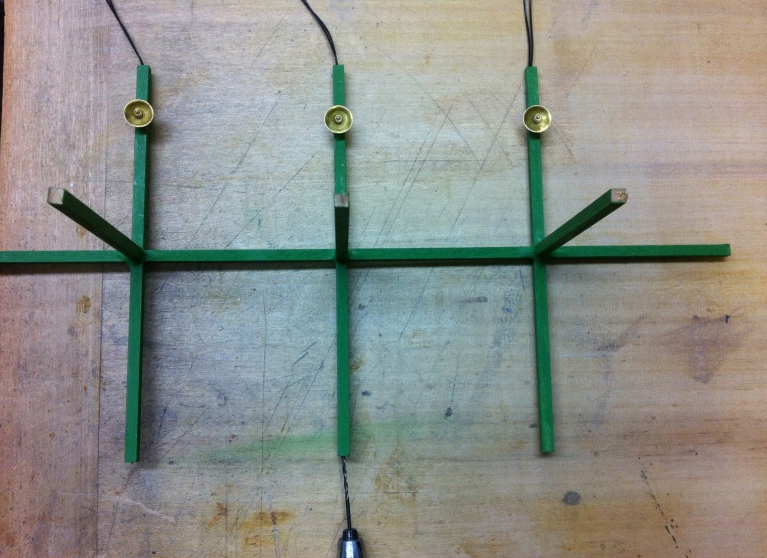
A ridge pole will be mounted longitudinal down the centre to which I will mount my lampshades with grain of wheat bulbs attached. As per instructions, there will be support posts underneath this longitudinal pole which at this stage I have not put in place. The reason for this is the fear of breaking them in the assembly process.
The photos below shows how the lights were fitted by drilling a 1.5mm diameter hole in the ends of the left and right bracing to the depth of 30mm and then the wires were pulled through and made sure that the lampshades were in the correct place.
All the wires were then collected both centre left and right sides and will be fed down as conduit to go down through the floor and down to under the layout to switches for the power.
Before placing the HO scale engine house in its final position, it needs to have the black wash all over it, again to give it that well used look. For the rust look on the metal objects, I use Gryphonne Sepia as well as Ogryn Flesh washes from the Citadel range of washes.
Once I am happy with everything in place and the lighting done, I will transfer the flooring of the engine house onto the layout and glue it in place. It will then be a simple step to glue the building in place and add all the detail around the exterior.
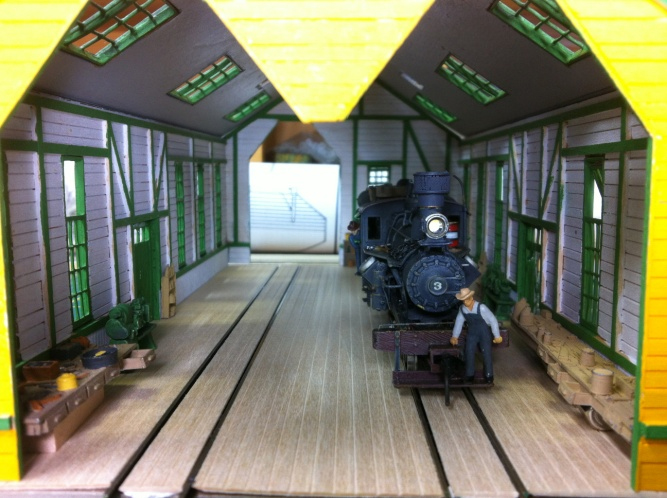
All the castings were placed in what I thought was the correct position, checked to see that the locomotives – Heislers and Shays cleared all the castings to make sure that nothing fouled the castings. The wedge plow just makes it for times when maintenance is required on it usually just before winter sets in and snow has to be cleared high up on the mountains in order for the fully laden log cars to be brought down to the sawmill.
Here I have fixed the floor (photos below) in place and temporarily placed the engine house in position to make sure everything fits correctly. This allows me to place the holes to be drilled through the layout for the wires from the lights to the power source under the layout.
With the positioning finalised, I can now remove the building and weather it both inside and outside. This is where I glue the final pieces of the building – the centre post between the two front doors. The two outside front doors, centre doors and the two doors at the back of the building are glued in position. The last pieces to be glued are the windows in the open position – seven of them.
I stuck the cardboard base to the layout using double sided tape. The floorboards were next, also sticking them to the cardboard base using double sided tape.
Placing the HO scale engine house on the base temporarily allowed me to position the holes for the wiring (lights) and drill through the base to the underside of the layout.
This is where the final and fun part of the whole process begins. The ballast and scenery material around the area and adding the castings, junk piles and everything else that would be found around this facility.
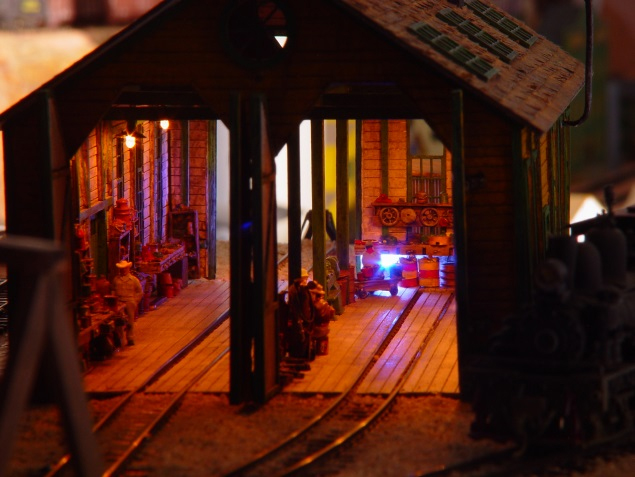
I have added an Arc Welding module to the interior under a workbench with a figure kneeling down as if he was welding. This was connected to the circuit with a separate switch to be able to leave the interior lights on and turn on the welding module at will.
With the ground cover hiding all the wiring done and the final detail added to the interior, the Engine House is now complete. Must just add the open window frames to the outside of the building.
Changes made in the construction of this kit.
The choice was to build this kit on the workbench and then add it to the layout instead of building it as a diorama. The reason for this is that I had already laid the track in place with all the wiring for DCC done.
Instead of using the wood strips for the flooring as supplied in the HO scale engine house kit, I used scribed siding as it was an easier way to finish the floor on the workbench and transfer it to the layout. This was done using double sided tape. An explanation of this method is described below.
Double sided tape is available at most hardware and art stores and comes in various widths. I used this for the floor as well as the shingle strips on the roof. It is very simple and quick to use.
As explained in the article above, I had marked out and cut the floor to size from 1.5mm thick cardstock. I covered the right side up with the double sided tape and stuck the scribed siding to this. In doing it this way, it allowed me to correct any minor miss-alignment that I had made in the measuring process and, able to work with one sheet of flooring.
The same process was done with the two halves of the roof. I glued the roof halves together and laid it on a flat surface. I covered the whole top side of the roof with strips of double sided tape. When the backing was removed on the top side, it is clear and you are able to see all the shingle lines as well as the smoke stack cut-outs. A sharp hobby knife was used to cut out where needed.
From here, it is a simple but time consuming job to lay all the individual strips of shingle paper onto the double sided tape. No sticky mess when using the glue method or water to glue the shingle strips in place.”
“Hi Al , just uploaded another video using the Mobius Actioncam, but now found better settings, and have made a cradle for it to ride on, well pleased with the result. This now looks like one of the better ones to use on a model railway.
A huge thanks to Brian for taking the time and trouble on his HO scale engine house ‘how to’. It’s a fantastic insight in to how he gets his layout looking the way it does.
Feeling inspired – then now’s the time to grab opportunity by the scruff of the neck, and get started with the Beginner’s Guide.
That’s all this time folks. Please keep ’em coming.
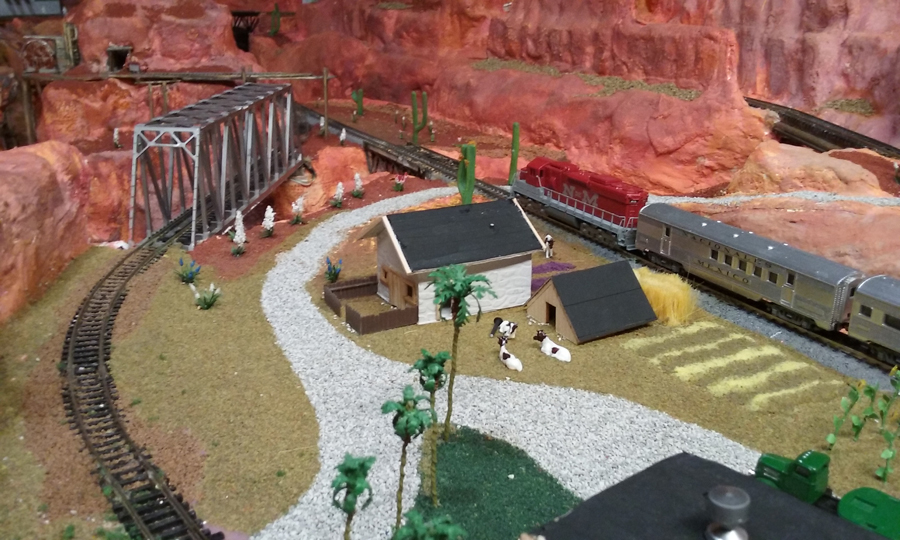
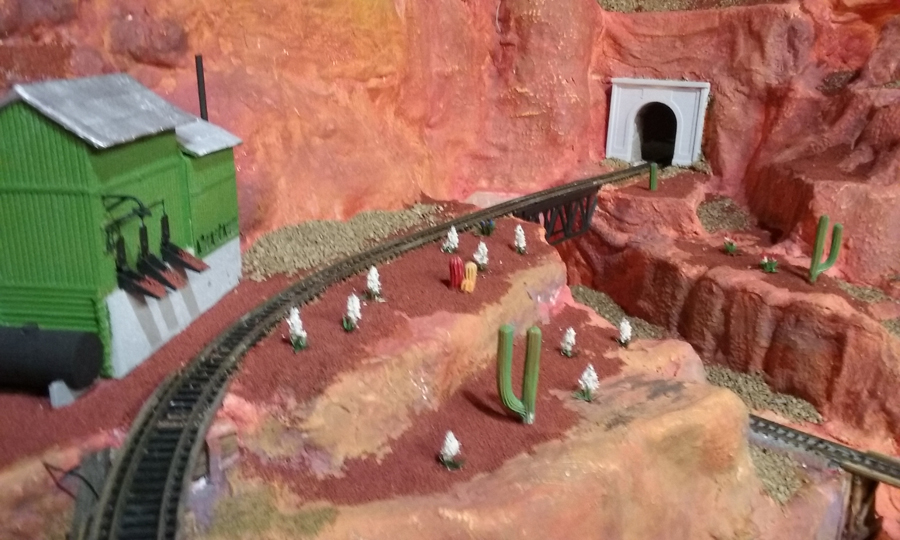
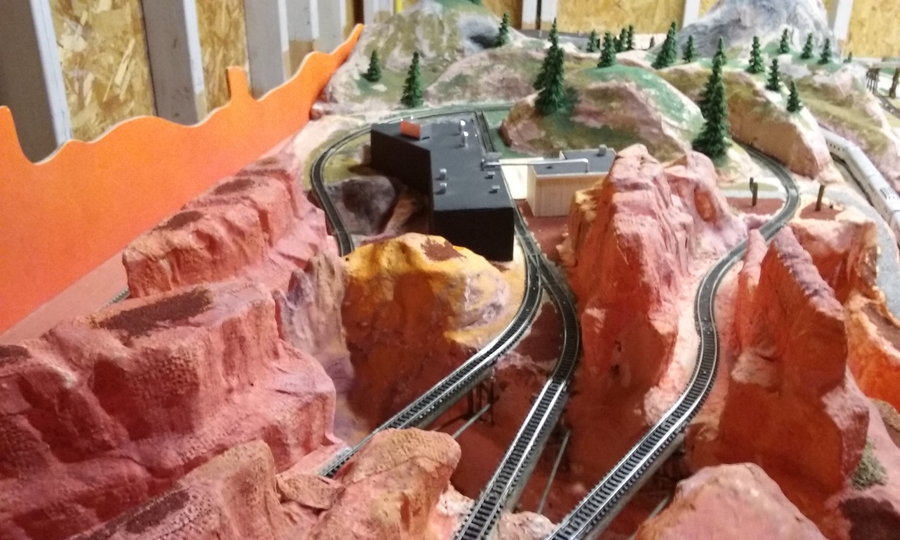
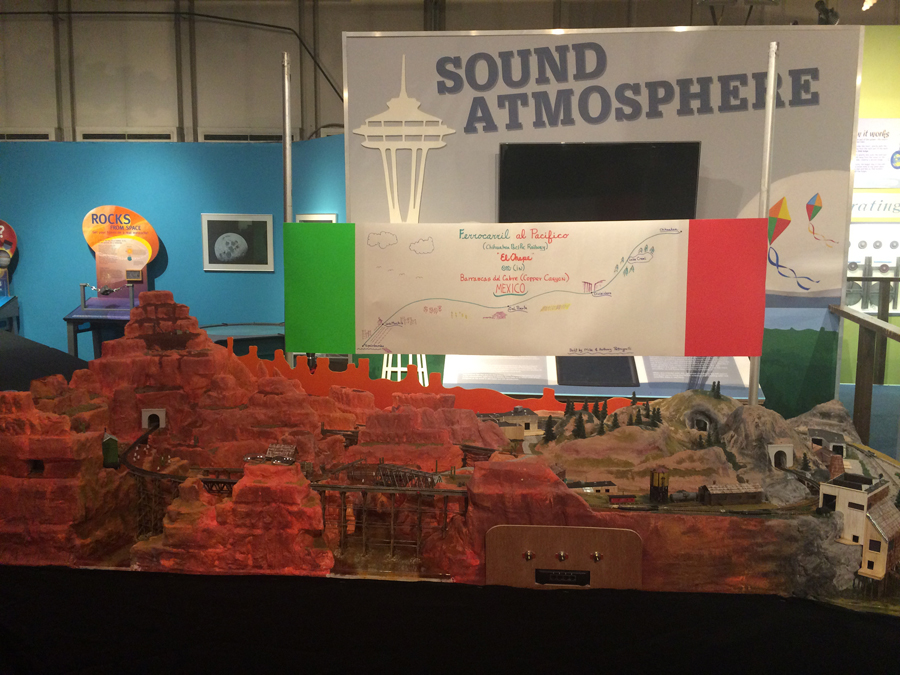
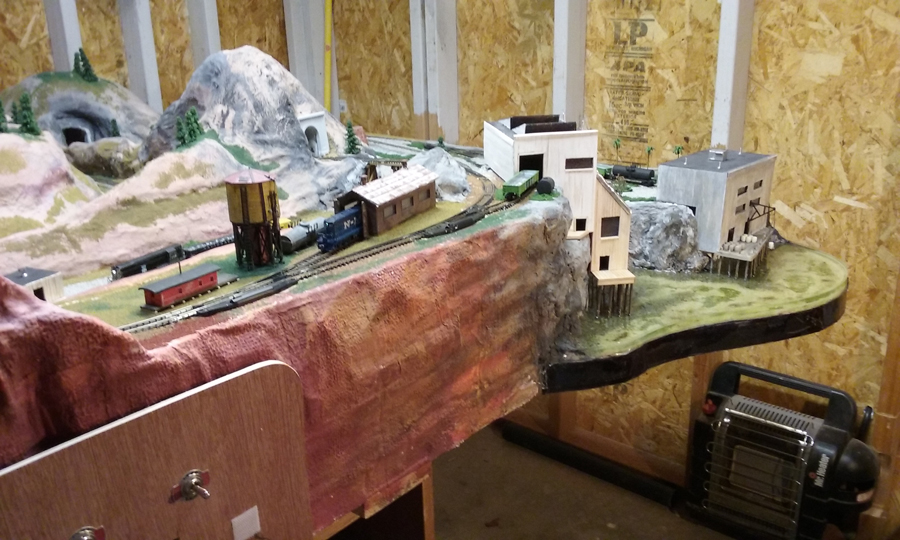
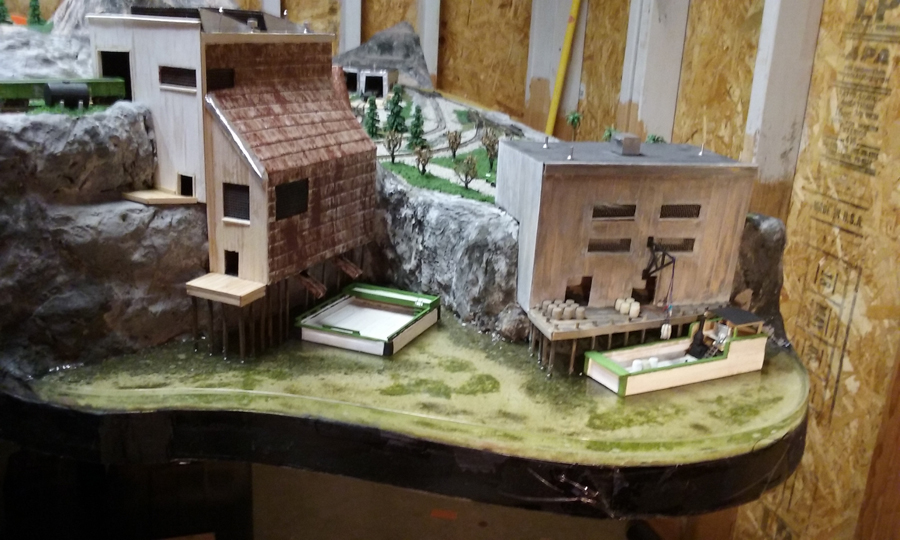
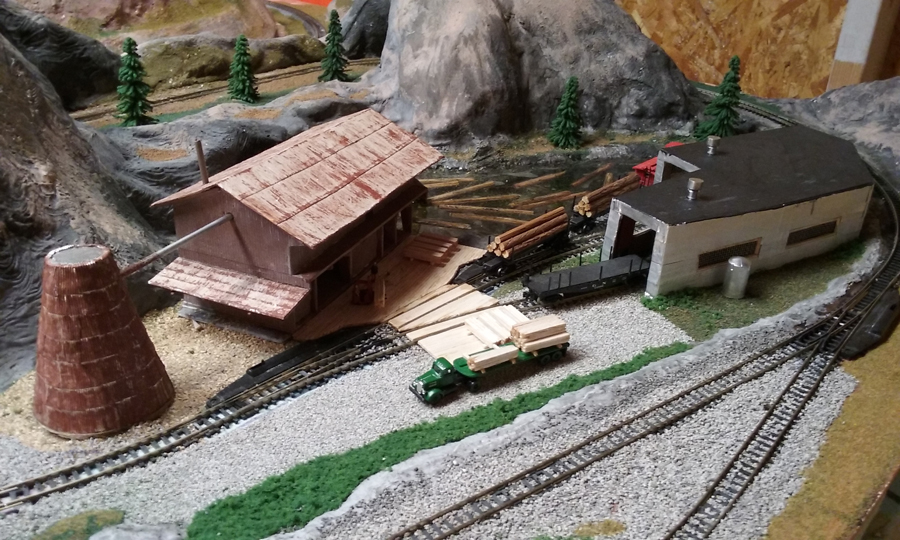
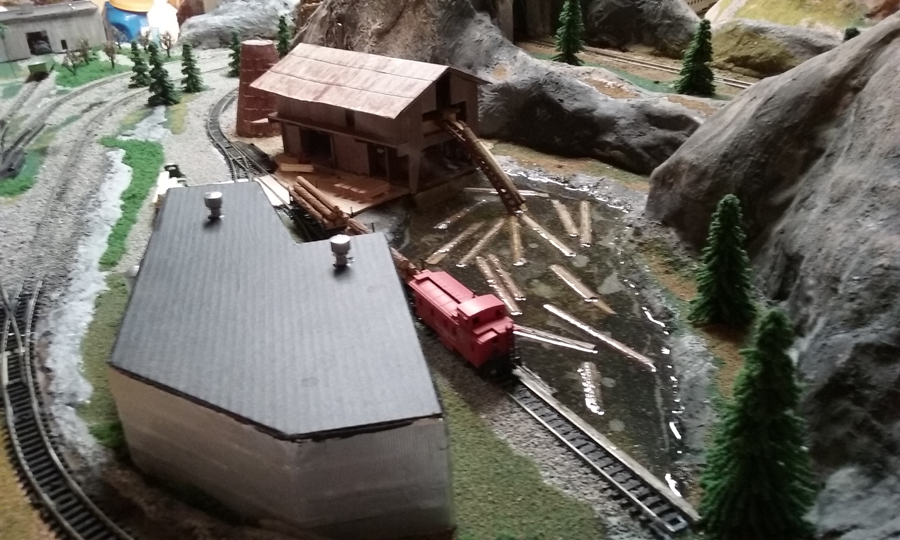
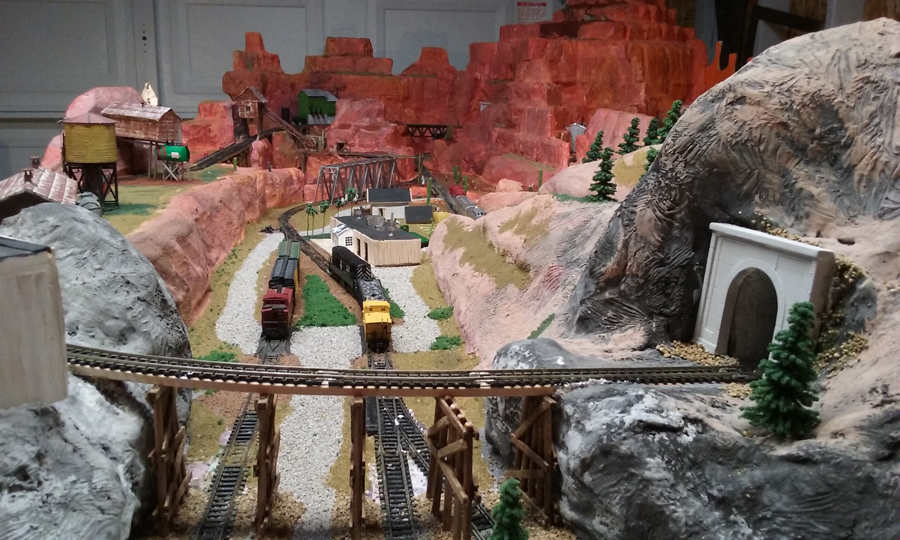
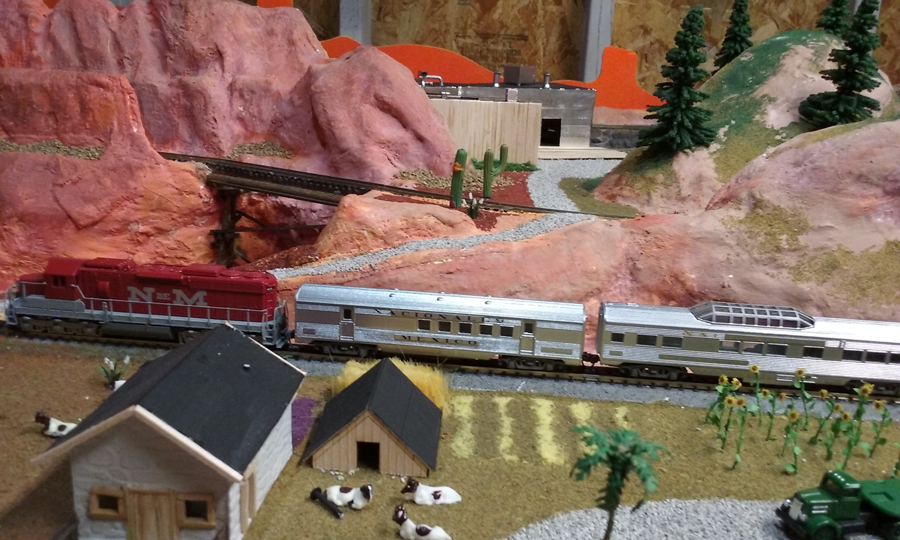
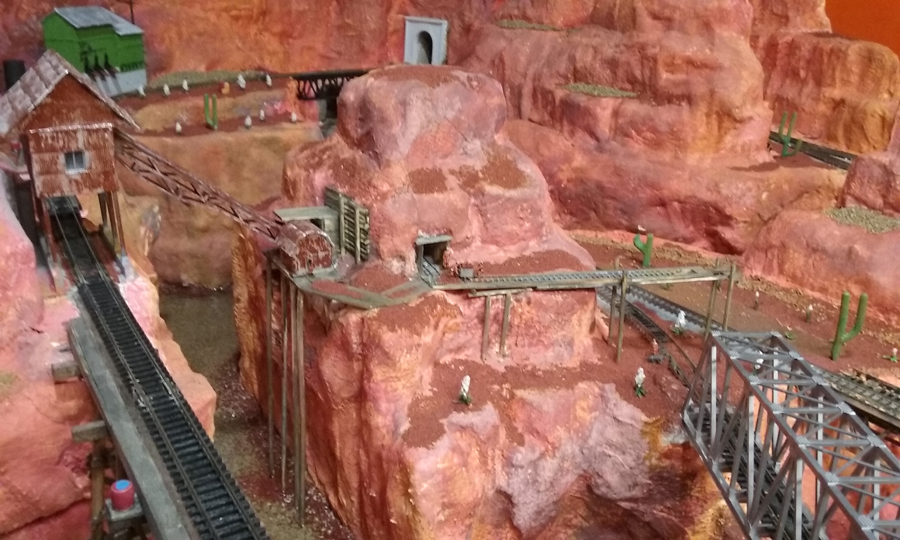
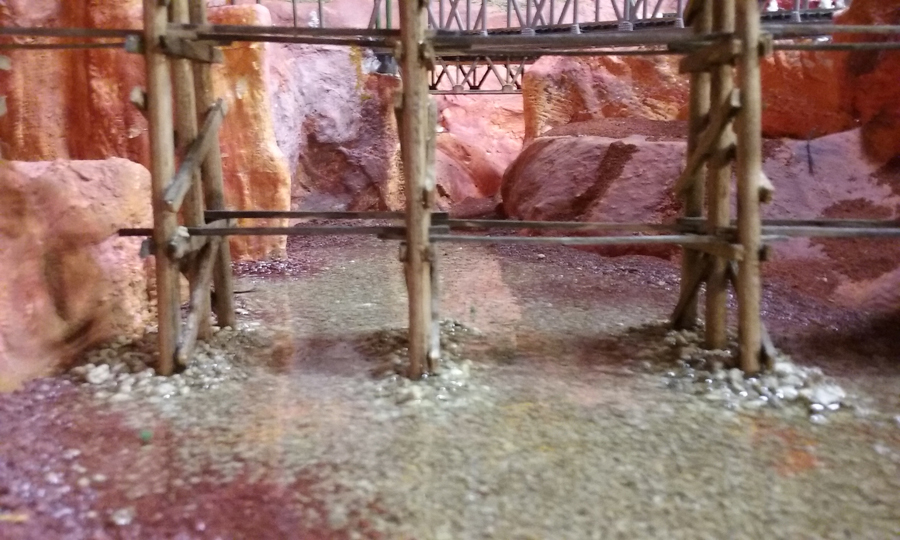
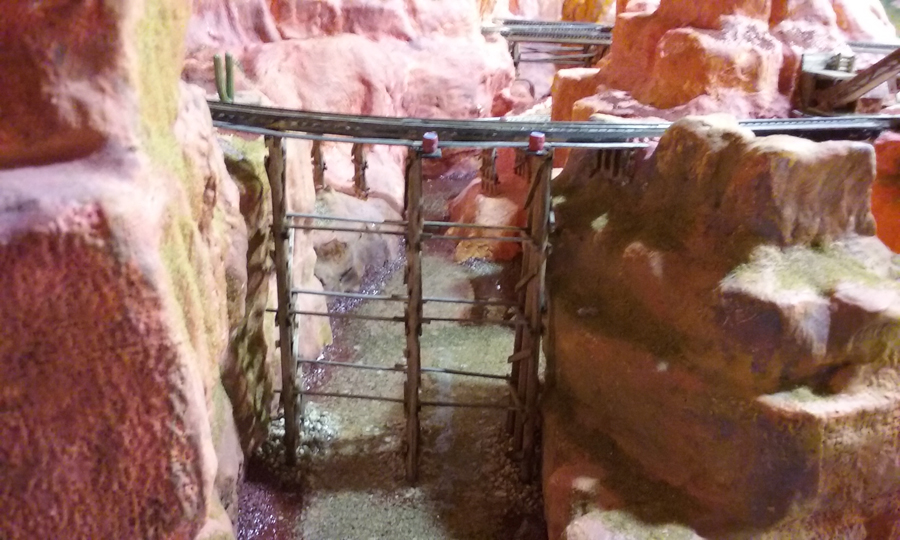
Mike’s been in touch with his N scale canyon layout:
“Hi again Al.
Started this layout in March after I sold the Seattle Pacific Science Center Show layout. That was HO scale, Copper Canyon is in N scale (Think I forgot to mention before,sorry).
Layout is on 3 hollow core doors with a sandwich of foam topped with thin veneer. From that point it’s pretty much all foam. Carving tools and track laying.
Then comes the plaster wrap and plastering. Moved out of house to train shed for finishing. Originally was 2 doors with 3rd added later to include the sawmill and ocean waterfront scene. It has a mainline with continual running and shortline that runs off the main with a short consist with switchback operation to make a complete loop back to the main.
MRC basic DCC with 3 controllers.1 for each consist…Keeps it fun…. And now it’s time for it to go away to make room for next year’s show…. It takes me about 9 months to complete a layout up and running…All for now….
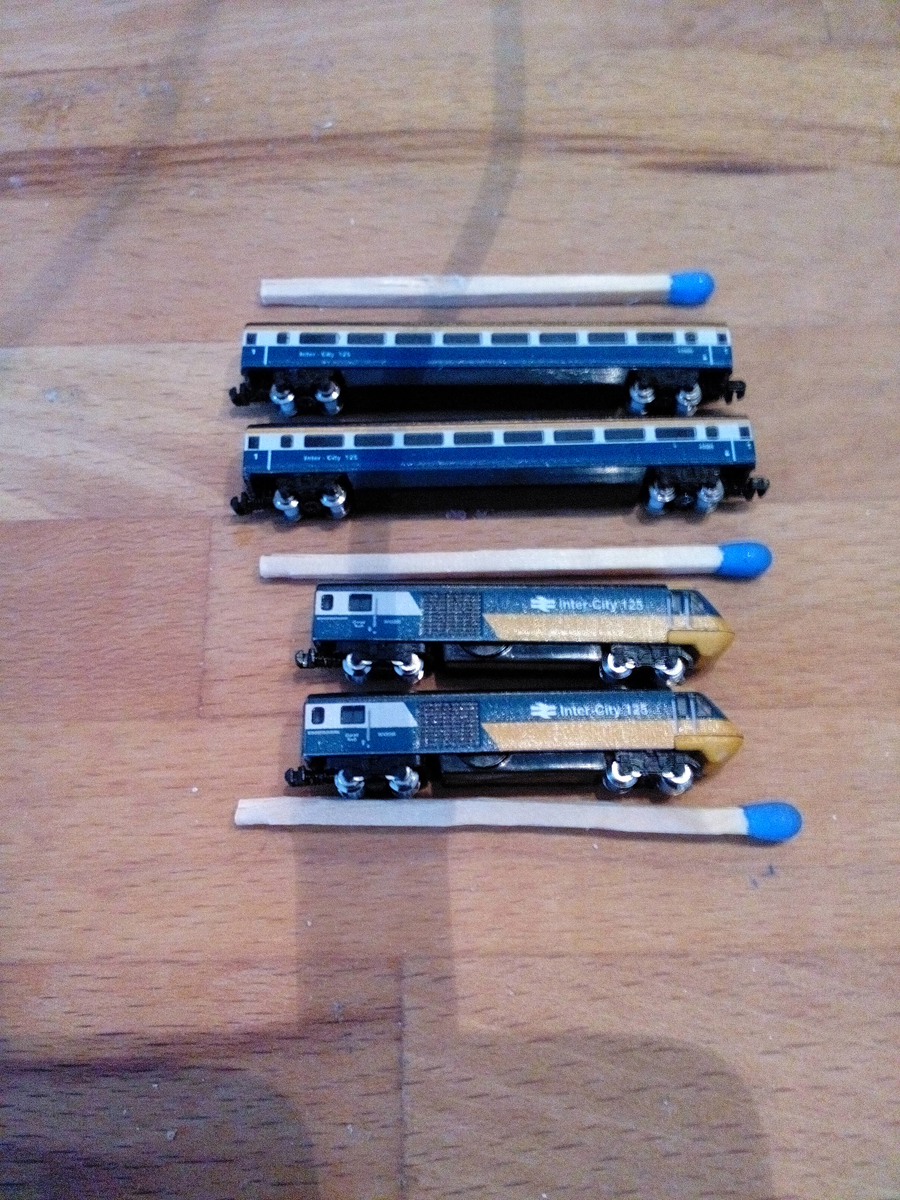
I visited the Scottish Model Railway Exhibition in Glasgow this weekend, and came across T Gauge
If anyone hasn’t the room for a larger gauge layout, they could try this.
The rolling stock is very small indeed. See attached picture.
All the best, and thanks for keeping the community going.
Paul”
A big thanks to Mike and to Paul for sharing his N scale canyon layout – Paul’s pic reminded me of quite a few of the layouts on the site that really are tiny. The suitcase one always sticks out in my mind.