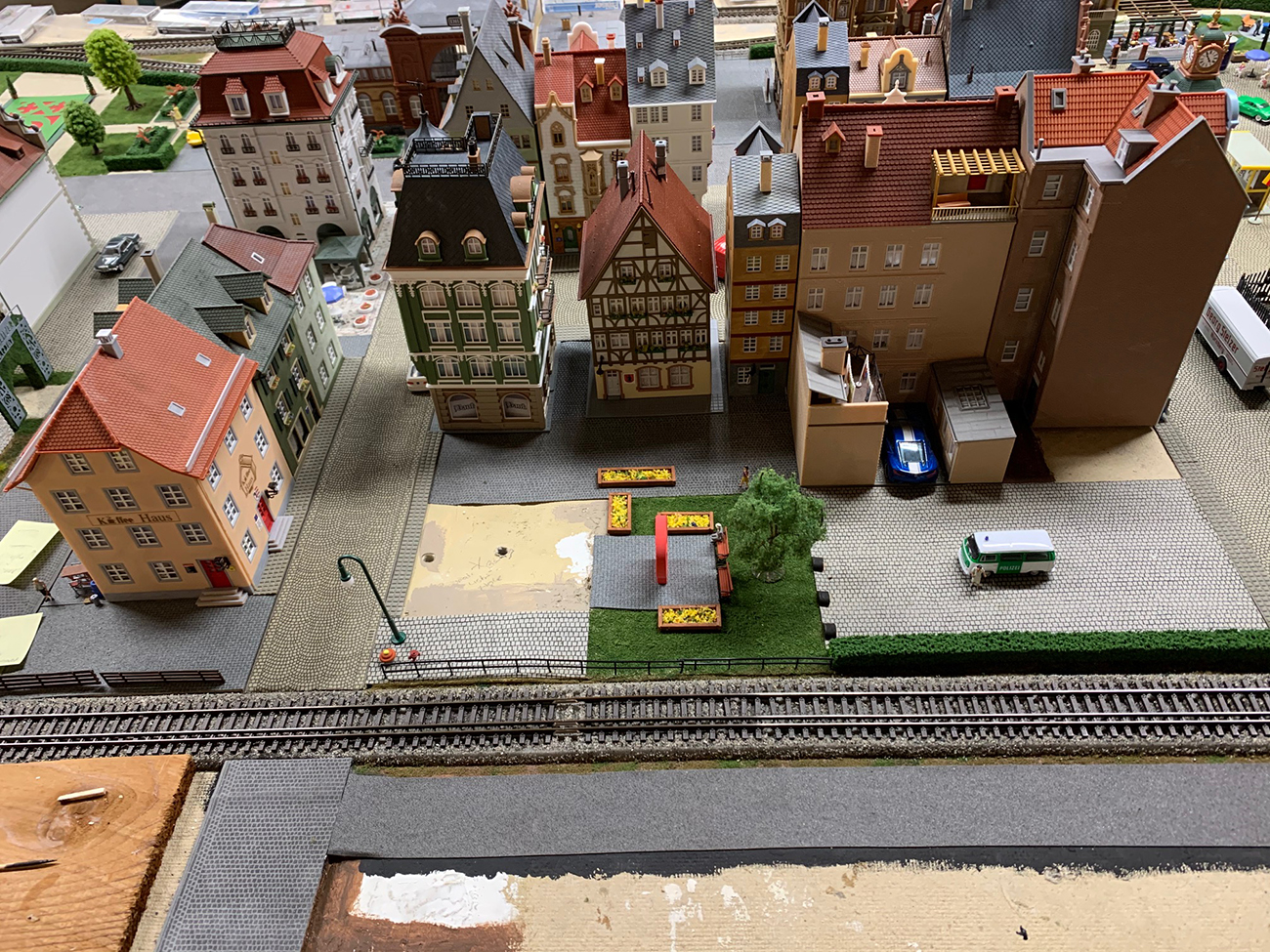
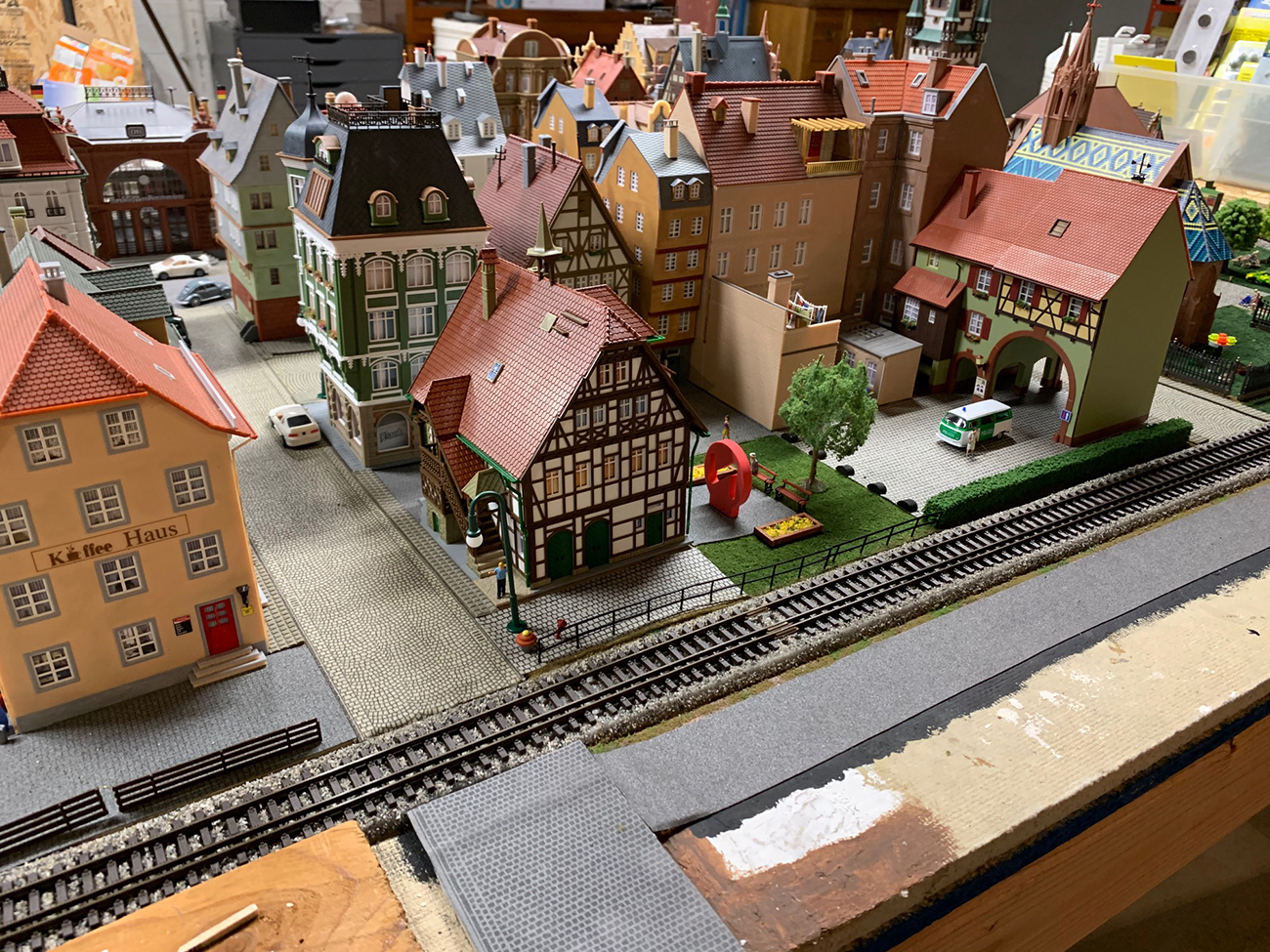
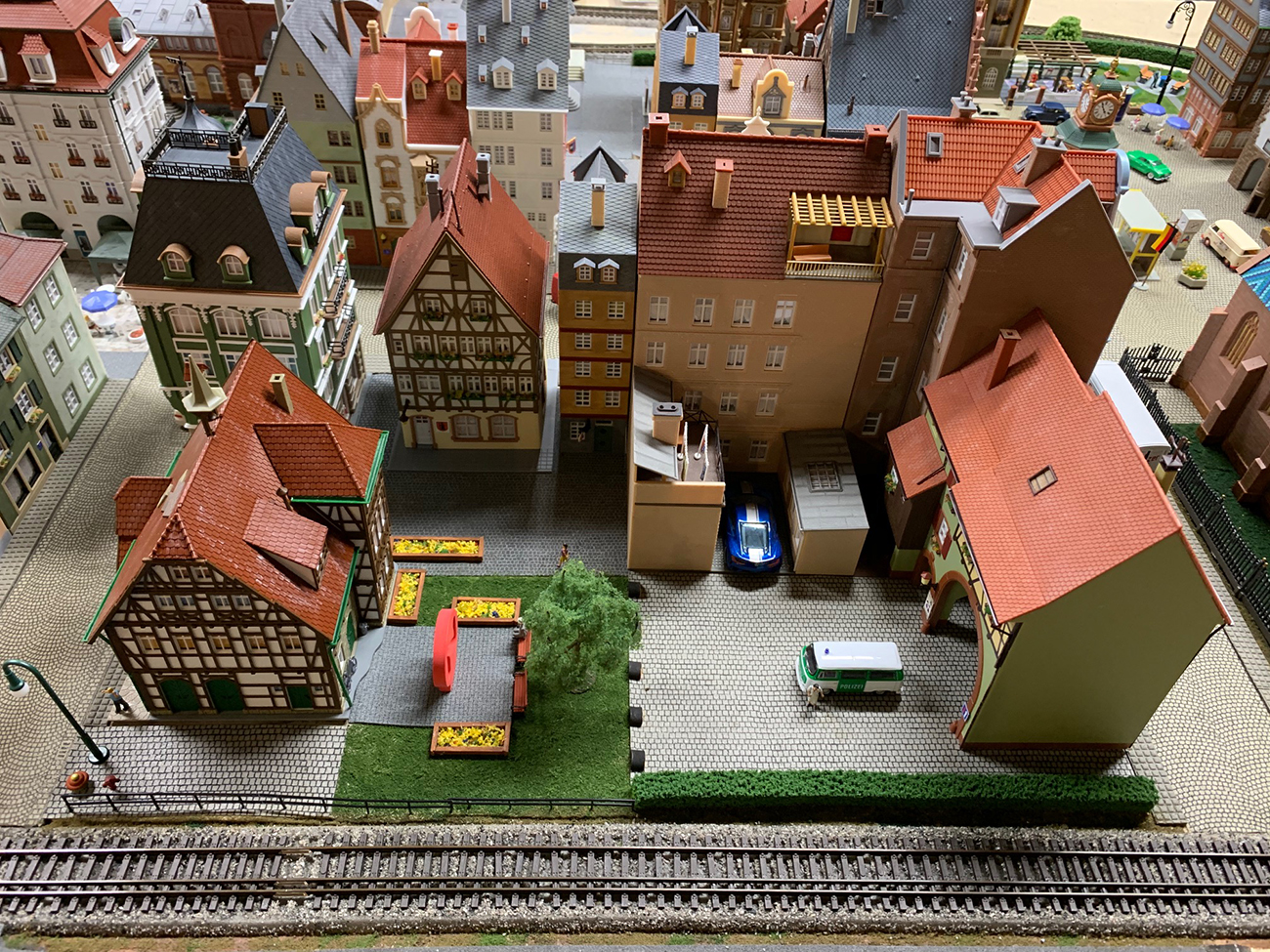
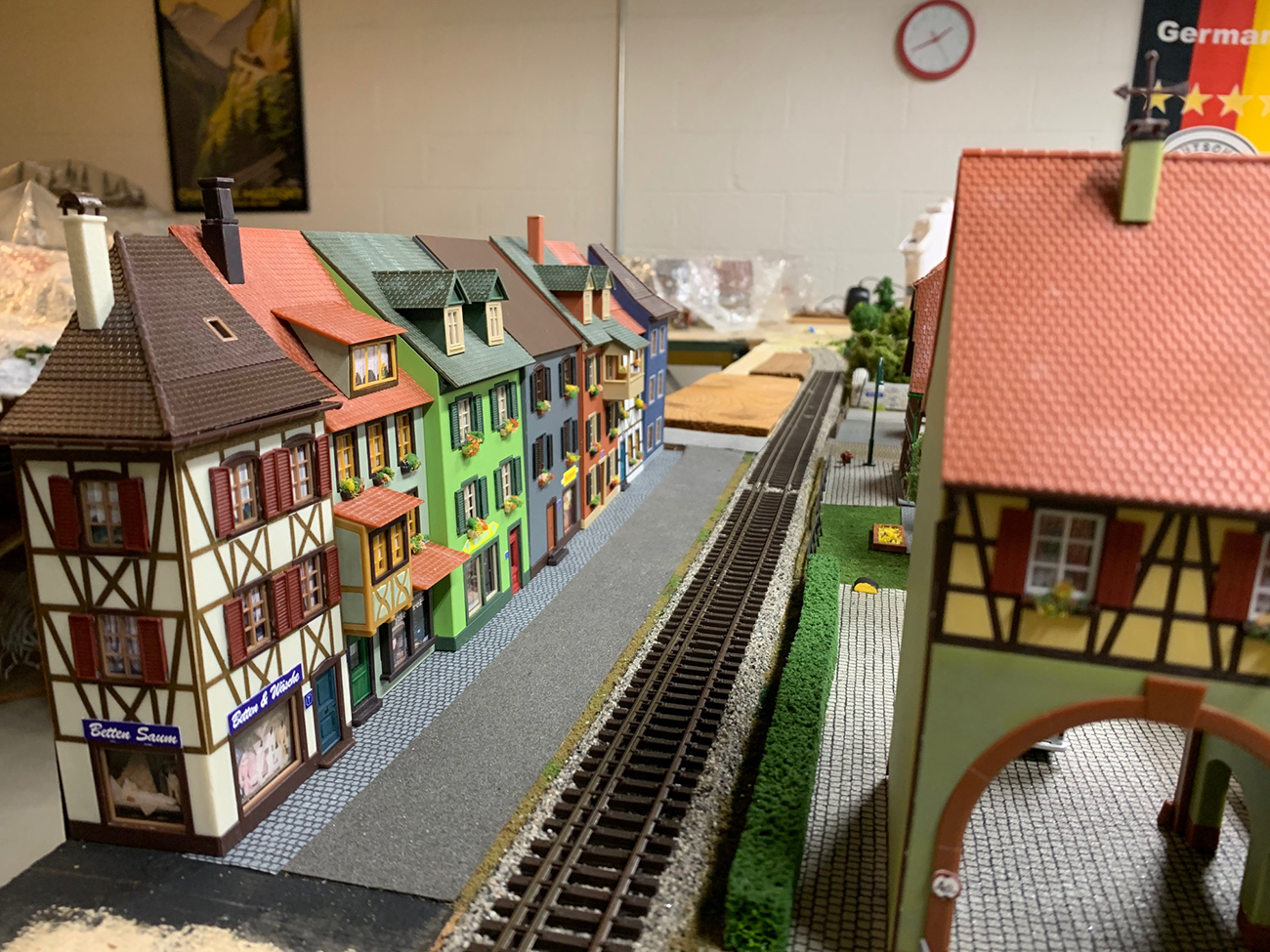
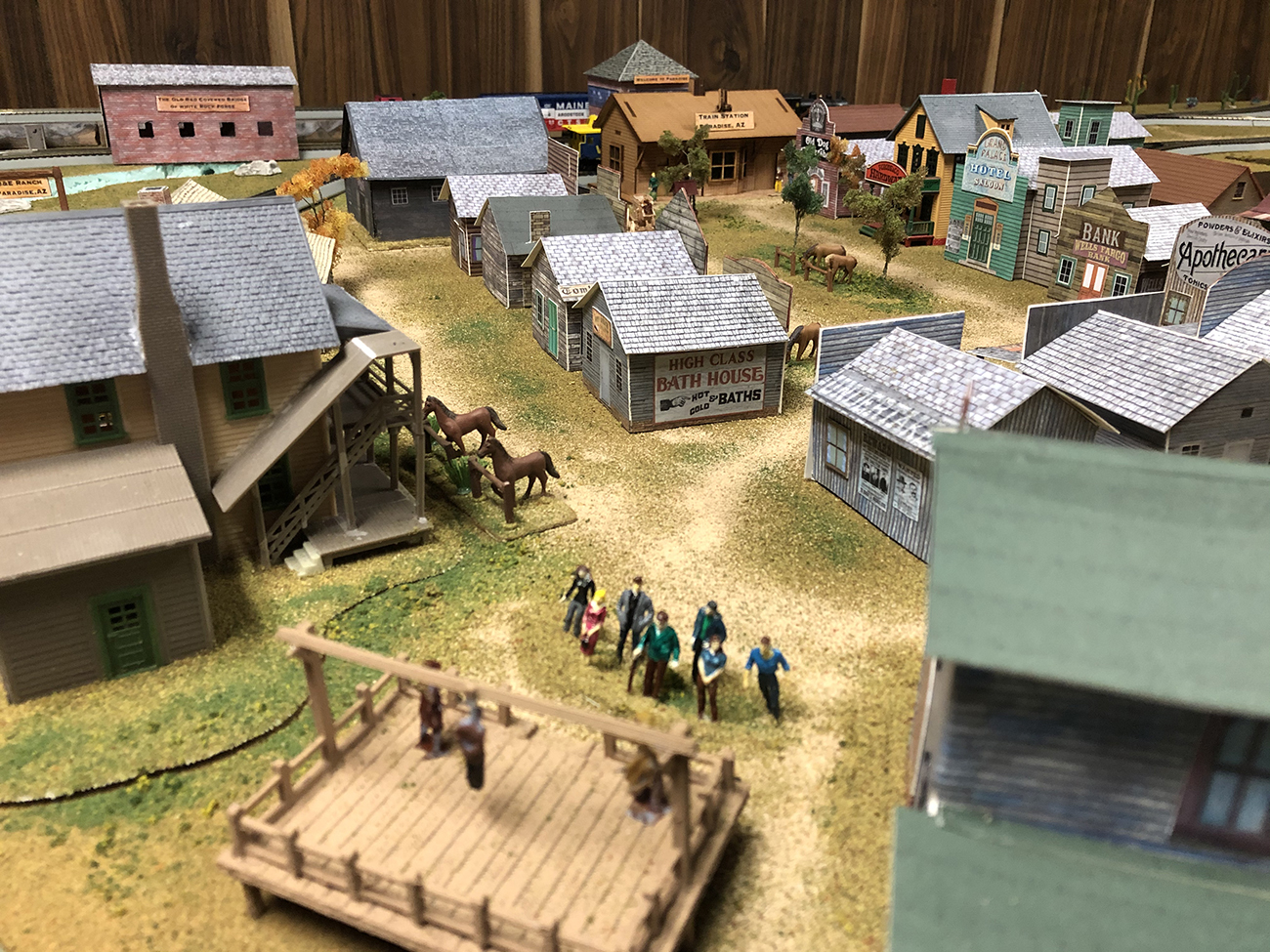
Model Train diorama

Tony’s been back in touch with his excellent model train diorama.

If you missed his last post, it’s here. Have a look at what he’s been busy with:

“Hi Alistair-

Here is the final segment of my diorama based on “The Riverside Local” by Don Breckon.

model train diorama

Just a quick review of the first two segments. I decided to build a diorama of this great painting as a modelling exercise, but also with plans to incorporate it in my future OO layout.

My original attempt to model the entire scene was abandoned after not being able to get the perspective right.

I decided to try again, modelling just the right side- to the river bank and this worked out better. Here is where I left off in the first post-

plaster paris for model train diorama

And here is where I left it at the second post-

model train diorama bridge

All the final little details, of course, took a lot of time. That’s the fun with a model train diorama.

Starting with the two vehicles, I was lucky to find that the excellent Oxford range of vehicles has a OO model of an Austin 7 and MG TC in the same colors as the painting. There were just a couple of modifications needed.

model train diorama cars

The bonnet (hood to us colonists) of the Austin 7 is black in the painting- a simple fix.

model train diorama cars

The TC needed a couple of changes. Painting the grill black, as in the painting, was easy and, I think, improves the look of the model.

model cars for model railway

The second change I found a bit annoying. Having owned a TC for 35 years, I am sure that no TCs were built with disc wheels, as in the model. They all had 19” wire wheels, unlike the later TD which had 15” disc wheels- which seems to be the inspiration for this model.

For such an excellent range of vehicles, this is a disappointing oversight. Luckily, I had a model of a TC in HO that had the correct wheels. The model itself was too small to use, but the wheels, although slightly under-sized, look fine.

model railway


Swapping the wheels also gave me the opportunity to ‘turn’ the front wheels to the right. This matches the painting, but it is a modification I often make to vehicles, adding a touch of realism.

These 2 cars are parked, but I always add drivers and passengers to vehicles that are on the road (perhaps the subject of a future post). The motorbike that is only partly in sight behind a hedge is not recognizable as to manufacturer (at least not to me). I had an old white metal kit around that did the trick.

model train cars

model train cars

I also had a white metal fence kit that nicely matches the painting. White metal, of course, is a misnomer, as the metal is silver.

After painting the fence poles and chain, the chain would not fit through the holes in the poles. Drilling out the holes was a little tricky but I had some good luck. The kit contained 10 poles. One broke during the drilling process, but the painting has just 9 poles. It doesn’t usually work out that way!

model train diorama fence

There are 13 figures in the painting and trying to match them to my model train diorama was quite a challenge. So as not to be too obsessive, I finally gave up looking for exact matches of poses and settled for close approximations.

I also ran into the perspective problem again. The model people (whether HO or OO) look smaller than in the painting. Looking at the diorama apart from the picture, the figures look fine, although they are placed in somewhat odd positions on the lawn (the positions work for the 2D painting).

I will probably change the positioning when I eventually install this in my layout. Please forgive some of these photos- it’s tough to accurately match angles!

model train diorama

model train diorama

I wasn’t planning on detailing the bridge as this will clearly change when installed in my layout, but the loco is across the bridge in the painting and I wanted to match that, so I had to add a portion of the bank on the other side of the river. This was not too much work, and I think it did the trick.

model train diorama river

model train diorama water

model train diorama

I knew the ’back’ of the scene was going to present the biggest perspective problem and I originally planned to look for a TT scale loco and carriages to address this issue.

I finally decided this would be a waste of time and money, so I just used OO. This looks fine on its own, but compared to the painting, the models look a little big. You can see that the coach sits much further to the right on the model than the painting. TT scale would probably have been about right.

model railway bridge

model train coach

The final issue was the river. I originally planned to model the water (in part) but I would have to rip it out later so I decided to just lay down some paint for now as a rough representation. I think it looks OK- and this way I got to include the children feeding the ducks (more white metal).

This whole exercise was fun and gave me some things to think about when modelling scenery. Other than an outdoor G-scale, I haven’t modelled trains for many years and this was a good brush-up of skills and techniques before starting on my new layout. And I expect most of us see old photos of scenes that we would like our layout to look like, and I think this shows that copying a scene is not a bad idea.

model train diorama

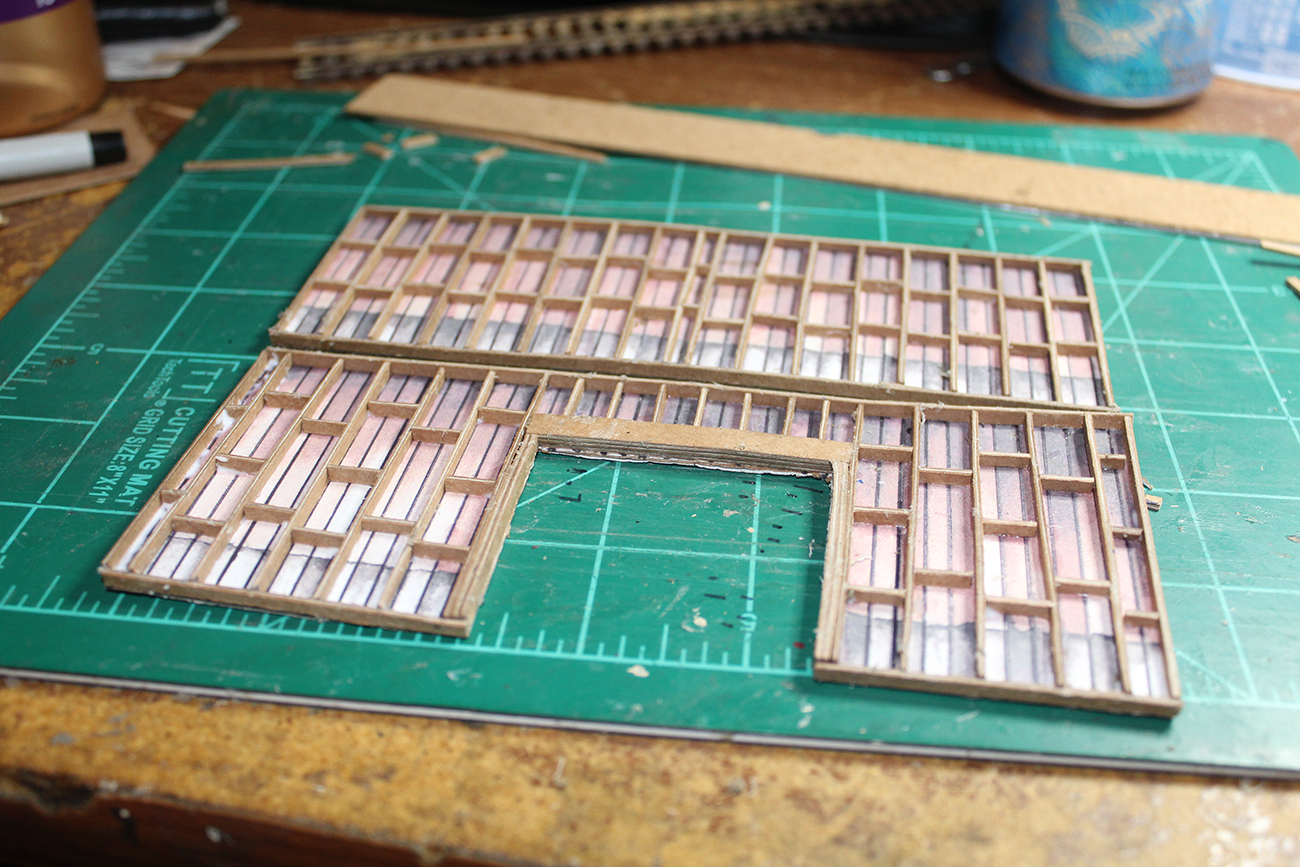
Just a quick tip that I came up with recently. When scratch building, I am always looking for the right size and shape of balsa strips. I had balsa sitting around in various places, and I often didn’t find what I needed.

I decided to make a start on getting my work area organized by organizing the balsa. I gathered some scraps of PCV pipe- 1 ½, 2 ½ and 3 ½” diameters (sorry, don’t know the mm equivalents).

I collected all my strips of balsa and laid them out according to size. I then cut the pipe to various lengths and glued them to each other. I made a wood base- finishing it all off with some grey paint. There is room to add another pipe or 2 if needed. A box with all the smaller scraps completed my organization.

As always, thanks Alastair- keep up the great work!

Tony

Kitty Hawk, North Carolina”

A huge thanks to Tony for sharing his model train diorama – and a small apology – he mailed me this upate but it fell through the cracks. I missed it. Fortunately though he got back in touch and I’m pleased to be posting this instalment.

If you enjoyed Tony’s work, have a look at his Book nook diorama.

That’s all for this time, folks.

Please do keep ’em coming, because we need these update more than ever right now.

Stay sane. Keep busy. The Beginner’s Guide is here.

Best

Al
PS Latest ebay cheat sheet is here.

PPS More HO scale trains here if that’s your thing.


HO scale guardrails

Gary’s been back in touch. This time he’s been busy making some HO scale guardrails:

“I am working through my layout on Sunnyside yard, I have done a lot of things from scratch and after reading what the other modelers send, I thought that I should do the same and maybe it would help someone.

So I am sending you two tips….the first on creating Highway Guardrails and the second on a real simple way for creating hedges.

I also have started working on the Commissary Building for Sunnyside Yards and thought I would share that also.

How to make highway guardrails easily and cheaply:

I wanted to add a track to display some other engines that I have but I had already put up the fence between the engine yard and what would be the Commissary Building area. So I decided to put a rail towards the center of the layout for the engines but needed to blend it in with the layout and also needed it to be separate from the commissary buildings.

The main road coming into the actual Sunnyside Yards comes down a ramp behind the buildings. My main road is coming into the yard also behind the buildings, but no ramp and I decided to separate the road from the display rail with highway guardrails.

I found them to be too expensive for the 4 feet of rail that I needed so I decided to go from scratch.

As it turned out it only cost me $1.03 for the material and my time. The pictures below will show how I made them and what I used.

Picture 1: Material – in picture one you will see three items for my HO scale guardrails.

The top item is a 4 foot strip of wood 1/8 inch thick used for the guardrail stakes, cost .24 cents.

The middle item is a wooden coffee stirrer; no cost, I took a handful from to local coffee shop.

The third item is thin plastic to be used for the guardrails. The product is called RexLace and cost .79 cents. I found it in an Arts & Craft store; but you can use anything that would resemble the guardrail.

The dime is just to show reference for size.

materials for HO scale guardrails

Pictures 2 & 3: Tools – I am sure that every modeler would have most if not all of these tools. I left a piece of charcoal colored chalk for weather out of the picture by mistake.

tools for HO scale guardrails

tools for HO scale guardrails

Picture 4: Prepare the pieces – As you can see in picture 4 the first piece on the left is the coffee stirrer marked with seven dot for drilling one inch apart; then drill a hole at each dot

The second piece from the left is the stirrer with the holes drilled.

The third piece from the left is the stirrer painted. You can paint it whatever color you desire (I probably should have used a more earth tone color).

The next piece is the strip of wood to be used for the stakes painted aluminum; this will be cut up into 1/4 inch pieces. The last piece is the guardrail also painted aluminum. I found it easier to have everything painted before assembling.

I also found that working with a 7 inch strip was a lot easier. You can make the lengths anything you want.

HO scale guardrails

Picture 5 & 6: – Make the stakes – for the number of holes you make in the base, cut 1/4 inch length for each stake from the thin strip of wood.

These should then be glued into the holes in the base.

HO scale guardrails

HO scale guardrails


Picture 7 & 8: Glue the guardrail onto the two end pieces and let dry so that they stay in place. I used CA glue and left overnight. Then glue the remaining stakes. Again, I let it sit overnight; they are sturdier to handle.

gluing guardrail

gluing guardrail

Picture 9: Touch Up and Weathering – When the glue has dried, take your paint and do whatever touchup is needed. I then took some rust color paint and dabbed some rust spots around railings and also used some charcoal to dirty up some spots.

Picture 10 shows what HO scale guardrails looked like when I was done. They are now ready to be placed on the layout.

weathering guard rail

weathering guardrail

Pictures 11, 12, 13 & 14 show what they look like in my layout. The large brown area in the pictures is where the road coming into the yard will be along with the Commissary Building, Power Plant, Yard Master Towers and Power Station.

HO scale guardrails

HO scale guardrails

HO scale guardrails

HO scale guardrails

Making Hedges – EASY

We have all bought scenery items for our layouts. I wanted to add some hedges to my layout around some of the buildings. I went to the hobby store and the person in front of me bought the last two items. I asked to see what they looked like; they looked just like a sponge.

When I go home I found a scenery package that was opened and in it were square sponge like packing. I painted them green and cut off a strip and they looked just like hedges. See the pictures below.

You can paint them any color and you can cut them up to make them look more natural.

HO scale hedge

ho scale hedge

HO scale hedge

HO scale hedge

Commissary Building (unfinished): Now that I am 99% finished with the engine yard, I started on the building for the Commissary Yard.

Below are pictures of the model I am building. It is not yet completed but I think it looks pretty good and I thought I would add to this blog.

model railroad building

model railroad building


model railroad building

Well, thank you for watching and reading.

Hope you enjoyed it and if I hope I gave someone ideas about their layout like you guys have given me.

Gary M.”

A huge thank you to Gary for sharing his HO scale guardrails step-by-step. What an update!

If you missed Gary’s last update, it’s here.

That’s all for today folks. Please do keep ’em coming.

And if you’re anything like me and want to avoid just looking out of the window, the Beginner’s Guide is here.

Best

Al
PS Latest ebay cheat sheet is here.

PPS More HO scale layouts here if that’s your thing.


HO scale farmhouse

Peter’s been in touch with his HO scale farmhouse:

“Hi Al,

Some revisions here and how to’s.

There was a gentleman that commented on the last post that I needed a fence so the animals wouldn’t trample through the garden…lol

Well, as I stated in that post, I wasn’t finished yet. I made the fence from northeastern strip wood products, then aged with a greying solution. India ink and alcohol. It’s getting real close now.

After the benchwork of a particular scene is complete, I grid it with 1 x 3’s to accommodate buildings, the rest is sectioned off with cardboard strips or metal light screen for the plaster cloth to adhere to.

After all plaster has been put on (1st the gauze then fill in with pre made plaster (mud) in tubs) It is all painted with a latex earth tone. When dry, texturing begins. I use a combination of a lot of things as you see.

Lot’s of ‘Wood scenic products, etc. grass tufts, many different shades of texture, rocks, sand for roads, and so on.

I scratch built the HO farm house and barn, though the barn was a spinoff from an old Campbell HO kit, I just built it up from scratch to 1/48 O scale that I model in.

Trees are mostly commercial, I just grab whatever, whenever it suits my aesthetic needs.

The water for the garden hose is woodland scenic products for water falls and still water combination.

The rest by viewing is self explanatory, sooo, if you could kindly post these pics of both the standard gauge & narrow gauge, it would be most appreciated.

Thank you,

Peter”

HO scale farmhouse

HO scale farmhouse barn

HO scale farmhouse barn

HO scale farmhouse barn

HO scale freight


HO scale store

HO scale store

HO scale roundhouse

HO scale roundhouse

HO scale roundhouse

control panel

HO scale freight

HO scale loading platform

HO scale bridge

And if you want to fast forward to Peter’s update, here it is: HO scale farm.

Tom’s farm layout is also good: HO scale farm layout.

Now on to Ray:

“Hello Al,

Yesterday I received this Walthers Dairy Queen model from my grandsons.

I woke up this morning and planned on putting it together. As I do first thing every morning , I checked your email, and I see Jon’s post on how he detailed a roof on his model.

What a coincidence, the model he was working on was the very model I received yesterday, Dairy Queen.

So I followed his directions and loved the results.

Thanks Jon and, of course, thank you for all that you share.

I’ve attached a picture of the final project.

Best,

Ray”

walthers dairy queen

(The post Ray mentions is at the bottom of this one: model railroad harbor.)

A big thanks to Peter for sharing his HO scale farmhouse pics (his last post is here).

His layout just gets better and better.

Ray really did put a smile on my face. I do love it when someone sends in a pic after they have seen how to do something on the site.

That’s all for today folks.

Please do keep ’em coming.

And if today is the day you get started on your layout, the Beginner’s Guide is here.

Best

Al
PS Latest ebay cheat sheet is here.

PPS More HO scale layouts here if that’s your thing.