Magnetic couplers

Dave has been in touch, this time showing how strong his magnetic couplers are.

“Hi Al…

Not sure if of interest but just done another test with the magnetic connections.

I have added them to a full rake of 11 coaches and used the deltic to pull these, as can be seen they held without any problem, and that’s going up an incline and running through curves as well.

I kept getting asked how strong the magnets are, think this proves that they sure hold a good rake… excuse the jumpy bits as using a Gimbal on my phone and seemed to have a mind of its own

Regards

Dave”

magnetic couplers pulling 11 coaches


If you missed his first post on his couplers, it’s here.

Peter shared his experiences too: Kadee couplings.

Now on to another Dave, who has a question:

“Hello Al

I’ve been getting your emails for a couple of years. One thing I do not understand is the underlay of track.

I have never used it with my trains. But then my brother and I grew up with Marklin, that our Father brought when he was stationed in Germany in the mid-fifties. So it’s the stamped metal type of track.

We put it up, like most at the time, at Christmas.

When my brother retired the trains were set up in a spare bedroom for the his grand kids to watch. And he set up an American set that make a single loop around the perimeter that they could control.
I retired a couple of years ago and we move into a home that has room for me to set up some or all of ours.

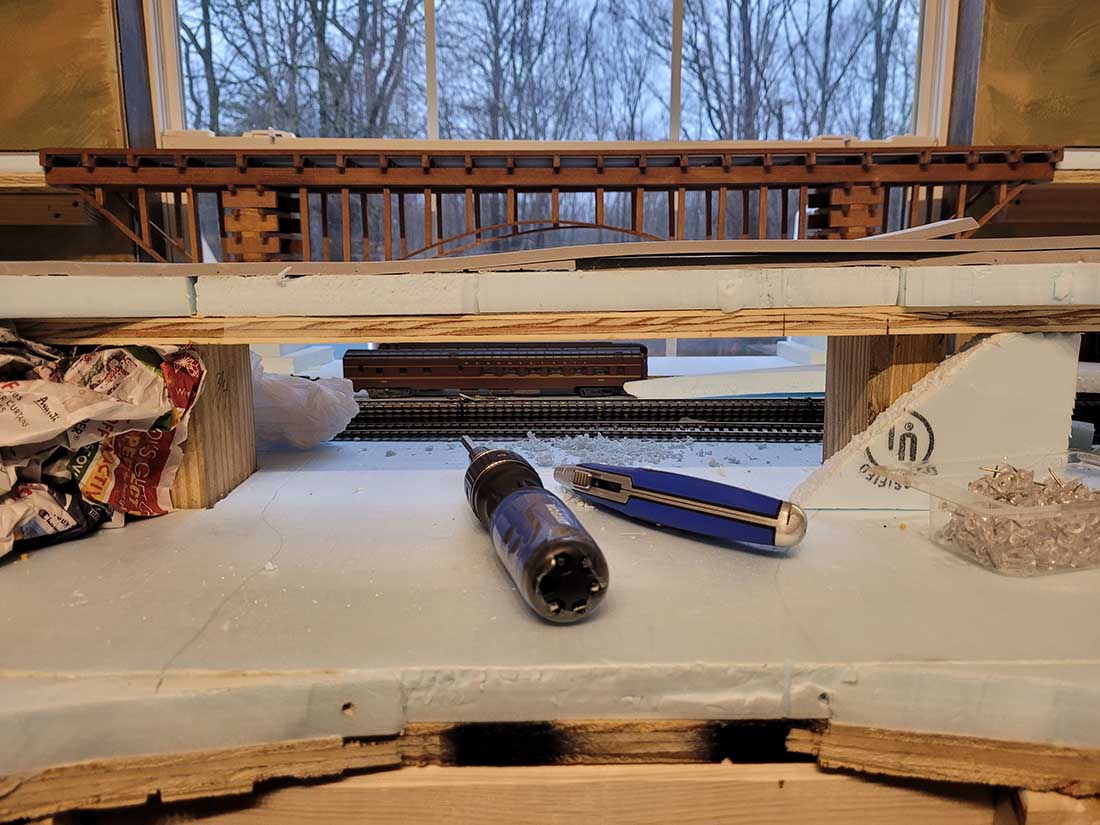
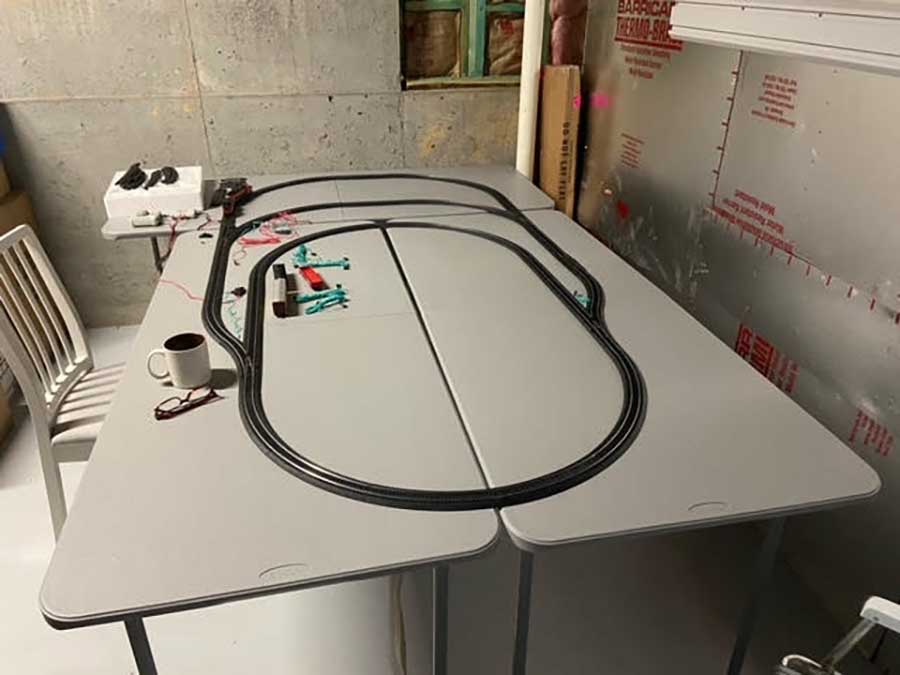
So with the pictured track what would underlay do, or do I even need it?

These are from the first box I grabbed. It is some of the newer track that will work with the older track, that has a solid middle rail.

Thanks,

Dave
In Virginia, just a bit south of Washington D.C.”

track foam

I thought it worth posting because the older I get, the more I subscribe to the point of view that if a question helps one person, the chances are it’ll help others too.

It’s very similar to this post, when Keith asked about how to secure his foam/cork bed.

Now on to Steve:

“Hi Al,

Wondered if you guys might be interested in a smaller 00 British layout project that I’ve been working on.

After a house move I down-sized and have very limited space. This layout is about 6’6″ x 3’6″, so VERY compact for 00 Scale. Some would say too small for a viable layout.

I considered N scale but I have so much investment in 00 with DDC sound locos, rolling stock and buildings etc. that it was too expensive to change.

The layout is very much a work in progress and nothing is fixed down because I need to dismantle everything when I need the space. The board is in two pieces, made of 9mm plywood and 2″×1” bracing.

It’s far from perfect but gives me a lot of pleasure with plenty of running options.

Hope that you like it.

oo scale model railway

7x4 track plan oo scale

oo scale freight


sidings

bridge

sidings

oo scale

.

oo scale model railway sidings

oo scale diner.

oo scale locomotive

That’s pretty much it so far. I’m married to an American girl so live between the two countries. Its been interesting looking at the HO layouts and comparing them to my 00 things. Considering a HO layout for our US base now.

There’s often a lot of negative comments on other forums dismissing anything small as insignificant so I’m hoping that it may buck the trend.

My previous garage layout was 12’x12 sort was a real challenge.

This project is limiting because it has to be packable when my wife needs to invite dinner guests !!

She’s a very tolerant and patient wife but she has her limits 😉

I’m in the US at the moment but will be back in England in a couple of weeks.

Thank you for all your hard work. The site is fascinating.

Regards

Steve
Withernsea, East Yorkshire”

A big thanks to Steve – his layout is another fine example of how lack of space should never stop you having fun.

Please do leave a comment below if you can help with Dave with his foam question.

That’s all this time folks.

Please do keep ’em coming.

And if today is the day you join in the fun, the Beginner’s Guide is here.

Best

Al

PS Latest ebay cheat sheet is here.

PPS More HO scale train layouts here if that’s your thing.


How to make model train trees

Hall of Fame Rob has been in touch with a very simple way to make model train train trees.

They look amazing too – and the ‘how to’ video is only 6 minutes too. Well worth watching when you see his pics:

“Hi Al,

I thiought you might be interested in this.

I took an 11 minute video and compressed it to 6 minutes. It is all about a method for making trees.

The method can be adapted to a variety of types of foliage. In the video I demonstrate one type.

The way I have demonstrated is using ground scatter as foliage for your tree. This works for many types of trees. It is inexpensive and easy to do.

I have really enjoyed my adventure in tree building and it has certainly enhanced my layout. My biggest problem is making them small. I must admit I struggle with getting the size down to what I think would be an ideal size for my 1:76 layout.

I recommend one tries building several trees at a time instead of just one. When you put all your eggs in one basket, then that is the result you think you must live with.

When you build several trees and vary them as they are made, you get a variety of results.

Like me, some will be great, so will be so so and some you may wiasah you could start over.

The materials for these foreground trees are relatively inexpensive.

You can certainly build these for less than you could ever buy the expensive prebuilt one for.

With practice you will find you are making trees that are much more interesting and better models of trees that can be bought commercially.

Trees in seven Steps

1) Build wire armature

2) Add smaller branches with loops

3) Use modeling paste to disguise the wire and bulk up the trunk and major limbs

4)Paint Trunk and major limbs

5) Add fine branches (static grass)

6) Cut loops and shape

7) Attach foliage

Note: Use Liquitex Matte Medium as glue for flexible long lasting results

Rob McCrain – Farland Howe”

model train HO scale tree

model railroad HO scale tree

HO scale tree model train

model railroad trees


model train tree scenery

model train tree by church

model train tree ho scale

model railway tree by tunnel


A big thanks to Rob – you can see more of his excellent model landscaping here:

Model train landscape

Now on to Bob.

I usually just direct people to ebay when they are after something, or want to sell something, but in this case, I thought I’d post:

“I was wondering if you know of anyone who may have a right hand HON3 # 6 switch they are selling.

A friend of mine is needing one to finish his current HON3 layout.

I’ve been trying to help him with this, but it seems like an endless trail of not in stock.

He has cancer and would like to see him finish this project.

Any help, leads or info, would be of great help.

Thanks

Bob”

Please do leave a comment below if you can help.

That’s all for today folks.

Please do keep ’em coming.

And if today is the day you poke boredom in the eye and join the fun, the Beginner’s Guide is here.

Best

Al

PS Latest ebay cheat sheet is here.


Union Pacific N scale

Dean’s been back in touch with his Union Pacific N scale layout:

“Al, greetings from Dean in New Mexico.

Here’s my latest input on my Conejos Valley Railroad, a 32” x 80” N-scale railroad designed for two train running as well as switching operations.

At this point, the table and baseboard are completed, and all the track work has been constructed.

I wanted to check out the operations of the track with a typically sized train before I moved on with scenery. Movement in and out of yard leads, cross over from the inner to the outer loop, etc. was completely tested and shown below in the photos I’ve included.

n scale union pacific freight train

Note that as you can see, I’ve begun to test out colors and methods of scenery construction.

Also, ballasting. I’ve standardized on an acrylic paint color and material for texturing the surfaces (sifted dirt from my front yard) and you can see that in the photos. This will be discussed in a future report.

Remember, the track was laid on a sandwich of three layers of white Styrofoam under a 1/8” sheet of Masonite. The outer loop was raised 2 inches and the Masonite gave a solid base for the flex track I used.

n scale model train union pacific freight

First, I made up a train by putting together cars in the yard.

n scale union pacific model train freight

The freight train moves on

N scale union pacific track test

Below I show it successfully crossing over from the inner to the outer loop.

N scale turnouts testing


Finally, I backed the train though the complex double-S set of switches into the yard for the night.

The video shows all the operations:


That’s all for now.

Cheers, Dean”

A big thanks to Dean – his layout reminded me of Andrew’s: Union Pacific N scale

And if you want to see Dean’s last post:

Dean’s Union Pacific layout.

Lastly, Keith has sent in this question that I thought worth posting:

“Hi Al –

I’m a beginner and am doing a 4×8 layout. I’m doing a layout loosely based on the Florida East Coast Railway. I feel good about benchwork.

However, as I look forward, I am concerned about laying track.

I would like to use roadbed, thinking cork. But, as I lay track, what do I nail the track into? The cork?

If so, what type of nails do I use? Do I use long nails to reach the plywood below?

Thank you for your help.

Keith”

Who can help Keith? Please do leave a comment below, I’d love to hear your thoughts on this one.

That’s all for today folks.

Please do keep ’em coming because it’s jolly quiet this end. Tomb like, in fact.

And if today is the day you get started on your layout just like Dean did, the Beginner’s Guide is here.

Remember, it’s the start that stops most people.

Best

Al

PS Latest ebay cheat sheet is here.