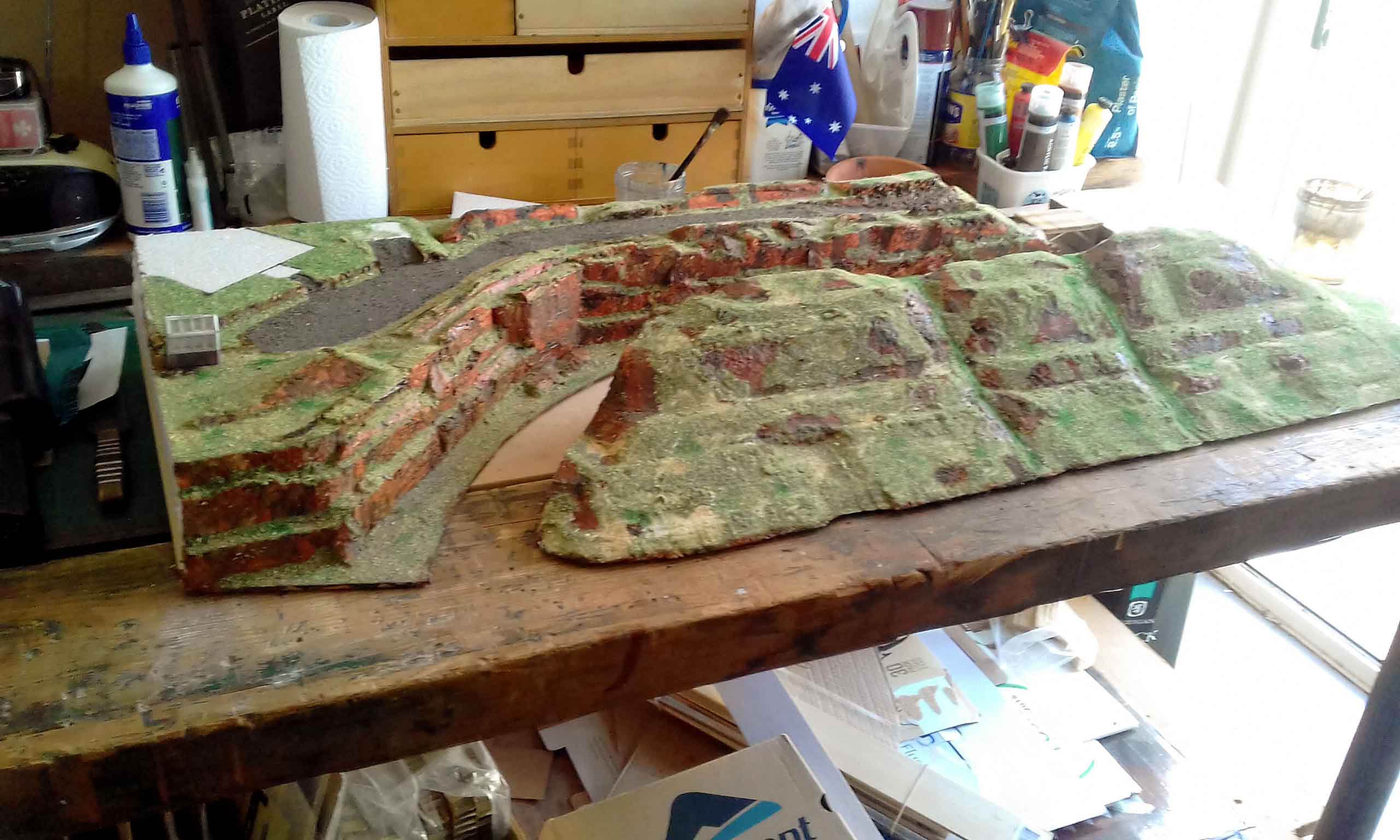
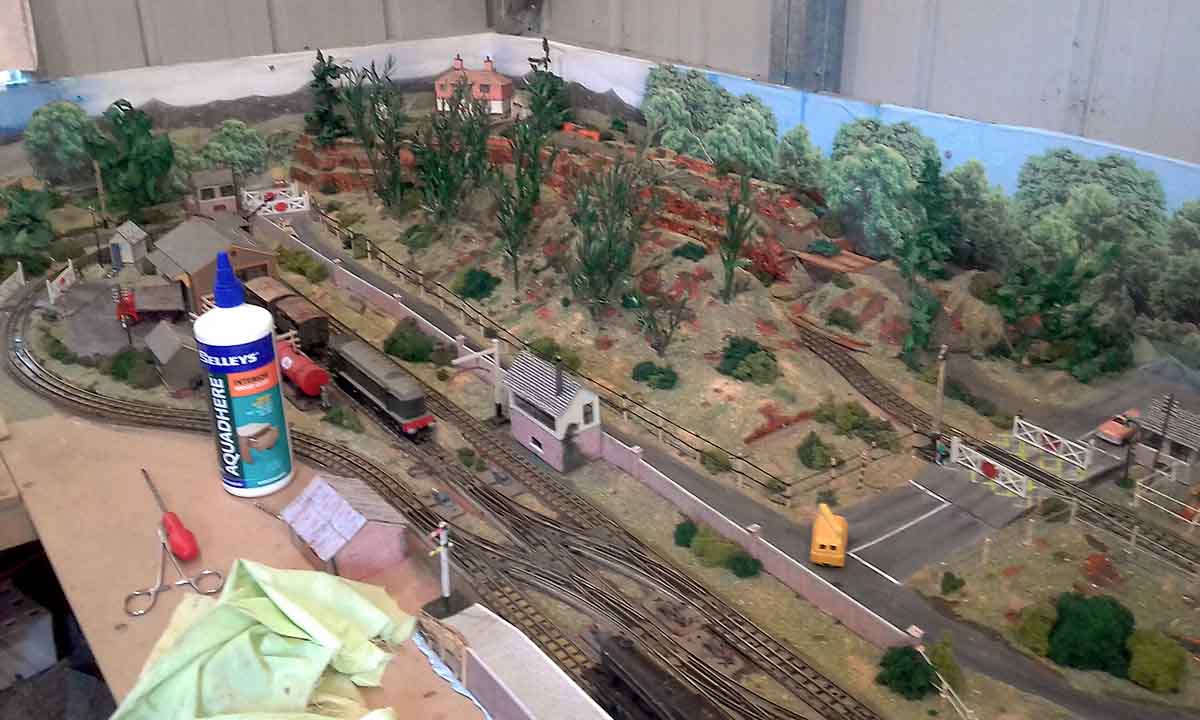
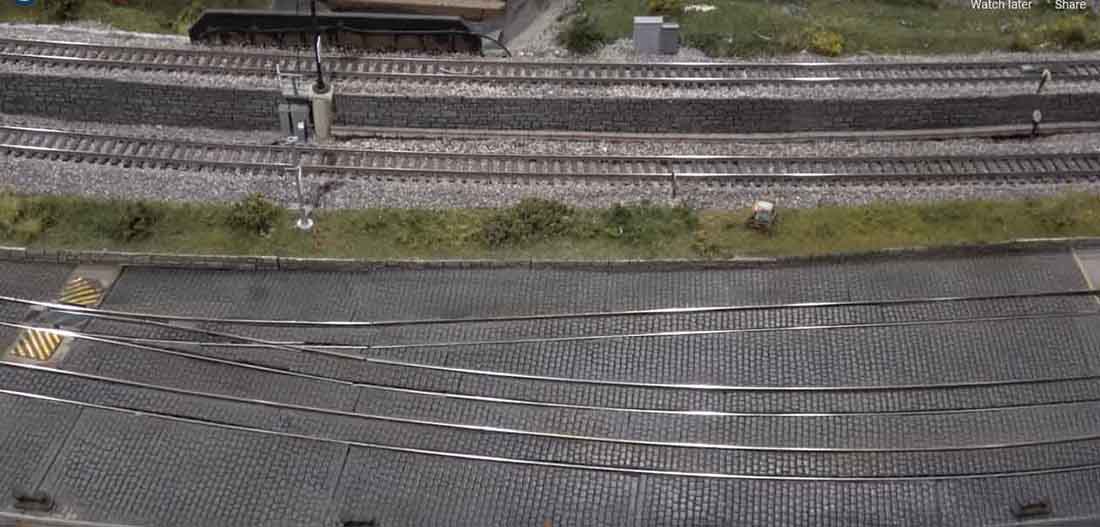
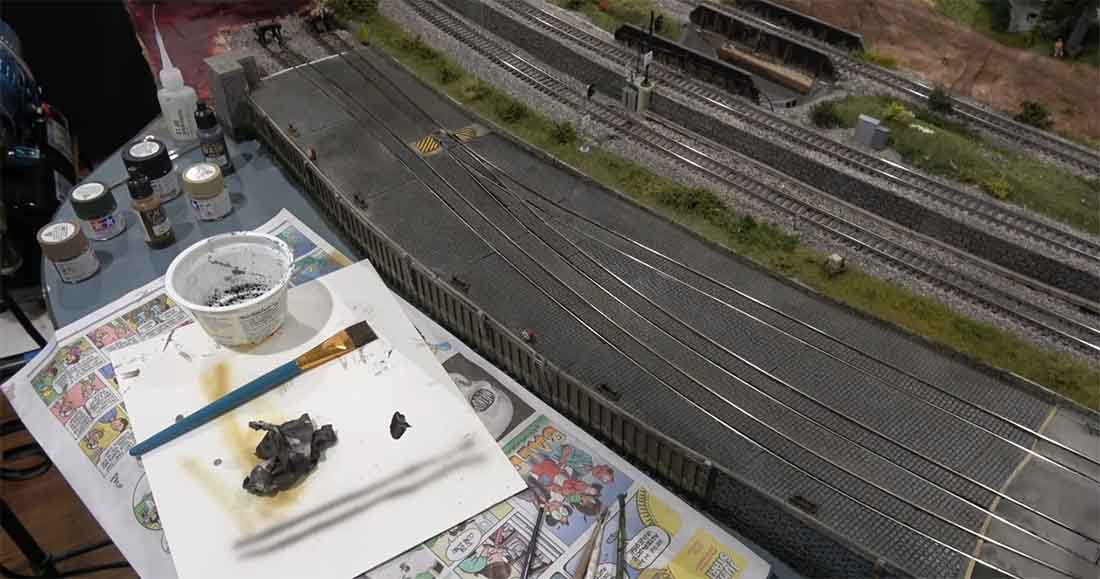
Making a Helix for your railroad

If you’ve ever pondered over making a helix for your layout, Lawrence has shared some good advice:

“Hi Al

I love to wake up each morning and receive an email that you pass on with some ones special layout, Thanks.

This email is basically about building my dual helix. I have added my track plan below showing the DCC section of my layout.

I have completed and tested all the runs (each run is at 4”, 7” and 10” off the table top) except for the two helixes and the bridge between them.

The idea is that all three tracks will enter one helix, cross the bridge and exit the other helix.

track plan for helix

The helix will connect to the three separate levels the trains run on.

I built the helix platform four inches above the rest of the HO layout to match the first DCC height run. My HO layout is directly above the O scale layout so I was not able to put a center hole in the helix platform.

On the platform I drew line corner to corner and side to side on card stock that covered the platform. With a ruler from the center (one inch on the ruler) I drew two circles.

The other holes on the ruler were one inch less than the 24” radius and one inch more then the 28” radius. Cutting out the one quarter of the circle on the card stock I have my pattern for making all the one quarter pieces for all the rings.

Displayed below in the next two pictures is the pattern and the first ring of wood cut out (P.S. the second picture shows the top of the O scale lift bridge). I was able to cut out eight, one quarter pieces from each one-half inch sheet of plywood, or two rings.

helix circle

helix template

To make the helix I decided to use upright stanchions with aluminum bases for the ring plywood.

From my ring diagram I labeled each stanchion and marked off how high the top of the bent one eight inch (just a hammer in a vice, easy) was to be. I used a seven inch inside width on the aluminum to ensure train clearance.

brackets for helix

As I have stated in a previous email all my DCC tracks run at three different levels. The DC track runs on the main base. This is displayed in the next picture.

levels for Helix

There are eight stanchion pairs per helix. The stanchion pairs assembled and mounted on the platforms are displayed in the next picture. The first ring and most of the second ring is also displayed.

Notice two tracks entering the helix. Because of that the 4-inch track enters the helix at the base of the platform.

The 7-inch track enters the helix enters at the second ring.

The 10-inch track enters the helix on the third ring.

The first ring only has one track so the extra space is treated as part of the layout and receives grass and trees.

The second ring has two tracks and had a small space that will receive grass and bushes.

The next picture displays the trains from the three levels entering one helix.

making a helix

I am not able to put a center hole in either helix as they are directly above the O scale track. What to do?

One helix center has a Ren Faire in progress with jousting. The other helix has two farms, one for cattle and one for crops.

making a helix

making a helix

The next picture shows how I move the bus wire around the layout. The connectors displayed are called Lever Nuts.

Three position lift up levers to accept wires from 14 to 26 awg. One lever nut for positive and one for negative.

When possible the bus wire is run between the uprights to where ever needed for connection to the tracks. Thus, all my wiring is on the table top and bending or crawling beneath the layout.

wiring for helix

Where I have to run the bus wire where it is not between standup, it is run next to a train track and covered with ballast.

The ballast I use is crushed walnut shells, it is course and has a brown color (I like the looks when it is in place and dried after the alcohol and Mode Podge (one to three mix with water).

I bought a 25-pound box walnut shells at Harbor Freight for $27 and have filled 30 of the standard size ballast containers and have not reached the bottom of the box yet.

The Mode Podge goes a lot further then the Scenic Cement and works just as well.

ballast for helix

At the present I am working on the third ring. The next picture displays the three rings with one track, two tracks, and three tracks.

The third ring through the seventh ring uses the complete width for the three tracks.

making a helix three layers

The last picture further displays the three rings and where I have gotten at this point.

On the far left of the picture the bus wires are raised up to the next ring for the feeder wire connection to the track.

As each ring is added track the trains are run back and forth. This is repeated a number of times after the ballasting.

Thanks

Lawrence of Madison Virginia”

A big thanks to Lawrence for sharing his experiences for making a helix.

There’s been a quite a few posts on the subject over the years.

Gary’s helix springs to mind.

And Doug’s Helix.

That’s all for today folks.

Please do keep ’em coming.

And if today is the day you get started on your layout, the Beginner’s Guide is here.

Best

Al

PS Latest ebay cheat sheet is here.


Detecting trains – Steve shows us how

Steve’s been in touch – have a look at his way for detecting trains:

“Hi Al,

Detecting trains on the layout can be very useful.

I Just thought I might share this little trick that I have developed. It is a simple, cheap, and very reliable method using just 3 resistors.

I use this method to:

    To operate a crossing

    A train position indicator

    Signalling

    To activate an announcement or sound

The advantages of this circuit are:

    Cheap and easy to build

    Works with any power mode, DC, DCC, battery etc

    Can work with any power supply

    Output can be adjusted to interwork with any other device

    Small current drain

Take two ‘light dependent resistors’.

One is placed under the track (r2), and the other (r1) is placed anywhere alongside the track. Connect the resistors together.

Connect voltage to the other side of r1. Connect the centre contact of a 50k variable resistor (trimpot, r3) the other side of r2.

Connect 0v to one side of r3. Adjust r3 to achieve the required output voltage from the centre connector.

All of these devices are simple, cheap, and can be obtained from any electronics retailer, or ebay.

The circuit is:

detecting trains block circuit

At normal, the three resistors make up a voltage divider, so that the output from r3 can be adjusted as required.

When a train passes over r1, its resistance goes much higher, reducing the output.

This output can then be used for almost any other circuit via transistor, microprocessor, LED etc.

detecting trains block voltage

The values of r1 and r2 were 2k at normal (4.5k when dark), but nearly any approximate value will work because r3 is used to obtain whatever value you require.

R2 is essential as it acts as a compensator for varying light conditions around the layout, or for night time running. If the light level alters, both r1 and r2 will change at a similar rate. This keeps the voltage divider ratios about equal.

For DC users, the voltage onto R1 could be taken from the NORTH rail (positive), and ov from SOUTH rail. But output will always depend on the input voltage. So a train moving slowly will not provide 12v (more like 6v). Also, a train moving in reverse will provide a different output.

Regards

Steve (Sydney)”

Clever stuff from Steve when it comes to detecting trains.

And now on to a subject I’m very keen on: making a start!

“Hello Al,

We finally made a start on the layout.

I love reading your post and your latest hall of fame inductees are well deserving, so congrats to the dynamic duo.

We decided to use RRinabox for the modules and then we have kit bashed it to redesign the extra track…our oldest son has gotten involved and he is way smarter than us. So it may get to suffisticated for Vicki and I to run.

There are 3 continuous loops that we can switch and run a train from outside upper loop all the way to inside lower loop and back out.

Its kind of cool and takes about 18 minutes with some operations of manually switching turnouts and crossovers.

The layout is currently 42″ x 96″ and we do have a plan to later add another module for the saw mill.

That’s all for now and we will send more pictures as we progress.

Your Texas fans,
Sid and Vicki”

model railroad track


“Hello Alastair,

The pictures show a load of lumber (HO) that I made from ice cream sticks. They are glued together and thin brown wires were used for tie-downs.

Guenter”

ho scale lumber

HO scale lumber

I kiked Guenter’s lumber trucks – simple but effective, like most of your wonderful tips and pics.

Lastly, a question from John which I thought worth posting, as I’m sure it would help others in the interest of making a start:

“Alastair, I have been a member so to speak for several years and I have finally acquired a room for a layout.

For me when I say “just starting out” I mean it.

Haven’t built a layout for several years due to lack of space. DCC, which is what I want, is new to me and my question to you is: what do I start with?

I am working on a 8X10 HO layout to begin with. Engines, cars, track, switches etc.

Any help would be greatly appreciated. I have really appreciated your work on the blog and all of the additional comments made by so many people.

Sincerely,

John “Red Label” Walker”

Please do leave a comment below if you can help.

A big thanks to Steve, Sid and Vicki.

All these years in and it’s still wonderful to see your solutions to specific problems.

And of course, it’s great to see those ‘starts’ because that’s where the magic is.

That’s all for the this time.

Please do keep ’em coming.

And if today is the day you get started on your layout, the Beginner’s Guide is here.

Best

Al

PS Latest ebay cheat sheet is here.


Bob’s fire station

Just a quick heads up.

Today is the last day for the $9 mega bundle deal.

You get 22 free printable buildings with the Beginner’s Guide – and one of them is the fire station:

“Hi Al,

Had a go at your firestation pleased with the way it came out

Bob”

And I also got this in from Daniel, which is very timely:

“Just spent a few minutes with crazy John while I had morning coffee on the porch. Big weekend for us Yanks, ya know. Haha. Video was very enjoyable.

The firehouse was certainly well done, but tell John that the tower is not a lookout, but a very important part of the firehouse….it is where they hang the hoses after use so they dry.

Modern hose materials may not require it as much, but that was the real intended use of the tower.

All the best to you.

Mn Dan

Dan”

That’s all for this one.

You can get the fire station and 21 other buildings all for $9 – but today is the last day.

Thanks to everyone who has or does support the site – you know who you are.

Best

Al

It’s a $216 saving when you grab this $9 deal. And it still comes with my 60 day money back guarantee too.