HO scale model railroad – John’s

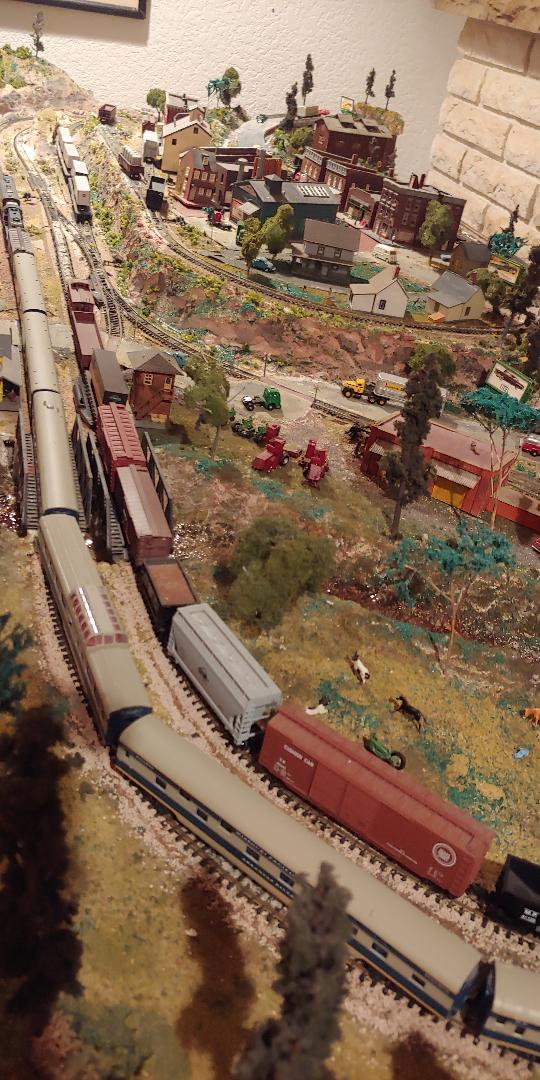
John’s HO scale layout is really taking shape:

“Hi Al, (From a longtime follower and great admirer)!

My love for trains started about 60 years ago and some of the trains on my layout today are some of my originals as well as my wife’s.

That HO train hobby stopped when I got my drivers’ license and was rekindled when our first daughter was about five years old. That lasted for about another 10 or 12 years when my wife packed everything up and neatly put them in the attic.

When the third generation was coming for Christmas about five years ago my oldest daughter called and said “Dad why don’t you put up the trains for the kids!” Luckily the trains were still in good shape and I had about six weekends to build a 4 x 8 layout. When the kids showed up for Christmas, it became immediately obvious that it was all worthwhile.

After the holidays I realized it was time to build a much larger layout. And I will admit it was not only for the kids!

My HO layout is called the Wismer Valley Line. The following objectives informed my plans:

1) Replicate to the extent possible, very long American freight trains, pulled by multiple locomotives, up long grades.

2) Focus on the specific shape of the plan and get as many trains as possible running concurrently.

3) Incorporate the vintage trains into the plans. FYI – The major Railroads on the layout are from areas of the country where my three daughters have lived as adults.

Maybe as important as anything, make my own rules. e.g. It’s OK to have the Pennsylvania RR running alongside the Union Pacific, at least in my barn!

The first thing I did was get your beginners guide!! This is a tremendous resource even if you have previously built train layouts.

Secondly, was to find someone local willing to give me ad hoc advice. This advice began with the key suggestion to avoid grades (especially curved ones) if I wanted to pull long freight trains and avoid derailments. I opted for a bi-level layout. Overall size is approximately 17 feet long and 11 feet wide at the widest point. The shape was dictated by the interior of the space including doors on either end.

The longest freight train, on the upper level outside track is pulling about 60 cars, using four locomotives (NO dummies!) in tandem (over 30 feet in total length). The rolling stock are from the late 1950s the early 1980s and the past five years (which included additional vintage railcar purchases on EBay).

I rebuilt about 100 of the vintage cars installing (Kadee) couplers and well machined wheels, along with new trucks when necessary. The wheels are critically important for long trains in order to minimize drag.

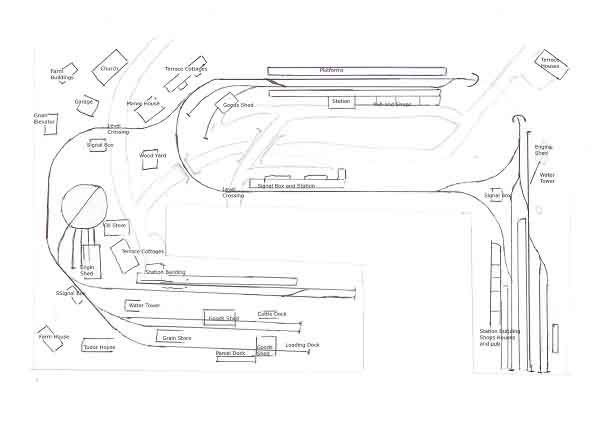
In planning the layout, as can be seen from the plans, I spent a lot of time working on the maximum radius that could be attained by each track. I am surprised to see that more of your readers have not mentioned this issue as longer locos simply can’t make it around tighter curves. Maybe it was just the unconventional layout combined with this many trains that created the issue. My original plans turned out to be invaluable as I used them constantly to measure and adjust the radius of each curve.

The deck is, bottom to top, plywood, Homesote, cork and then the tracks. All seams taped and spackled. Total weight exceeds 600 pounds.

My biggest engineering challenge was the concrete floor in the old outbuilding on our farm. It is neither flat nor level! The solution was to overbuild and use 24 heavy-duty casters so the entire layout can be pulled out from the wall to allow for total access. There are also 4 cutout/lift-out windows (which eventually will be disguised by scenery), where I go underneath and come up out of the hole, enabling me to reach every square inch of the layout.

I spent significant time making sure everything was as level as possible, despite the uneven concrete floor. When working on it, it is pulled out from the wall about 3 feet. When running it, it’s back in the corner. With all those casters, once I get them going in the same direction, it’s not too bad to move; and they have the added benefit of finding their own version of level.

The deck is 43 inches off the ground. If I did it over again it would be a couple inches higher to allow for easier access.

I’ve included a few photos of the plan, and build out as well as a video of the six trains moving at the same time, and a short video of how I test the track.

Original plans and beginning construction:

HO scale track plan

HO benchwork

Construction continues:

HO scale bench


HO track

Laying track HO layout

Up and running:

HO scale steam locomotive

HO layout steam engine

HO track plan

Trains running:


Final notes: With all of the wiring required for the six separate train lines I wanted to make sure that the tracks were really laid down properly, before I commenced with the wiring. As you can see from the short video, I push one railcar and see if it makes it all the way around the track (approx. 40’) with no problems. I also listen carefully. Sound will tell you if there is something loose or out of alignment. Better to discover this, BEFORE you do the wiring!

Al, thanks again for this wonderful service you provide for all of us. So much of what you show is the perfect combination of sheer genius crossed with amazing creativity. Inspiring!

Jonathan

P.S. Now it’s time for the ballast, hills, sage brush, and maybe a few sidings, if I can fit them in etc. Perhaps I did this a bit out of order, but I really just love rebuilding old running stock and operating the trains!! You might ask, why not DCC? Well it is quite simple, all of my locos are DC and I don’t particularly care for new technology. Much of what I make these days is with hand tools (not electric). I have rushed for most of my life and find that making things by hand slows me down just enough to think about what I am doing…… before I do it! If that sounds like a rationalization, sobeit.”

A huge thanks to Jonathan – what a joy to see all that rolling stock running.

Lastly, I know some of you had duff links to yesterday’s mail. Sorry about that. Here it is again if you missed it:

Model train wiring tips (Sunday’s)

And the day before too:

Alan’s 6×4 N scale (Saturday’s).

That’s all for today folks.

Please do keep ’em coming.

And if today is the day you get started on your layout, the Beginner’s Guide is here.

Best

Al

PS Latest ebay cheat sheet is here.


Richard’s 2.5ft x 8ft layout

My word, what a week.

Last Friday I told you all I was hanging up my boots, because sales didn’t cover costs.

I thought a closing down sale may save the day, but it fell short of the mark.

But then some bright spark asked why the sale was only running until Monday – I know, it sounds obvious now – so I kept it open.

What’s more, the same bright spark also asked why the print-out-scenery wasn’t in the sale. So I added that.

And guess what?

Although I’m not out of the woods, it means the blog is going to make it into the New Year, and then some.

However, the bright spark (my new best friend) also pointed out that unless I change a few things, I’ll be in the same mess again, very shortly.

So, I’ll be mailing everyone who bought the Beginner’s Guide or the print-out-scenery, and asking them to help me out with a very short survey, which should point me in the right direction.

Thank you to everyone who supported the site.

And thanks for all the kind comments and emails too. I’ve had lots – just like this one:

“Dear Al, this is basically a (huge) thank you note.

In one respect, I want to thank you for all you have done for so many of us around the world who love trains. I’m not sure when I started with your blog, but I think it’s close to 8? years. I think everyone should have the right to stop and take a breath and figure out what they want to do with their life.

Everyone has their own set of motivations. The thought process obviously needs to consider economic factors as well as others. Hopefully your current strategy will soon allow you to check the ”economic box”! Of course if it’s a membership fee or some other mechanism which allows you to continue, I’m in!

Speaking for your “members” I can guarantee you, that the service you provide does more to help people all over the world, than you will ever know. You keep people going and you keep them interested. Your service allows so many to feel a sense of accomplishment with this wonderful hobby. How many people can say that about what they do for others? Of course you also put smiles on the faces of so many including our kids and grandchildren!

I send you this photo which I took a few years ago when my wife and I visited Wales and England for our 45th anniversary. We rode a number of the Welsh narrow gauge railways. What fun and what great memories. Here’s hoping that you’re looking at this photograph wondering what’s over the next hill or around the next curve, for your blog.

Although if you’re looking at it from the caboose, I wish you nothing but the best, as you have certainly done more than most to make the world a better place!

Gratefully, Jonathan

From Pennsylvania”

A wonderful mail, and everyone I’ve had cheered me up. So thank you all.

Now let’s get back to trains.

Richard has been kind enough to send in this fab narrative:

“This begins a story that covers 35 years. I started designing this railroad in the early 1970s based on my love of train layouts I had as a child and began construction in the latter part of the 1970s.

My childhood involved S Gauge American Flyer trains but this project had to be more than just a circle of track on a 4 foot by 8 foot layout so I chose to build my current train in N Gauge to allow for a more realistic model in essentially a 2.5 x 8 foot space.

The plan was to have block and sector control for almost every 3 feet of track from a control panel with multiple DPDT rocker switches with a center off position. This concept predated many of the advanced control systems of today. This allowed for multiple power supplies to service up to three trains simultaneously.

The railroad concept was to be a logging and coal distribution layout from the forest and stone quarry at one end and coal mines at the other end to a distribution yard location in the middle section.

It would have passenger service provided to move workers to the forest and mine locations as well as a through route to distant cities.

The railroad is an extended helix design that travels from one end of the layout to the other while rising in elevation to service the two industries. The railroad project was photographed throughout the construction phases to highlight the elements added in each phase. A layout sketch is shown in Figure 1 and the actual control panel is shown in Figure 2.

model train control panel

Figure 1 control panel sketch shows turnout controls at the top and bottom and block and sector switches placed throughout the layout. Dotted lines show track in tunnels.

model train control panel

Figure 2 shows the actual control panel. The green, blue, orange, purple labeled tracks are stacked above each other in the upper tunnel areas to conserve lateral space.

A number of lighting features and turnout labels on the actual right of way would be added later The first construction project on the railroad was to build two wooden high mountain trestles to span an open valley as one of the central themes.

It was designed and constructed as two balsa wood structures built from scratch resembling high mountain structures of the 1930s and 1940s in the US. I built the two long bridges in Figure 3 by estimating the span based on the railroad plan and sketch I had settled on much earlier.

The upper shelf in Figure 4 shows the planned location for the stone quarry and logging and lumber cutting industrial site.

A vertical panel is planned for the back side of the entire layout and would be removable to access tracks for maintenance within the mountains in case of derailment.

The upper shelf in Figure 5 shows the planned location for the coal mining operation.

Figure 6 shows the back side of the layout with the cover panel removed. Tracks are stacked as part of the extended helix configuration and the block and sector wiring is routed and taped to the vertical risers that support the tracks.

At this stage of construction, train and turnout operation was checked before adding screening and plaster scenery so corrections to the layout could be made without undue disassembly.

Unfortunately, career obligations, vacations to most of the US National Parks and biking for rails-to-trails recreation limited the time available to continue the railroad construction for at least 30 years until I retired.

After retirement, I was eager to begin working on the model railroad again. The delay, however, caused excessive track corrosion which impacted train operation. Track cleaning was taken on as a major unplanned event and seemed to solve the continuity problem and I moved on to creating my empire.

N scale trestle bridge

Figure 3 trestles located in the middle of the layout with no screen or plaster scenery.

Figure 4 shows a shelf on the left side of the layout for the logging and lumber industry. A cavity beneath the railroad contains the wiring for all tracks and features.

n scale coal mine

Figure 5 shows a shelf on the right side of the layout for the coal mining operation.

Figure 6 shows how the tracks are stacked at the back side of the layout before installing the back panel.

Nylon screening was chosen to support the plaster and was screwed to free standing support posts and to the existing railroad superstructure as shown in Figure 7, 8 and 9.

model railroad train bridge

Figure 7 support posts for the screen and plaster

Figure 8 coal mining region with screen mesh in place.

model train logging factory

Figure 9 stone quarry and forest logging and lumber region with screen mesh in place.

About 40 pounds of uncolored plaster was added over several months to give the railroad a mountainous terrain as shown in figures 10, 11 and 12.

model train quarry

Figure 10 stone quarry and forest logging and lumber region with plaster in place.

Figure 11 coal mining region with plaster in place.

Figure 12 complete railroad with plaster in place.

Ground color, buildings and selected regions of grass, bushes and trees were added to bring the railroad closer to a final presentation.

Figure 13 shows the completed stone quarry, forest logging and lumber cutting industry. A shipping dock and crane tower were added to facilitate movement of raw and cut lumber. A small rail station and hotel service the workers at this industrial site.

The log saw mill is high on the mountain top along with a green seemingly water tower on Lambs Knoll. Lighting has been added for a night operation.

model railroad

Figure 13 a stonequarry, forest logging and lumber processing region.

The trestle bridges were stained a more reasonable burnt orange as shown by Figure 14.

A coaling tower and coal dump station were added in Figure 15 to the yard location with an unlikely covered bridge to allow heavy trucks to move to either site. Colored posts were added to each turnout location as labels identical to that on the control panel for ease of operation. Rail cars have found their way into the yard at Trestle Junction.

Figure 14 stained railroad tressles.

Figure 15 railyard and coal processing region at trestle junction.

Figure 16 shows the coal mining region. It started out with a small coal mining operation and soon flourished into a major coal processing facility accompanied by a general store, hotel and rail station to service the mine workers.

The white tower at the far left in Figure 16 is a hardened but abandoned microwave relay antenna tower at Cross Mountain. Tropo-scatter communication antennas are shown on the right side of Figure 16 for the Hearthstone Mountain facility.

The radar dome was added for color but does not exist in the real environment just like the actual coal mining facility due to the high power transmitting site. Lighting has also been added to the night time operation of the modeled coal mining facility.

Figure 16 coal mining operation and lighted turnout signal towers

figure 17 extended helix railroad with lighted features.

Figure 17 shows the completed railroad. Track conductivity was again becoming a problem and the cleaning process is now more difficult even with access to the tunnels.

Phase II

The Extended Helix Railroad is being modified to include another 2.5 foot by 4 foot section beyond the coal mining facility but at a lower level to enable trains to change direction without traveling to the top of the mountain and back down, a short coming in the original design.

Secondly, the deterioration of the track conductivity has led to a bold step into the future of model railroading. Research has led to the concept of battery power for train operation.

“N” gauge is quite small and limiting when trying to shoehorn in a battery power system into freight and passenger cars to electrify the engine motor when the battery cannot be integrated in a steam or diesel locomotive. A control chip and speaker must find their way into the tender of the steam locomotive or into the “B” unit of a diesel locomotive.

Both the steam locomotive tender and the “B” unit must be permanently connected together along with the battery powered freight or passenger cars. This means the train must always be configured with at least two or more battery powered cars.

Lithium Ion batteries have been made small enough to package two batteries into a passenger cars for a passenger train but must be configured in four freight cars or four flat cars for a freight train. Four batteries in series are required for a 14.8 Volt at nominally 1.5 A/hour. A controller must radiate the signal that controls the pulse width modulation used by the motor in the locomotive to efficiently control the use of battery power.

Lithium Ion Batteries have been procured for a 3.7 V and 1.8 A/hour rating. Military grade connector pins have been ordered to conveniently connect the cars together and charge the batteries when needed. The next expense is for the control system offered by Ring Engineering.

A follow report will document the expansion of the railroad and operation under battery control.

Richard”

A huge thanks to Richard – I can’t wait to see his update. Fab stuff.

That’s all for today folks.

But don’t forget, now the books are balanced, I’m putting the prices back up.

So this is your last chance to grab the silly discount sale on the print out scenery.

And the same goes for this fab offer on the Beginner’s Guide too.

Best

Al

PS Latest ebay cheat sheet is here.

PPS Got the Beginner’s Guide and not had your login details? Please mail me.

How to make a train diorama – Tony’s update

Tomy’s been back in touch again with the part 2 of his ‘How to make a train diorama’:

“Good day Alastair,

“This is a follow-up to my previous post. For those who didn’t see the previous, I am building a diorama based on Don Brekon’s wonderful print “Riverside Local”. I am just modelling the right side of the painting- ending at the river bank.

riverside local painting for diorama

It is OO on a 18”X20” base. My previous post ended at this point- with the basic terrain being laid down in plaster. So here we go: How to make a train diorama.

diorama plaster base

After the basic terrain was set, I put down a quick coat of color. The colors aren’t that important- they won’t show in the end, but they are a helpful guide to laying the ground cover. They also prevent any white plaster showing through.

In the pictures, you may notice the Inn and various details, such as trees, come and go. The point is there is a lot of experimentation as you build scenery- it rarely looks right the first time. And the photos are not in exact sequence as I illustrate certain points.

adding base color

I next turned my attention to the rail bridge and footpath tunnel. I had assumed that I would be able to find a portal and basic girder bridge to match them in my parts bin and, if not, find them on line. I didn’t have any luck finding ones that looked right so I decided to scratch build.

I started by taking various close-up photos and experimenting with printing size. Once I got the size I needed, I just printed out a bunch of copies on card stock. Then it was just a matter of cutting balsa and card and building up the tunnel and bridge in layers. It came out pretty well, but it was a lot more work than I had planned.

model train tunnel print for diorama

model train print for diorama

I used Alastair’s sheet of brick walls for the inside of the tunnel and bridge. I can see that sheet having many uses.


How to make a train diorama:

Once the basic bridge and tunnel were in place, I built up the pathway to the correct height and built up the bank with chicken wire and plaster.

wooden tunnel for diorama

Next I started on the ground cover. There are many ways to install grass etc. and I use a simple method that I have used for many years. I have a few dioramas that have been around a long time and the scenery has held up well. I always work in pretty small areas. I think this allows for accurate details- plus, when I mess up, there is not that much to be removed to start over!

I first put down some Elmer’s glue-all or wood glue (they work equally well- I think they are pretty much the same- with a little coloring in the wood glue!). I just lay down strips and spread the glue with my finger. I then pour some ‘grass’ or other cover onto a folded index card and sprinkle it on.

model train brick

How to make a train diorama

There are many brands of grass and I have at times made my own, but for this project, I have used all Woodland Scenics. I like the products, and if you look for them on sale or on Ebay, they are not too pricey.

I also am very impressed with their wide range of products and how they are continually coming up with new ones. I figure they are doing a lot for the hobby and I will give them my support when I can.

Fine Turf Burnt Grass looked the closest in color to the painting and it came out pretty well. After doing a few areas and letting them dry, I give it a quick spray of scenic cement. This will change the color and texture a little, but in this case it came out to what I was looking for. Working in small areas takes more time, but I think is worth it.

When I got down to what will be the river bank, I covered it in layers. First an earth, then grass, then a darker coarse turf and then a little bit of lighter coarse turf. Each layer is done the same way- glue and then spray. I fiddled around with mixing a few colors for the road/path because the color in the painting is a little unusual.

I finally just settled on Fine Buff Ballast and I think it has come out looking right.

How to make a train diorama

How to make a train diorama:

Before finishing the ground cover, I built up the woods at the back of the scene. I think the placement, type, and size of trees is one thing that can make or break a railway scene. If a tree is in a location that has been planted (a front garden, perhaps), then it can be any size, type or color.

If it is part of a wood, though, all the trees need to work together to create the scene. First size- they won’t be all the same size! And color- they won’t be all the same color!

In this case, I picked the largest tree first. In most cases, we don’t really model the true size of trees. Notice in the painting, the largest tree is almost twice as tall as the Inn. We rarely use trees this tall- but they will look right (the one I used was listed as ‘O’ scale). I then picked out the various other trees that are visible.

How to make a train diorama

Once the trees were in place, I continued with the ground cover. When I got to the bank and tree line, I put down about 4 layers of various colored ground cover. Although it will be in the background, some of this will show. I then added various shapes and colors to complete the bank and wooded area.

How to make a train diorama

The area next to the road (on the right) is out of the picture. I decided to add a flowering hedge – for a little color.

How to make a train diorama

Now I am basically at the point of completing all the details. I will be leaving the track, river and rear of the building semi-complete so that I can eventually fit it into my layout. I have a feeling that the details- mainly the people in the painting, will be difficult.

There are 13 different figures in the painting- all in specific poses. A quick look through my (rather large) box of figures tells me that I am going to have a hard time finding specific ones so I’ll just try to get as close as I can.

Hopefully, I will complete this before the end of the year. Stay tuned.

Tony”

A huge big thank you to Tony for sharing how to make a train diorama. I’ve very much looking forward to the next update.

That’s all for today folks.

Don’t forget The Beginner’s Guide is here if you want to keep yourself busy and have fun too.

That’s all for today, folks.

Best

Al

PS Latest ebay cheat sheet is here.