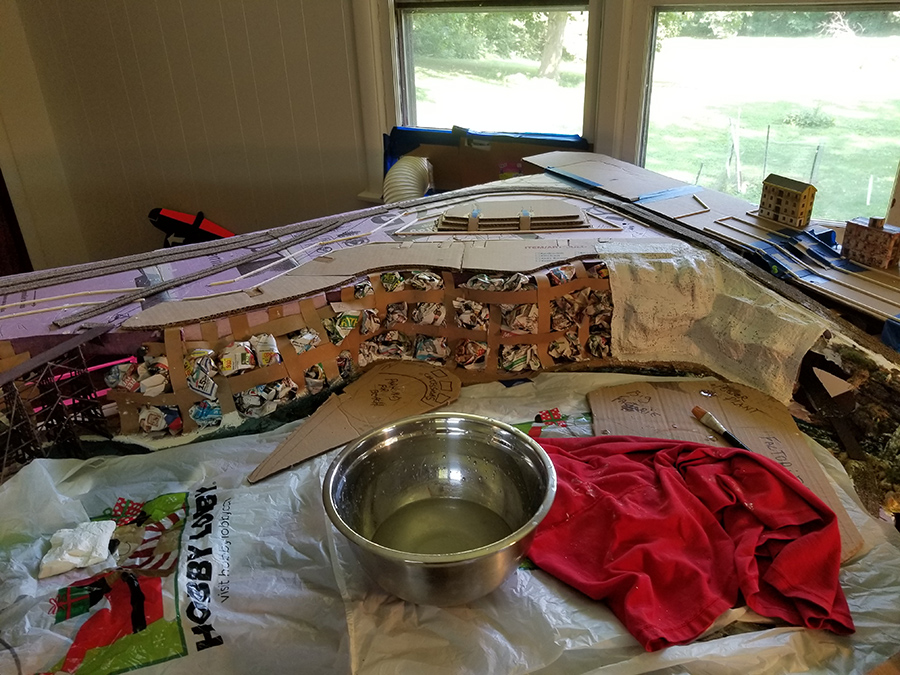
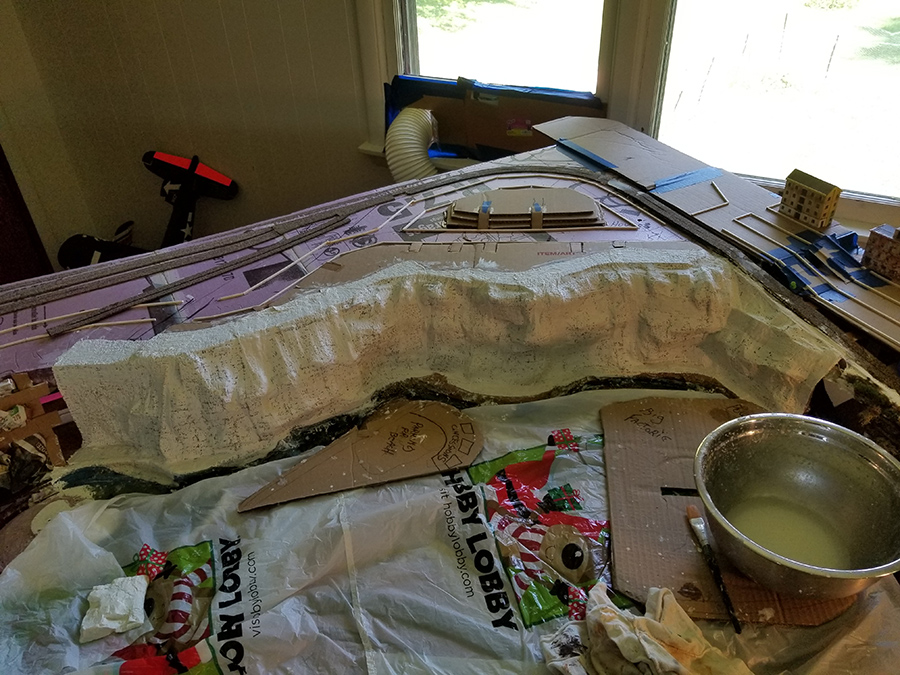
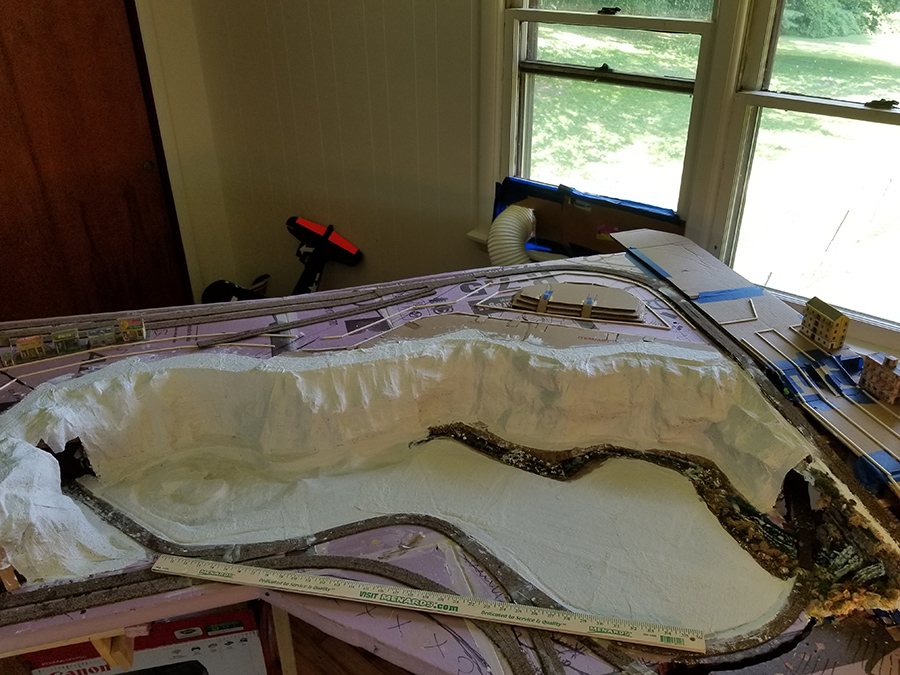
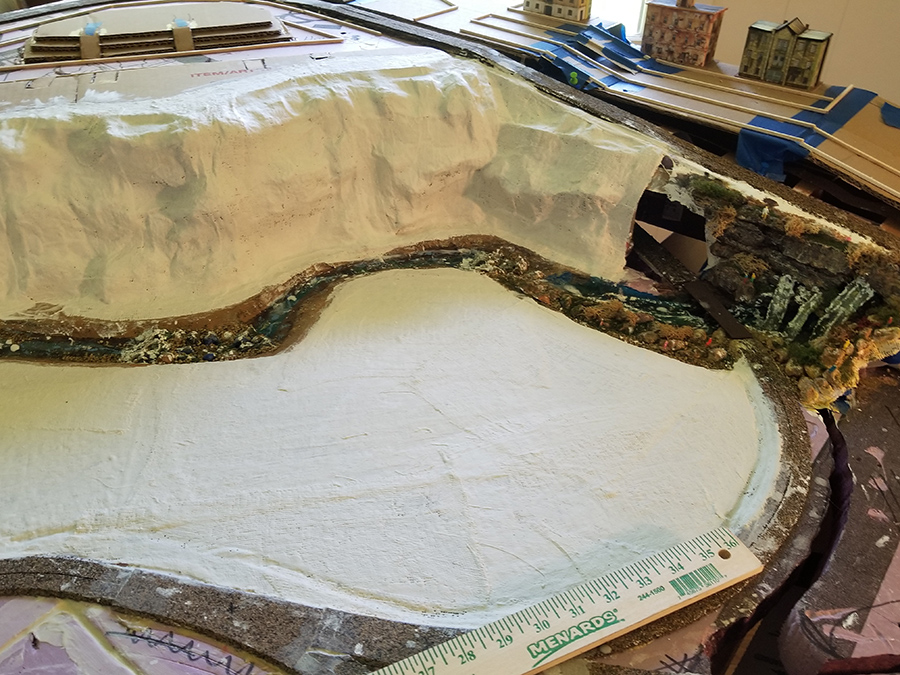
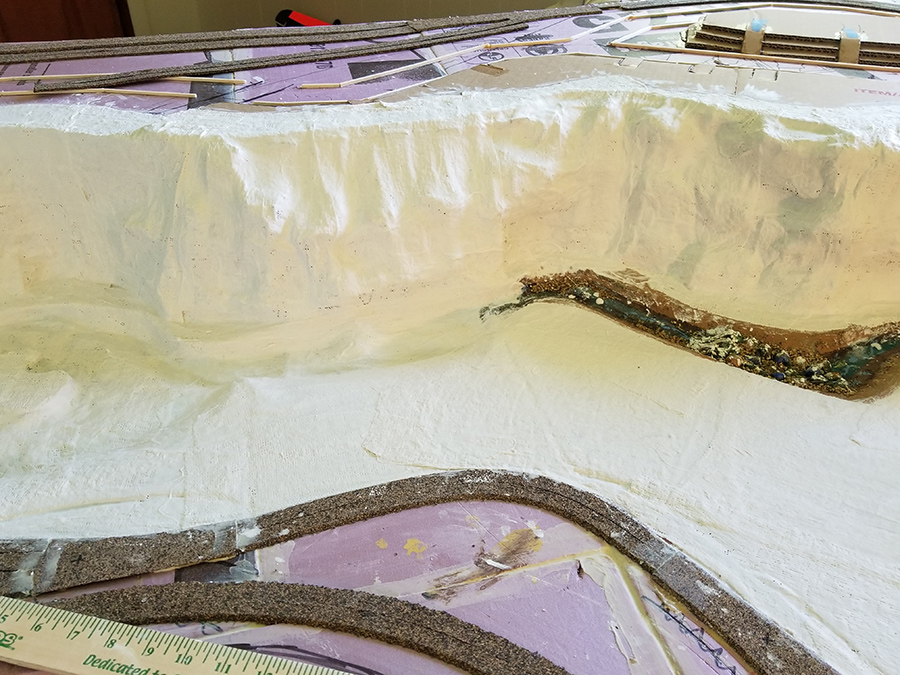
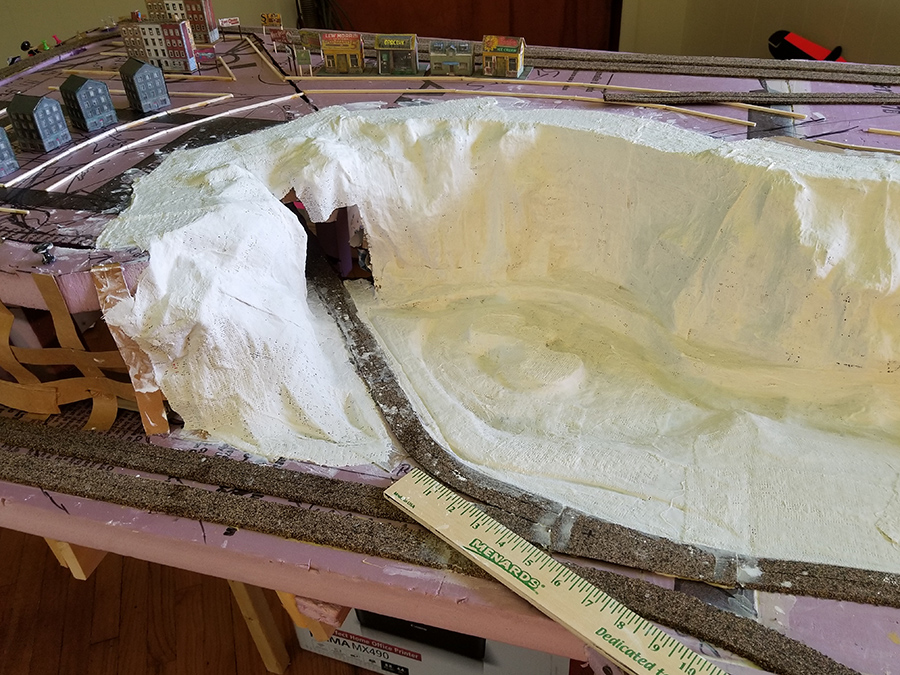
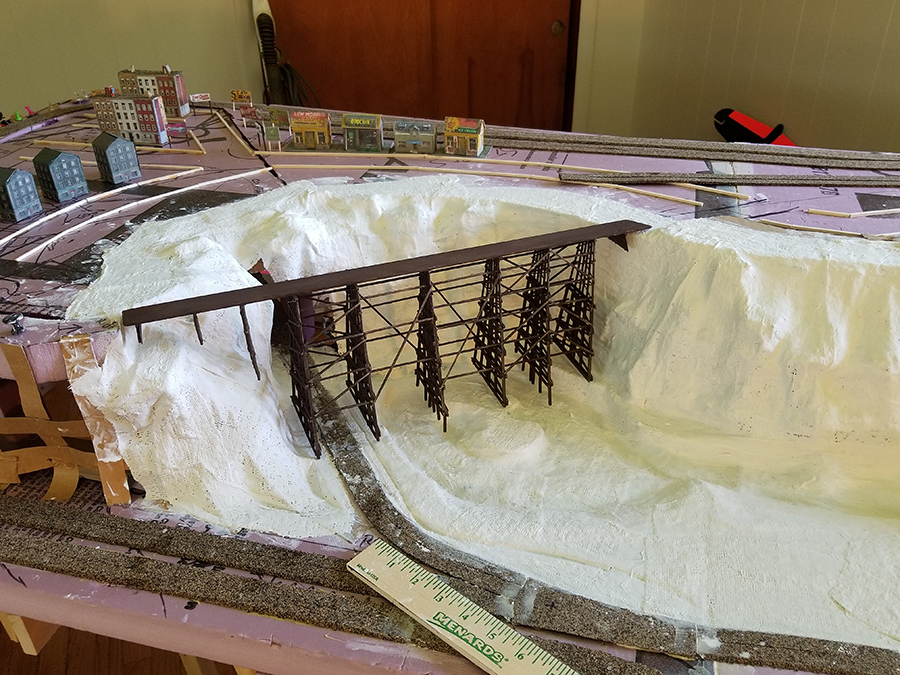
I have no idea why, but when ever I see pics of mountains or rock faces in the making now, for some reason I always think of
Model railroad rock landscape, probably because it shows the different stages of creating a rock face.
Also, pretty much every post on the blog is a reminder that there is no right way to do any part of this hobby. What ever you are trying to achieve there will be many different ways of doing it.
Some people use cardboard and plaster cloth for mountains, some folk use carved insulation foam, some use rock moulds, some use old ceiling tiles…
Jim’s been back in touch with his modular HO layout:
“Hello Alastair
From across the big pond, my name is Jim Volmer Sr, in Buffalo NY.
It has been a long time since my last post, but have experienced a lot of medical and family issues to deal with.
I am in the beginning stage of moving to a new home, hopefully with in a next few month’s so my layout is in total disarray, with packing all of the trains, buildings, electronic equipment and supplies etc…getting ready for the move.
I really did not have the chance to complete what I started, but that will change once I am in my new location.
So I thought that I would share some information on the Model Railroad Club I belong to. The name of our club is Western New York Trainmasters.
We are currently housed in one of our member’s basements, still looking for a permanent location. The club did have a location, but it ended quite unceremonious, that layout was destroyed and the club moved to where we are currently. We have a total of six members and are looking for new members all the time.
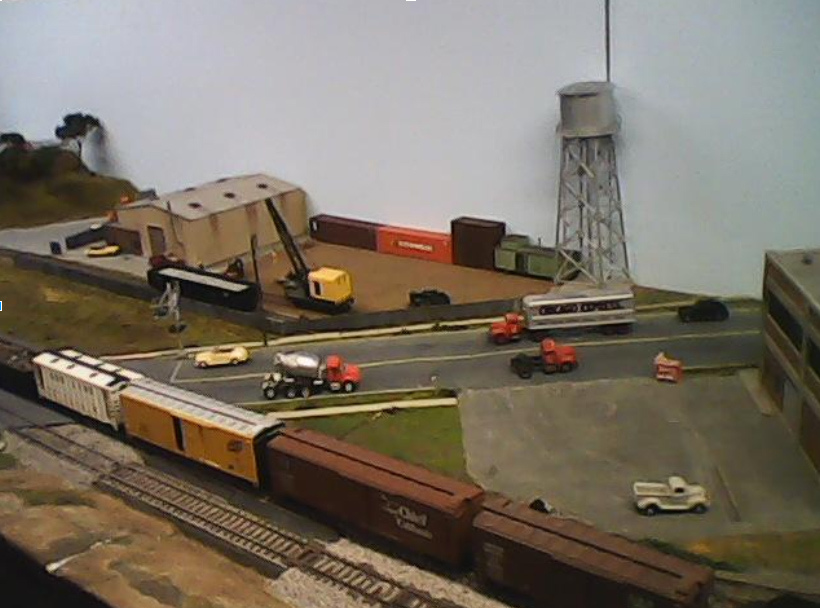
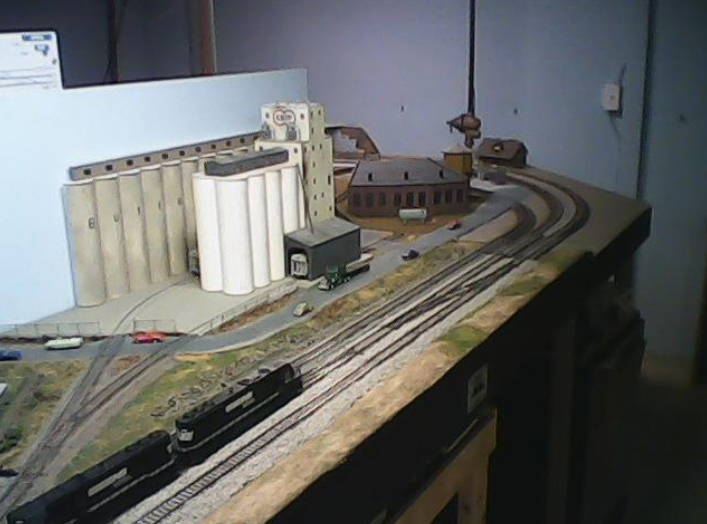
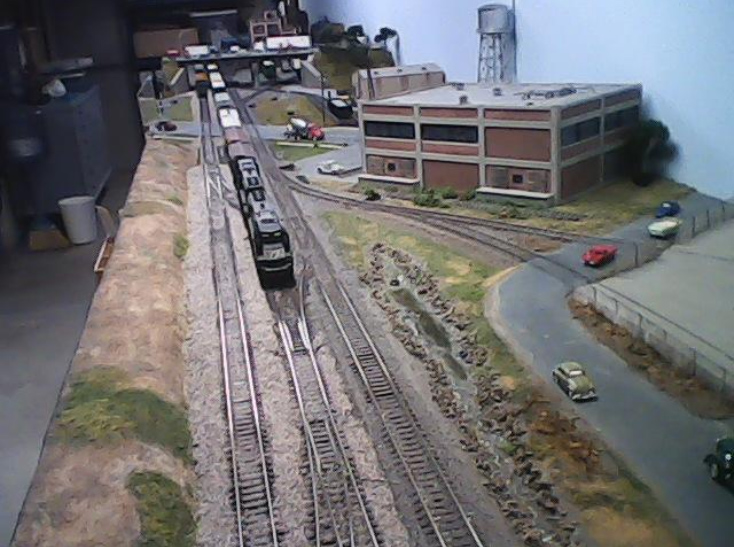
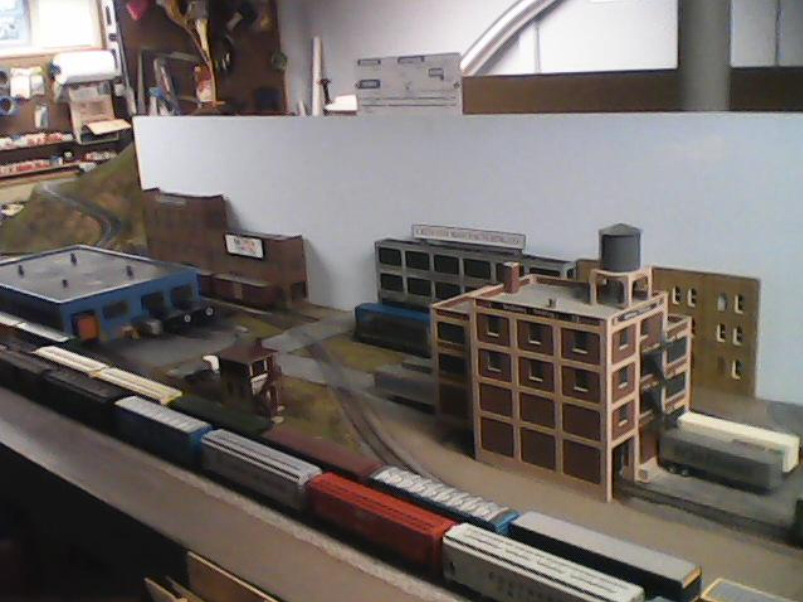
The railroad is called the Buffalo Erie and Niagara, a modular HO layout that is approximately 26 feet long with two 38 inch wide sections ( one in the front and one in the rear of the layout ), with industries, sidings, turntable, round house, and staging yard.
Two continuous loops around the entire layout allow trains to travel East and West at the same time. The train that travels West will be used to deliver products to the various destinations. The delivery destinations are: Buffalo Grain ( a Grain mill that once was in our area ), Buffalo Salvage Yard, McKinley Printing Plant, Crescent Manufacturing ( a company that builds small appliances), Jamestown Container ( a paper and cardboard distributor ), and Buffalo Industries ( for dry and cold storage ).
During our operating sessions, the dispatcher will assign a train to the engineer and conductor, for delivery of rolling stock to the various industries. As the West Bound train travels it route, the dispatcher will notify the engineer that the turnout for the industry lead track is thrown and cleared for entry. Once the train has entered the industry lead, the dispatcher must reset the turnout. It is then up to the train crew to deliver the different rolling stock to their proper destinations in a timely manner, utilizing a Card System.
Each Card has the name of the rolling stock, its identification number, what is contained in the rolling stock, and its destination. On the facial of the outside front modular, is a set of Card Holders, with the name of each industry on them. It is up to the conductor to make sure the correct card is in the correct Card Holder. After the cars are unloaded, the train crew collects the various rolling stock, with the card associated with it, and the train is then sent back to the staging area.
The rear modular area of the layout is mostly empty at this point, with only operating tracks and one turnout.
There are plans in the works to add more turnouts and operations around the walls to a second larger staging area. We are in the planning stage of placing a river, with a railroad bridge crossing over it, a mountain and tunnel for the train to pass through.
There are currently a total of fourteen turnouts. Ten of them are controlled with Tortoise Switch Machines and NCE programmable controllers, connected to the Digitrax system. Four turnouts are manually controlled. The one turnout that leads to and from the staging yard, has an automatic stop feature to it. The train cannot pass through the turnout until it is activated. Sometime in the future all of the turnouts will be set this way.
There are plans in the works, to have an automatic block control system, dwarf lights for all of the turnouts, a automatic grade crossing signal controller. Currently the grade crossing signals are controlled by a switch.
I have included some pictures of the modular HO layout for all to view. Hope you enjoy.
just aa short running session video I took yesterday using my phone, it was forecast for rain, so thought I would check out the layout after all the hot weather, glad to say all ran OK, it amazes me the quality of the footage as all taken on my iPhone, thought you may be could use it as a stocking filler as they say.
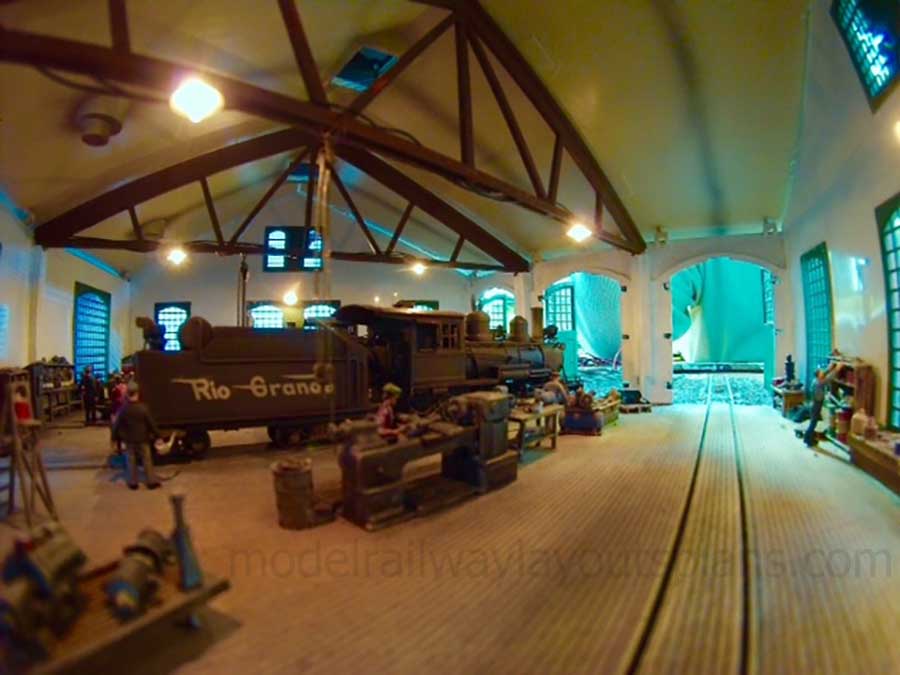
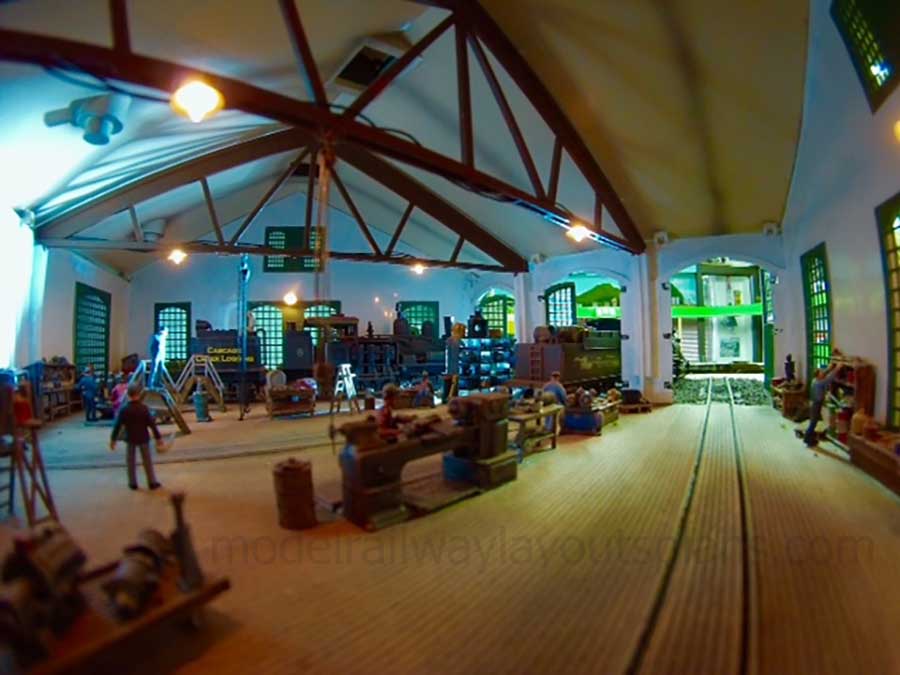
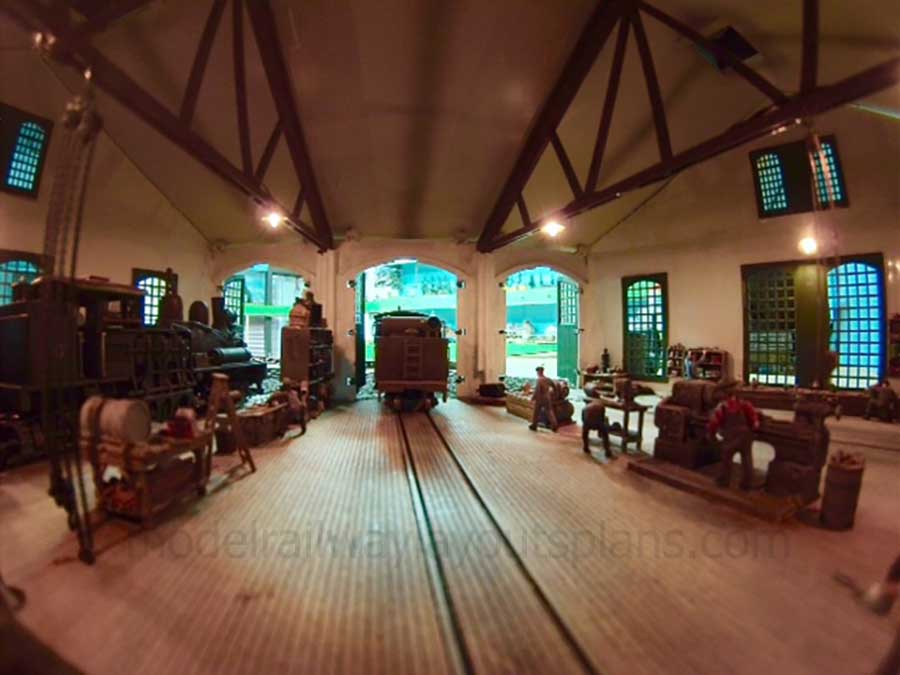
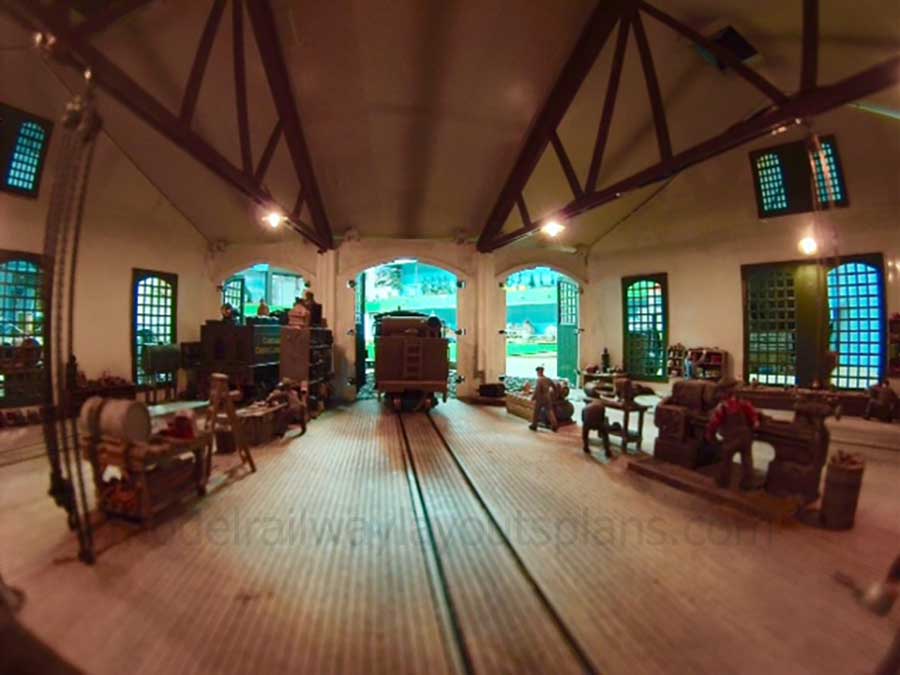
Brian’s been back in touch with some more HO scale roundhouse interior details:
“Hi Alastair, fantastic response to the write up. I did reply to the questions asked in it.
I have a few more photos taken from the inside of the building in case you would like to publish these as well.
The question about the locomotive in one of the photographs, it is the front of a 3 truck Shay – a logging locomotive.
The photos below were taken with a GoPro Hero 3 camera which has a nice wide angle lens to get some nice shots of the interior. I connect this camera to the GoPro app on my cellphone, lift the roof off the building, place the camera inside and then put the roof back on.
The interior lights are turned up to 12 volts to brighten up the interior for the photographs, but during normal operation, they run at 6 volts for the correct lighting effect. This is a reply to someone who said that the lighting was a bit bright. No offense taken on the comment.
just uploaded this video showing the Power using Double headers, or as they say in America ..in Consist… well it is a wet cold day, so what better than running a few Trains.
Regards
Dave”
Now on to Lester who touches on something that always comes up on the blog – train speeds.
I know some of you like to run your trains rather fast – and all I can say, your layout, your rules.
“Hi AL.
I read your email every time I get one. I enjoy them so very much.
I’m not exactly a newbie as I have made at least 10 layouts since I bought my first train set as an adult in December 1963 for my two sons, then ages 3 & 4.
I have made or helped make layouts in O gauge, HO gauge and N gauge and have had fun with all of them.
I’m current in HO gauge and probably remain there for the rest of my life.
I don’t know what category in which to put this, but I’m a number cruncher in real life (accountant) and here are formulas for calculating speed of HO/OO gauge trains.
actual feet/time in seconds * 59.386 will give scale mph
actual meters/time in seconds *313.493 will give kph
O
MPH: actual feet/time in seconds*32.728
KPH: actual meters/time in seconds*109.091
N
MPH: Actual feet/time in seconds*109.091
KPH: Actual meters/time in seconds*575.88
Lester in Georgia, USA”
Next, on to Simon:
“Hi Al
Love the posts. Thought I’d pose a question for you and the readers.
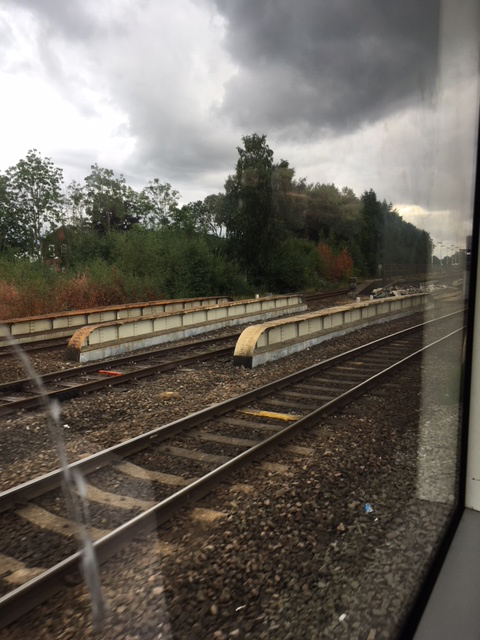
Can anyone name these lineside structures and what purpose they serve? Many thanks
Simon”
A big thanks to Brian for sharing his stunning HO scale roundhouse interior details.
And can anyone help Simon? I have to confess, I’m as keen as he is to know. What on earth are they for?