Rob’s been back in touch with his Faller model train road.
He’s been having fun making the vehicles move – this time, a night bus:
“Hi Al,
I thought your readers might find this interesting.
I added headlights and tail lights to my Faller Road bus some time ago. I thought it looked interesting running along in low light.
I shot some video the other day and added some new music to the scene. When I watched it, I found it quite pleasing. It is a very short video. It is slightly over one minute long, but it is an intriguing minute. While watching, I can imagine it is real.
If someone is interested in these Faller Roads and vehicles, I have several videos about how I built my road on my YouTube channel.
Adding the lights was more trouble than I expected. I was able to operate the tail lights from the motor circuit, but the tiny LEDs I used for the headlights wouldn’t work that way, something to do with resistance or something.
For them, I had to add a second small battery and a tiny switch to turn them off and on under the bus. I have done this to my DHL truck as well. Before I added the running lights to the vehicle, they just didn’t look right to me.
Thanks again for all you do for the rail modeling community all around the world.
Dave’s been back in touch with a wonderful step by step video on scenery for model trains.
And best of all, you can see him running his trains at the start of the vid.
The end is quite entertaining too, as you’ll see.
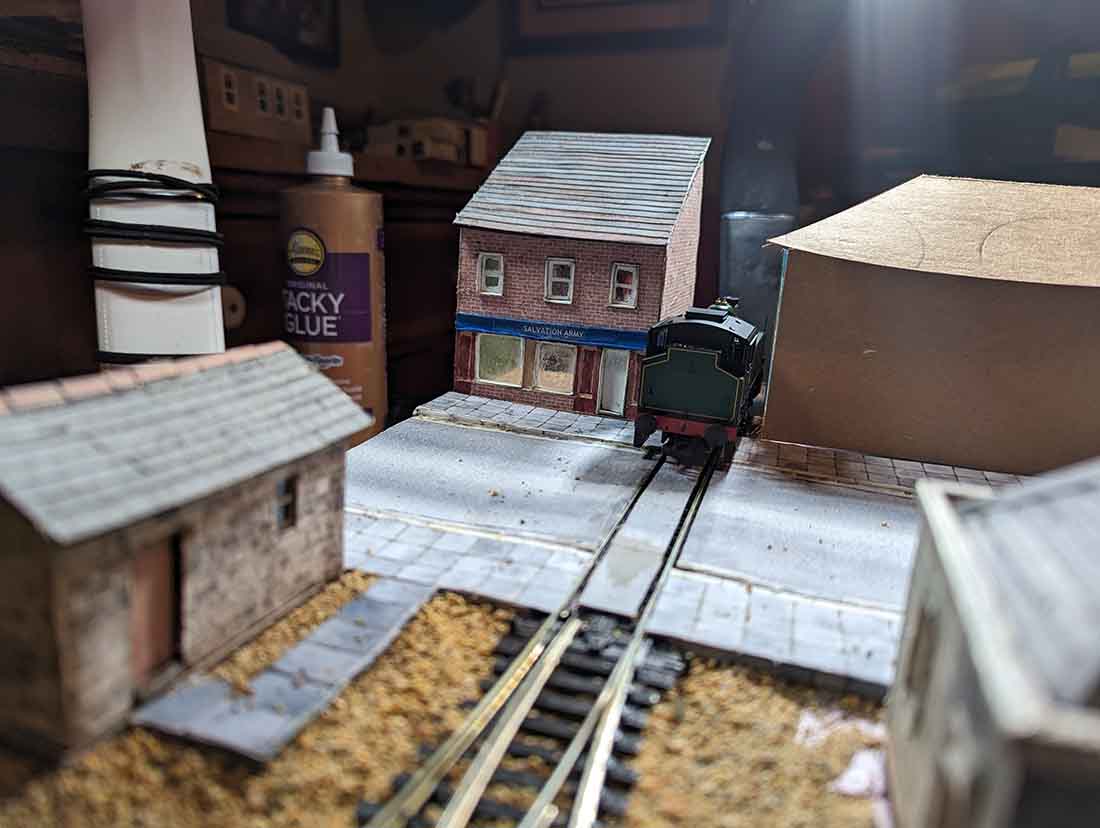
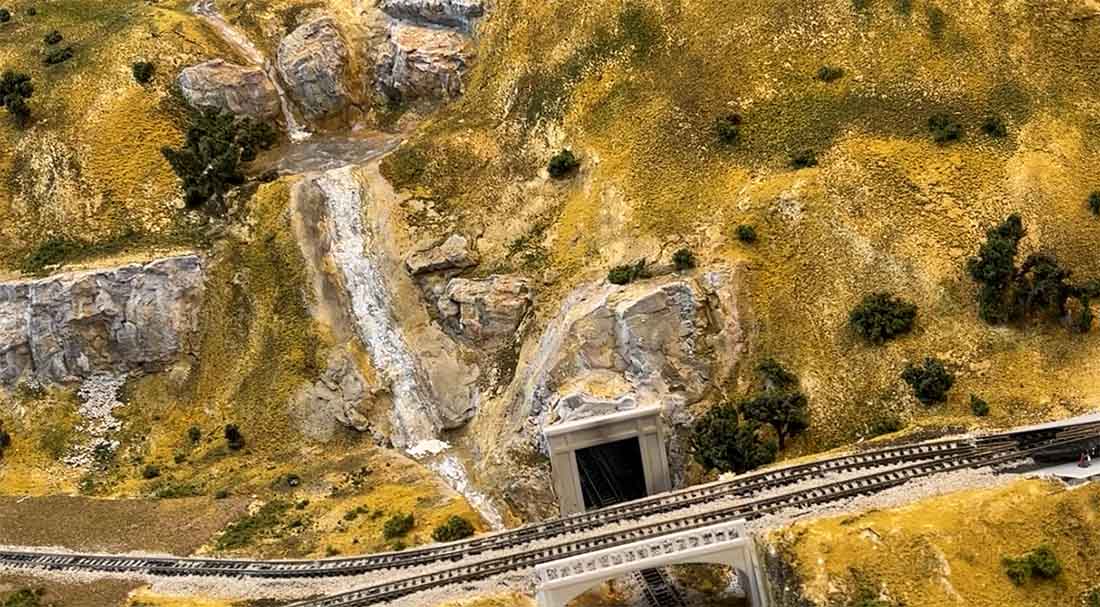
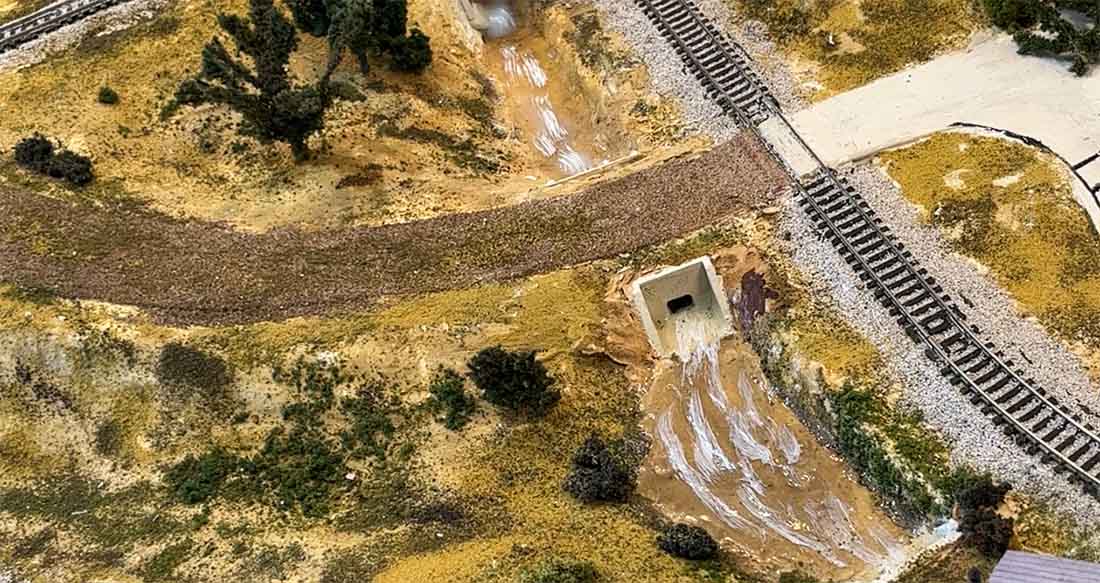
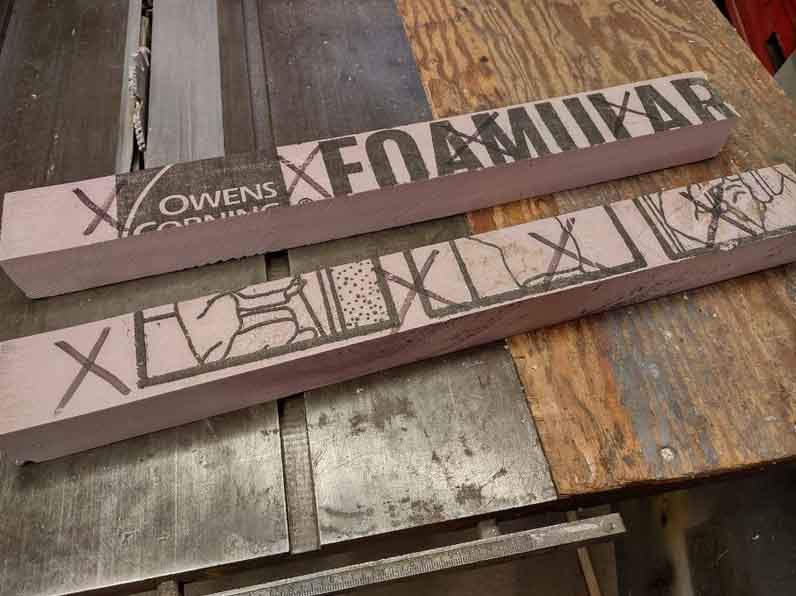
I’ve added pics, but they don’t really get across hoe Dave does his does stuff, it’s wonderful to watch.
(Vidos is below the pics.)
“Al…
I have just uploaded a new video showing step by step how to add scenics to a model Railway.
I tried to speak slower as a few have problems understanding my Yorkshire acent on the last one, but I am sure that they will understand and realise how easy it is to add scenics to a layout.
I have started out with a piece of plain board and built up a Diorama with a hillside, ballasting, adding static Grass, shrubbery, etc.
Its step by step, just sorry it is a bit of a long one but I tried to get everything in to it…
Regards
Dave”
From this..
… to this.
Crumple up newspaper in water to create the embankment.
Add as many as you need for you scene.
Add Mudrock.
Tap it down and leave to dry.
Add base coat for the static grass.
Add the base coat on the front too.
Add ballast.
Even out the ballast with your finger.
Add some brown to the base coat.
Add green and some glue.
Do the same all over the scene.
Add different shades of ground cover.
Cover up the tracks.
And the screw, add glue…
Get busy with the static grass – you can see it stands up nicely.
Hairspray will keep it in place.
Shake on more static grass.
Add brush and brambles to the edges.
Add trees and more brush cover.
Spray on the sleeper grime.
Wipe the rails clean.
Add backdrop.
Add rust pain to the rails.
Touch up with different shades.
The finished scene… but the pics don’t do it justice, have a look at the vid, it’s really worth watching:
A huge big thanks to Dave for sharing his Scenery for model trains vid.
I’m always banging on about making a start and I think a diorama is an excellent way to dip your toe in the water.
A layout, is not different to a ‘large’ diarama. When it comes to wiring, just start simple.
Best of all, a diorama can be anythign you like, an engine shed, a railway hut by some track… anything:
Here’s one from the archives, and another one from Dave:
“Al
I have enjoyed your site for a long time, since I have retired had to find something to fill the spare time, I purchased one of your (Big Bundle Deal) and printed out one of the Engine sheds among many others.
I have created my own version of the Engine shed as shown in the pictures.
With added and above doors are my creation of lamps, LED lights.
Scratch built table and chairs with tools.
Interior detail.
Side walls have ventilation fan vents.
I have dreamed to set up a model railroad layout for a long time and when I started to make it a reality one thing came up after another, like kids, education, weddings and now I have time and room to finish the dream, but not much of a budget.
Best to all talented people like Hall of Fame Dave, talented hobbyists and their many beautiful layouts.
Now on to the very same Hall of Fame Dave, who has also sent this vid in:
“Hi Al,
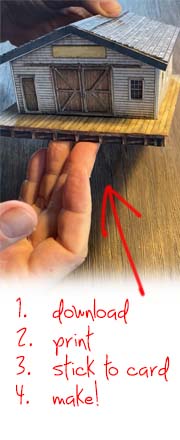
just uploaded video showing building that Railway cottage from your site, turned out not bad, and it was easier than what I thought, just a case of getting a decent piece of card to put the print on, then cutting to size.
Dave”
So there you go, if you don’t know where to start, pick a scene, build it, and see if you enjoy yourself. I suspect you’ll find it a lot of fun. Pottering over scenery for model trains is relaxing too, just go at your own pace and enjoy it.
Are you really going to miss out on this crazy offer?
Here are some of the buildings on your layouts:
“Al, like you I have been retired for some time now.
I have gone back to my American Flyer, s Guage boyhood train.
I have had “n guage, HO, G scale”, and this American Flyer has been the most fun of all. I guess it takes me back to my parents basement where my 4 x 8 foot layout was back in the early 50’s.
I resized your wonderful old barn and had so much fun building it. Here are some pics. Hope everyone enjoys it as much as I have.
Jerry from Illinois, USA.”
“Al,
Great project and a lot of fun. The barn is on it’s way to the Railroad Club.
Charles”
“Al
I have enjoyed your site for a long time, since I have retired had to find something to fill the spare time, I purchased one of your bundles and printed out one of the Engine sheds among many others.
I have created my own version of the Engine shed as shown in the pictures.
Side walls have ventilation fan vents.
I have dreamed to set up a model railroad layout for a long time and when I started to make it a reality one thing came up after another, like kids, education, weddings and now I have time and room to finish the dream, but not much of a budget.
Best to all talented people like Hall of Fame Dave, talented hobbyists and their many beautiful layouts.
Ryszard”
And of course, there’s lots of the printable buildings on your layouts.
Here some pictures of them:
Mike has used a lot of the houses and grain elevators (not featured in the bundle – just using a print out example).
But don’t forget – it’s not just the printable buildings you get – it’s the Beginner’s Guide too:
Of course, I’m biased so here’s what others say about it:
“Al,
I really like the Beginner’s Guide. As a true beginner it helped me quite a bit. The Guide answered questions I didn’t know enough to ask.
I haven’t gotten to the building prints yet, still working on my terrain.
Bruce”
“Hi Alistair,
Your print out building kits have saved me hundreds of dollars on buildings and they provide the unique option of being able to customize the builds most any way I desire.
Until I came across your kits, I was very limited on what I could add to my planned N-scale layout. Commercial building kits are way too expensive for a retired person’s budget.
I now have the ability to not only build nice scenes, they don’t require weathering. Something I’m not terribly adept at accomplishing. Also, as a 70 year old kid, working in N-scale can be challenging for clumsy arthritic fingers. Your kits eliminate most of those issues. All I need is a sharp blade, scissors, glue and my imagination.
Also, your beginner’s guide is invaluable. I’m a retired network systems architect, so tech is not scary to me yet surfing the web for information can be tedious. I was a pre-teen the last time I played with model trains, and a lot has changed in the hobby since the early 60’s. You’ve solved all of that by providing one source for virtually all my basic needs, plus your daily email blog covers it all. What an incredible resource you are to this hobby.
Thanks for doing all of what you do.
Best Regards,
Ken”
“Hi Al
I really enjoyed the beginner’s guide book. I’m new to the train world. I have just retired and trying to make an attempt to start a hobbie with HO scale trains. You and your followers have encouraged me for the last two year’s. I Thankyou and your followers for sharing their train world
Sam”
Of course, I’m very biased, but I think the Beginner’s Guide and all these printable buildings bundled free are a real steal.
I think Ken’s quote above puts it best:
“Your print out building kits have saved me hundreds of dollars on buildings and they provide the unique option of being able to customize the builds most any way I desire.”
You get 25 printable buildings with the Beginner’s Guide (although with a bit of imagination you can make, many, many more).
You’ll see these buildings sell in the store for $9 each or more.
And the Beginner’s Guide sells for $27.
So you are saving a massive $342 on this deal.
You’re also getting the track plans PDF too.
What’s more, have a look at throught the store and you can see it’s a real, genuine, saving.
But please bear in mind, this silly sale is only for a few days, and then it’s all goes back to normal.
I do like to think that when I have a sale it’s genuine, and there is real value.
So if you fancy this bargain before it disappears like a shadow in the night, grab it right now.
Or, I know some of you good people just buy it to support the site. God bless each and every one of you.
Whatever your reasons, the Beginner’s Guide for $9 and the free printable buildings make it easy for you to make that all important start.
And that, my friends, is what it’s all about. Making that start.
Dean from New Mexico has been back in touch with his Atlas track plans:
“My last layout, the Scenic Ridge, is pretty much complete, and it’s time for me to start on my next layout, another small railroad.
Today I’m going to talk about my design process using Atlas Track Planning Software (ATPS) and the design I came up with.
First, here are the design criteria I developed to help in the process:
A standard door size (30″ x 80″)
Lots of action!
Two main tracks so I can run two trains at once unattended
Support for a yard engine to
–assemble cars in a classification yard
–work several industries
Use flex track for better realism
DCC
Here’s how I started the planning process. Many people begin with a simple oval. It’s an easy layout, but it’s kind of boring.
Here’s a second start—adding curves and tunnels or other features makes it more interesting, but there’s not much room for getting in my double line or industrial sidings.
This is another design that I actually built in both G scale and N scale, an up and over layout. If you follow the black route around, you see that it has one main track that comes back on itself.
So back to the drawing board for my future layout. For this I started with two ovals.
In my final design shown below, each of the two loops can have a train running around continuously.
To the two main tracks I added some sidings, two stations (red), a mine (blue), an engine facility with an engine house (red), a classification yard, and several possible industrial locations (green and yellow).
Note that the long branch line to Romeo can be used by the yard engine to work the classification yard and industrial areas.
The yard engine can be working the yards and sidings, assembling and disassembling trains while the two trains on the mains keep running by themselves.
There is a complication for the local yard switcher that makes operations more interesting.
The local needs to dodge around the two main-line trains to work the industrial sidings at Fox Creek or the mine at Platoro. This siding at the lower right, representing the interchange to the D&RGW can be used as a fiddle track to add and remove cars.
In my plan, I have added two tunnels, a large mountain (dark gray) on the upper right, and lower hills (light gray). To help separate the two towns, I added a river (blue) and a central hill (gray).
To see more details on my planning process and final design, please see my youTube video at
Right now, I am calling this the Conejos Valley Railroad. The Conejos River valley exists in Southern Colorado, Platoro and Romeo are real towns, but Conejos is fictional.
In my mind the railroad connects with the Denver and Rio Grande Western in Alamosa and runs from Conejos, through Fox Creek, up the river to Platoro. FYI, conejos in Spanish means rabbits, and Platoro is a combination of plata (silver) and oro (gold).
I think my plan is more representative of what I call the “British” model. Great Britain has a much more extensive railroad system than in the U.S. with many more trains, both freight and passenger.
I think of the British layout as having 2 or more concentric circles of track (I’ve seen up to five loops) and lots of details–buildings, people, autos– completely filling the space.
In the U.S. we have far fewer passenger trains and long trains passing through varied landscapes. Except for the Atlantic coast, there are few passenger lines. For example, Amtrack serves only a few cities in my state with only two trains running per day.
Thus, U.S. model layouts tend to have a longer single main line, with more scenery between towns and few passenger trains. I think of the folded loop layout above as “American”.
Here’s an interesting, but unrelated, story that Al might want to pull. Thirty years or so ago, my wife and I were traveling around England and had spent a day in Windsor seeing the castle and town.
We had traveled down over the short stub line from Windsor to Slough and were waiting for a train back to London. After a bit, several police in flack jackets showed up on the platform across from us and directed everyone there to leave.
Suddenly a long black train with royal markings silently pulled into the station. “The Queen?” Unfortunately, no.
Several people (Royals?) got out of the train and were led up to waiting cars where they were whisked away, presumably to Windsor. Very exciting to us!
Dean”
Now on to Hugh:
“Hi Al
I think some of the American Flyer die cast Locos are nearly as detailed as mid 1930s Lionel. So for Kid Proof Christmas displays I have used a couple AF 420 shells with Marx motors. Some shells are broken and cheap but if they have all the trim the bodies can be fixed with products like JB Weld epoxy.
This red one is a mixture of many spare bits.
The tender is a Marx wedge with post war Lionel trucks.
The flat car is prewar Lionel with post war trucks and the PRR caboose is the last tin plate one that Lionel made in the late 1930s and continued into 1946.
The next to the last image is a modern era Lionel powered AF loco set up to pull a 1934 Lionel North Shore set.
Hugh”
A big thanks to Dean for sharing his Atlas Track plans.